
The transition to electric vehicles (EVs) represents a monumental shift in how motorists fuel their transportation. For millions of drivers across the United Kingdom, switching from petrol and diesel to electric power promises quieter journeys, lower maintenance requirements, and substantial long-term fuel savings. However, a persistent source of frustration for many EV owners—particularly those living in apartments, terraced houses, or properties without dedicated off-street parking—is the surprisingly high cost of public charging.
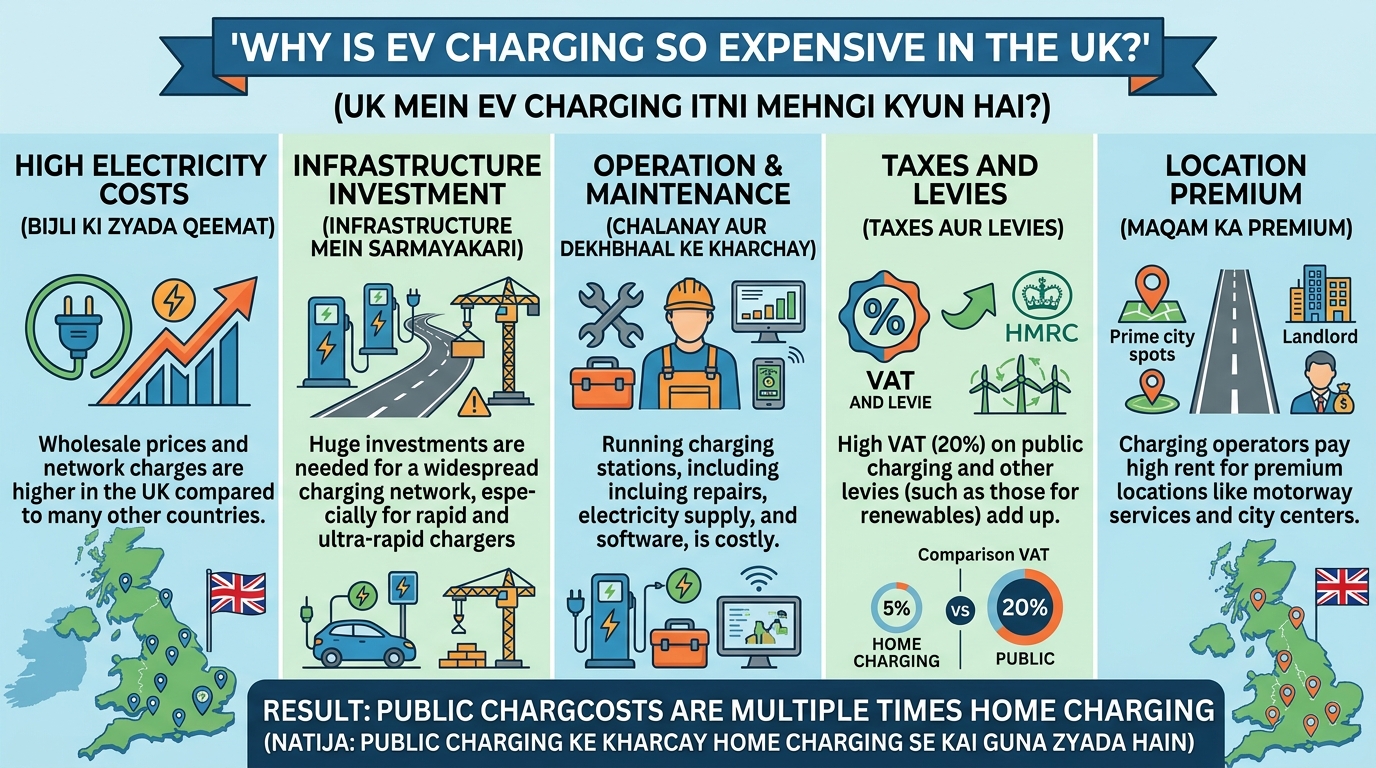
Public EV charging in the UK is expensive primarily due to a steep 20% Value Added Tax (VAT) rate, high commercial electricity and grid-connection costs, and expensive high-power hardware installation.
While home charging benefits from preferential tax treatment and low overnight tariffs, public rapid and ultra-rapid chargers are weighed down by heavy commercial overheads. Here is an extensive, comprehensive guide examining the structural, fiscal, and technical factors that drive up the cost of public EV charging in the UK.
1. The Discrepancy in Value Added Tax (VAT): The “Pavement Tax”
One of the most significant structural drivers of high public charging costs is how the UK tax system classifies electricity supplies:
-
The Domestic Rate Advantage: Electricity supplied directly to residential homes for domestic use has historically enjoyed a reduced VAT rate of 5%. Furthermore, temporary fiscal measures have driven domestic energy VAT down to 0% during specific relief windows. Because most homeowners charge their vehicles overnight using domestic wallboxes, their fueling costs carry minimal tax burdens.
-
The Commercial Public Rate: In stark contrast, public EV charging networks are legally classified as commercial electricity supplies. Consequently, they are subjected to the standard 20% VAT rate.
-
The Inequality for Non-Homeowners: This creates an uneven playing field often criticized as a “pavement tax.” Drivers who rely exclusively on public chargers because they lack driveways pay four times the VAT percentage compared to homeowners, eroding much of the financial incentive of driving electric.
To understand how home charging infrastructure differs in cost and setup from commercial networks, read more about various charging types.
2. Commercial Electricity Tariffs and Distribution Use of System (DUoS) Charges
Unlike domestic consumers who pay predictable flat or tiered household rates, public charging station operators face complex commercial energy pricing structures:
-
Wholesale Energy Volatility: CPOs (Charge Point Operators) purchase electricity on the wholesale commercial market. During periods of peak market volatility, high wholesale prices directly inflate the per-kWh cost passed down to motorists.
-
Standing Charges and Grid Fees: Commercial properties incur heavy fixed daily standing charges just to maintain a live connection to the grid.
-
Distribution Use of System (DUoS) Charges: Network operators must pay substantial fees to regional electricity distribution companies for moving power across local networks. These fees fluctuate by time of day, spiking during peak evening hours when grid demand is highest.
To explore how smart home energy management, solar integration, and load balancing help households avoid similar peak domestic tariffs, check out our guide on smart home EV solutions.
3. High-Power Hardware CapEx, Maintenance, and Land Leases
Building and operating a public ultra-fast charging hub requires massive capital expenditure (CapEx) and recurring operational expenditure (OpEx):
-
Expensive Equipment: Ultra-rapid DC chargers capable of delivering 150 kW to 350 kW of power require heavy-duty liquid-cooled cables, robust power cabinets, and sophisticated payment terminals. A single ultra-fast charging stall can cost well over six figures to purchase and install.
-
Grid Upgrades and Substation Reinforcement: Tying high-power chargers into local distribution grids often requires digging up roads, running heavy underground conduits, and installing dedicated commercial transformers—costs that operators must eventually recoup through per-kWh pricing.
-
Land Leases and Business Rates: Setting up charging hubs in high-traffic retail parks, motorway service areas, or municipal car parks involves expensive commercial land leases, property maintenance, and local business rates.
For comprehensive insights on EV infrastructure planning, charging safety standards, and expert advisory services, visit us at EV Charger Advisor.
4. The Path Forward: Can Public Charging Prices Drop?
As the UK EV market matures, industry bodies, consumer advocacy groups, and transport authorities continue lobbying for regulatory reform:
-
Equalizing VAT: Industry campaigns strongly advocate for reducing public charging VAT from 20% down to the 5% domestic rate, arguing that fair taxation is essential to encourage widespread EV adoption among urban drivers.
-
Grid Modernization: Investment in localized battery energy storage systems (BESS) and smart grid integration can help operators bypass expensive peak DUoS charges and reduce reliance on costly grid upgrades.
Summary: Key Takeaways on UK EV Charging Costs
-
Public charging is expensive largely due to the 20% standard VAT rate, commercial energy tariffs, and heavy grid connection fees.
-
Drivers with access to home charging enjoy significantly lower running costs, while urban drivers without driveways absorb higher commercial overheads until structural tax reforms take hold.

















Leave a Reply