

Electric vehicle (EV) charging infrastructure is rapidly maturing, but regional standards continue to shape the ownership experience across different continents. Two of the most prominent charging protocols globally are the North American Charging Standard (NACS / SAE J3400) and CCS Type 2 (CCS2).
A common question among EV enthusiasts and industry operators is: Is NACS better than CCS2?
The short answer is that neither connector is universally superior—whether NACS is “better” depends heavily on geography and local electrical grid infrastructure. While NACS offers superior physical design and ergonomics for single-phase North American power grids, CCS2 remains the undisputed standard for European and global three-phase electrical systems.
For comprehensive comparisons of charging hardware and port types, visit EV Charger Advisor.
Understanding NACS and CCS2: Core Differences
To evaluate both standards, it is essential to understand their underlying design philosophy and primary deployment markets.
1. What Is NACS (SAE J3400)?
Originally engineered by Tesla and standardized as SAE J3400, NACS was built specifically for North American power distribution ($120\text{V}/\text{240V}$ residential and $277\text{V}$ commercial single-phase lines). It utilizes a compact 5-pin handle that shares the same physical contacts for both AC charging and high-power DC fast charging.
2. What Is CCS2 (Combined Charging System Type 2)?
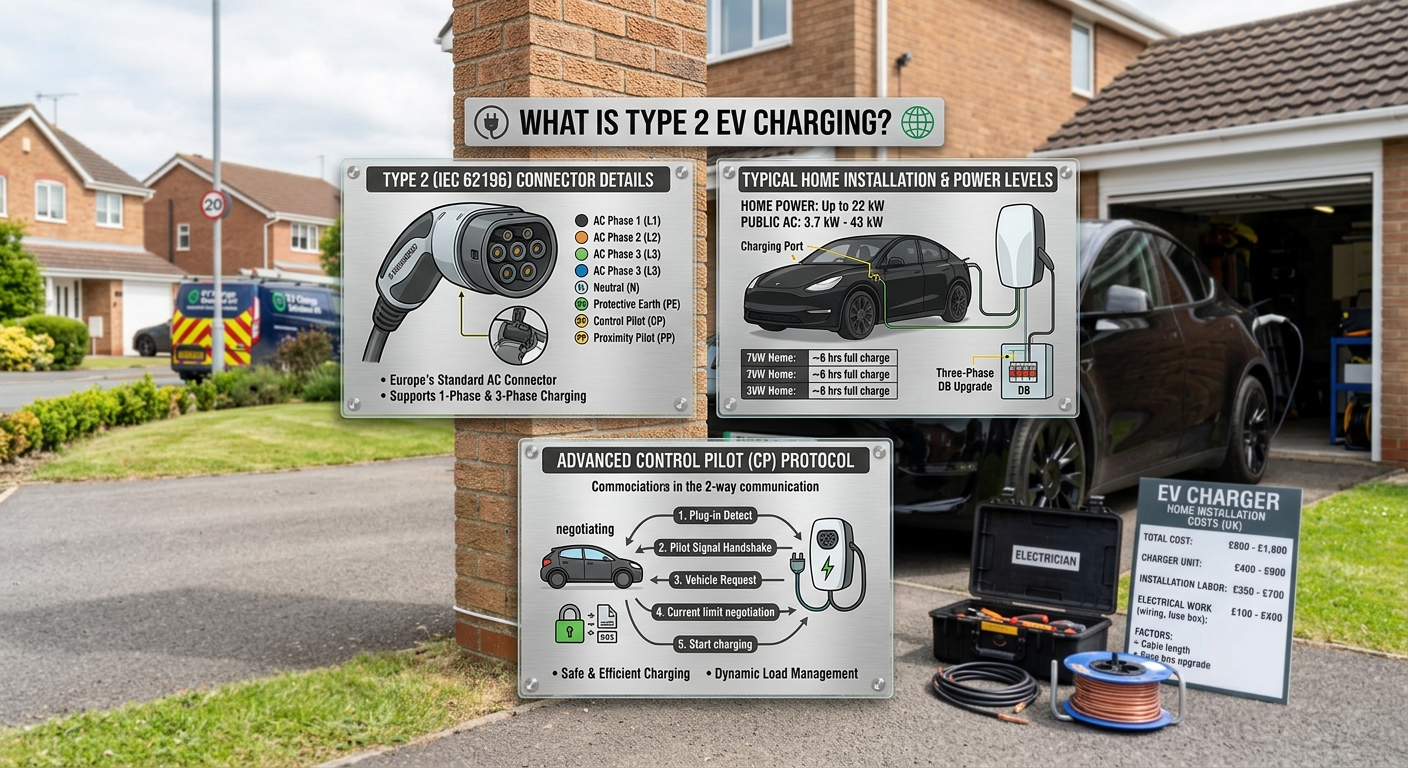
CCS2 is the mandatory standard across Europe, Australia, New Zealand, India, and large parts of Asia and South America. Built on top of the European IEC 62196 Type 2 (Mennekes) plug, CCS2 features a larger body with a 7-pin upper section for single-phase or three-phase AC charging, plus two lower dedicated high-power DC pins.
To explore how these formats fit into the global landscape, read our detailed guide on EV charging types.
Architectural and Grid Compatibility Comparison
The biggest technical driver behind why these two standards exist comes down to household and commercial utility power.
Single-Phase vs. Three-Phase Electrical Grids
-
North American Power Grid (NACS Domain): Residential homes predominantly use single-phase split-phase $120\text{V}/\text{240V}$ service. Because three-phase AC at home is extremely rare, NACS was designed with two power contacts that handle single-phase AC or direct DC power natively.
-
European & Global Power Grids (CCS2 Domain): Homes and commercial properties across Europe, Australia, and Asia commonly have three-phase $400\text{V}$ AC power. CCS2 incorporates three separate phase pins ($\text{L1}$, $\text{L2}$, $\text{L3}$), allowing AC home chargers to deliver $11\text{ kW}$ to $22\text{ kW}$ without requiring massive electrical amperage.
Step-by-Step Mathematical Example: Calculating AC Charging Speed (NACS vs. CCS2)
To illustrate how grid design impacts real-world AC home charging, let us compare charging an EV with an 80 kWh battery pack (charging from 20% to 80% state of charge) using a high-output NACS charger versus a standard three-phase CCS2 home wallbox.
Given Parameters:
-
Energy Required: $80 \text{ kWh} \times (0.80 – 0.20) = 48 \text{ kWh}$
-
NACS Level 2 Home Setup (Single-phase 240V / 48A): $11.52 \text{ kW}$
-
CCS2 Home Setup (Three-phase 400V / 32A per phase): $22.0 \text{ kW}$
Calculation 1: NACS Single-Phase 240V AC Charging
Calculation 2: CCS2 Three-Phase 400V AC Charging
Result Breakdown: In three-phase markets, CCS2 enables home AC charging rates up to $22\text{ kW}$, cutting home charging times nearly in half compared to standard single-phase limits.
Key Comparison Matrix: NACS vs. CCS2
| Feature | NACS (SAE J3400) | CCS Type 2 (CCS2) |
| Primary Markets | North America | Europe, Australia, India, Global |
| Physical Handle Size | Extremely Compact & Light | Bulky & Heavy |
| AC Grid Support | Single-Phase (120V / 240V / 277V) | Single-Phase & Three-Phase (230V / 400V) |
| Max AC Power Rate | $11.5 \text{ kW} – 19.2 \text{ kW}$ (Single-Phase) | Up to 22 kW (Three-Phase) |
| Max DC Fast Charging | $350 \text{ kW} – 500 \text{ kW}+$ | Up to 350 kW – 500 kW+ |
| Pin Design | 5 Shared AC/DC Pins | 7 Top AC Pins + 2 Bottom DC Pins |
| Communication Protocol | ISO 15118 / PLC | ISO 15118 / PLC |
Which Standard Is “Better”? The Verdict
Why NACS Is Better in North America:
-
Ergonomics & Ergonomic Design: NACS handles are significantly smaller, lighter, and easier to plug in compared to heavy CCS connectors.
-
Unified Port Design: Eliminates bulky rubber dust covers for separate DC pins.
-
Optimized for Single-Phase Grids: Perfectly tuned for North American residential and commercial $277\text{V}$ power lines.
Why CCS2 Is Better in Europe and Rest of World:
-
Native Three-Phase AC Support: Crucial for Europe’s grid infrastructure, allowing up to $22\text{ kW}$ fast AC home/destination charging.
-
Global Ubiquity: Mandatory across Europe, ensuring zero connector fragmentation for drivers traveling across international borders.
-
Equal DC Fast-Charging Performance: Capable of matching or exceeding $350\text{ kW}+$ high-power highway charging speeds.
To explore modern smart features available on chargers worldwide, read our guide on smart chargers.
Summary & Key Takeaways
-
Context-Dependent Superiority: NACS is ergonomically superior for North American single-phase grids, while CCS2 is technically superior for European three-phase grids.
-
Equal Fast Charging: Both standards comfortably deliver ultra-fast DC charging speeds above $350\text{ kW}$.
-
Advanced Intelligence: Both NACS and CCS2 support ISO 15118 protocols for automated Plug & Charge billing and bidirectional power (V2G).
















Leave a Reply