
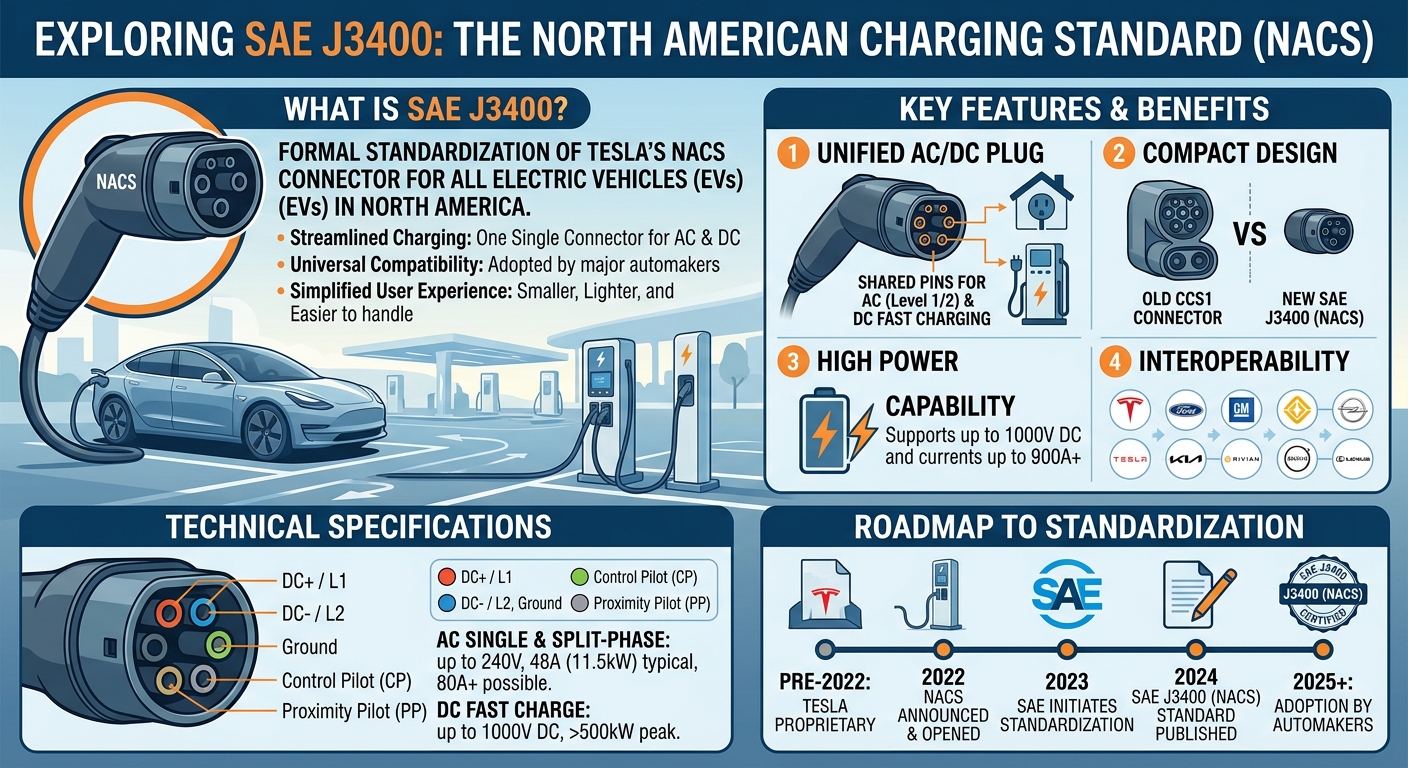
The electric vehicle (EV) sector in North America is undergoing a fundamental transformation. For years, EV owners faced fragmented public charging networks, bulky connector handles, and complex adapter requirements. Today, the entire automotive industry is unifying under a single official open-industry specification: SAE J3400.
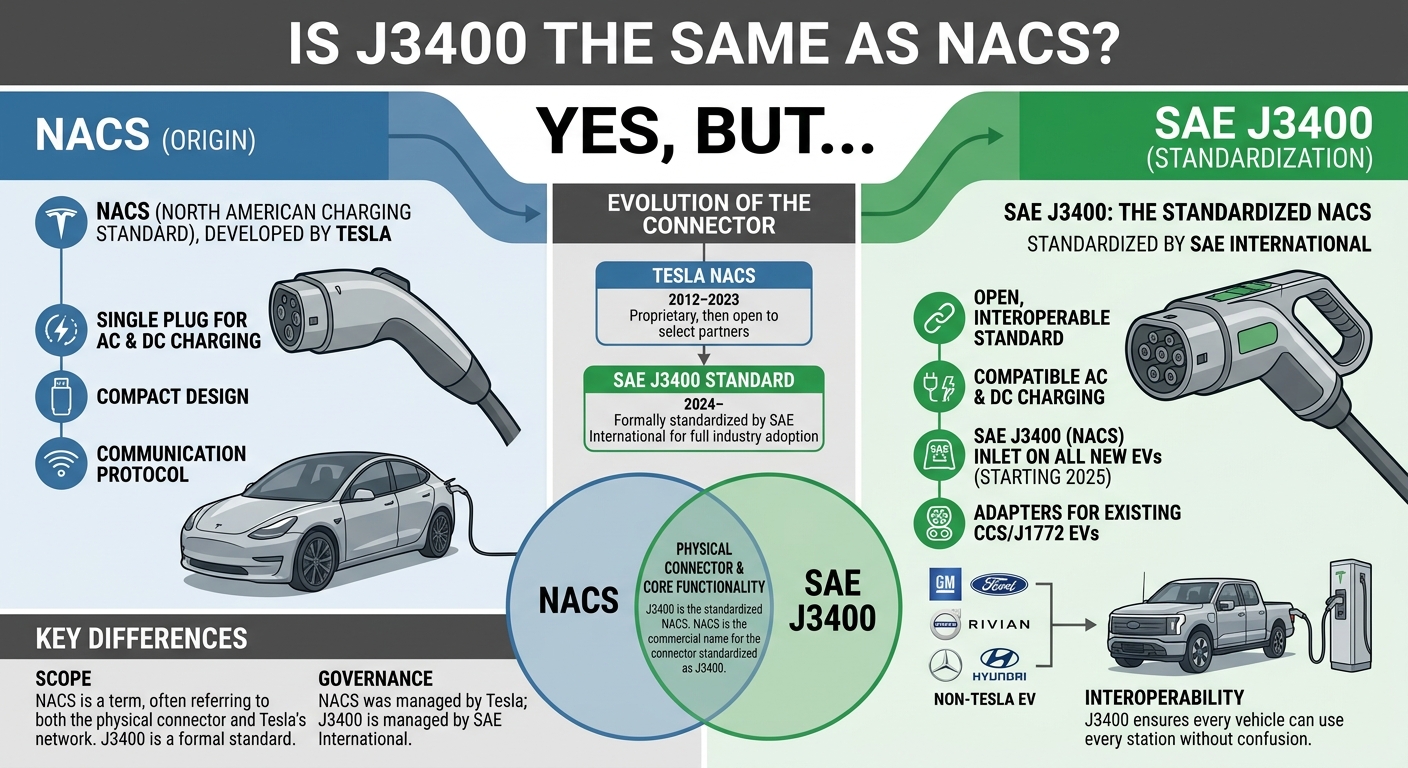
Published by SAE International, the SAE J3400 standard formalizes and standardizes the physical and electrical design known as the North American Charging Standard (NACS)—the unified AC and DC charging connector originally engineered by Tesla.
Whether you drive an EV, manage commercial fleet charging, or plan home electrical upgrades, understanding SAE J3400 is essential.
For detailed hardware comparisons and home setup guides, visit EV Charger Advisor.
What Is the SAE J3400 Standard?
The SAE J3400 standard is the official engineering specification published by SAE International (Society of Automotive Engineers) to establish universal requirements for conductive EV charging couplers in North America.
1. Origin & Transition from NACS
Tesla introduced this compact plug in 2012 for the Model S. In late 2022, Tesla opened its specifications to the public under the name “NACS.” However, to achieve full adoption across non-Tesla vehicle lineups and federally funded public charging networks, the industry needed an independent technical standard. SAE International stepped in to standardize the technology as SAE J3400.
2. Purpose of SAE J3400
SAE J3400 establishes open requirements for manufacturing, testing, electrical safety, thermal limits, and interoperability. It ensures that any car built by any automaker can plug into any charger built by any equipment manufacturer with complete safety and reliability.
Core Architectural & Technical Innovations
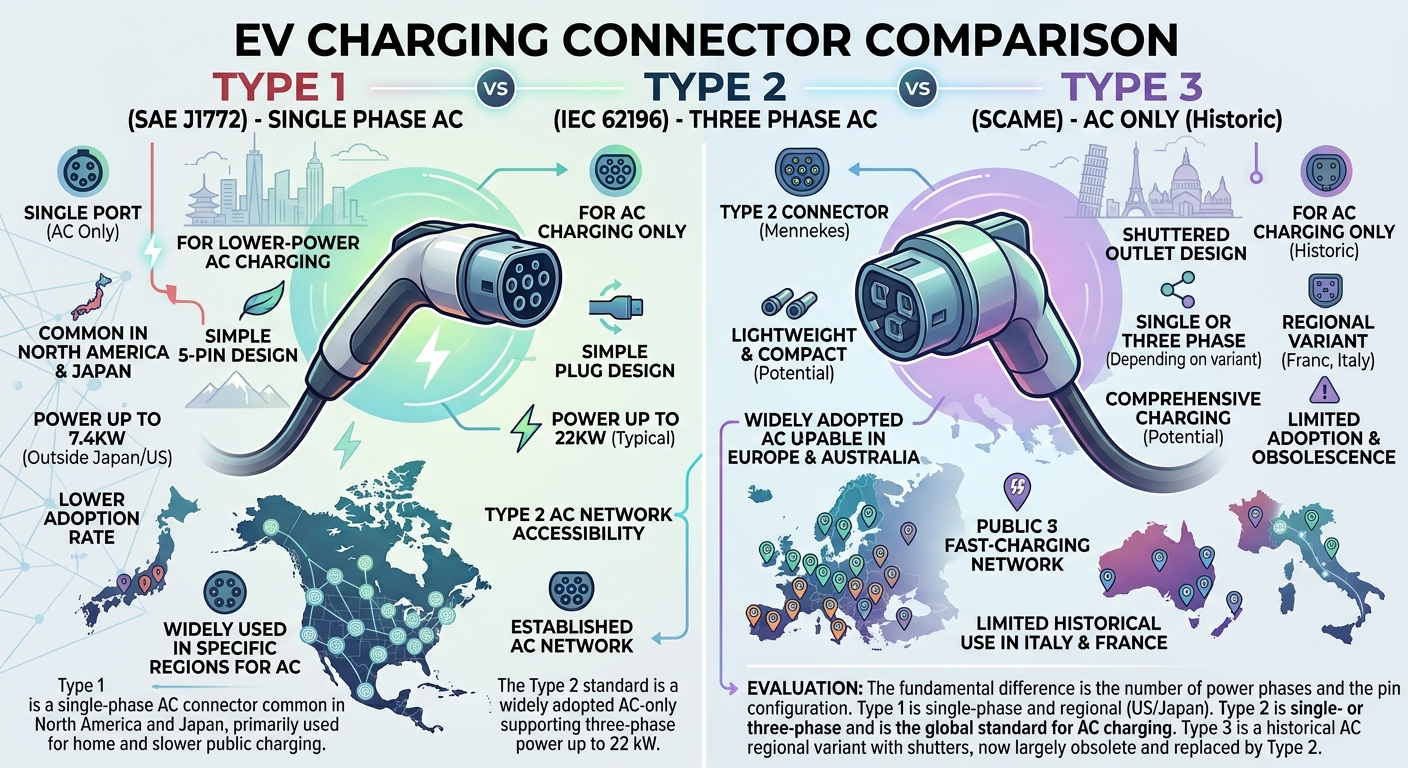
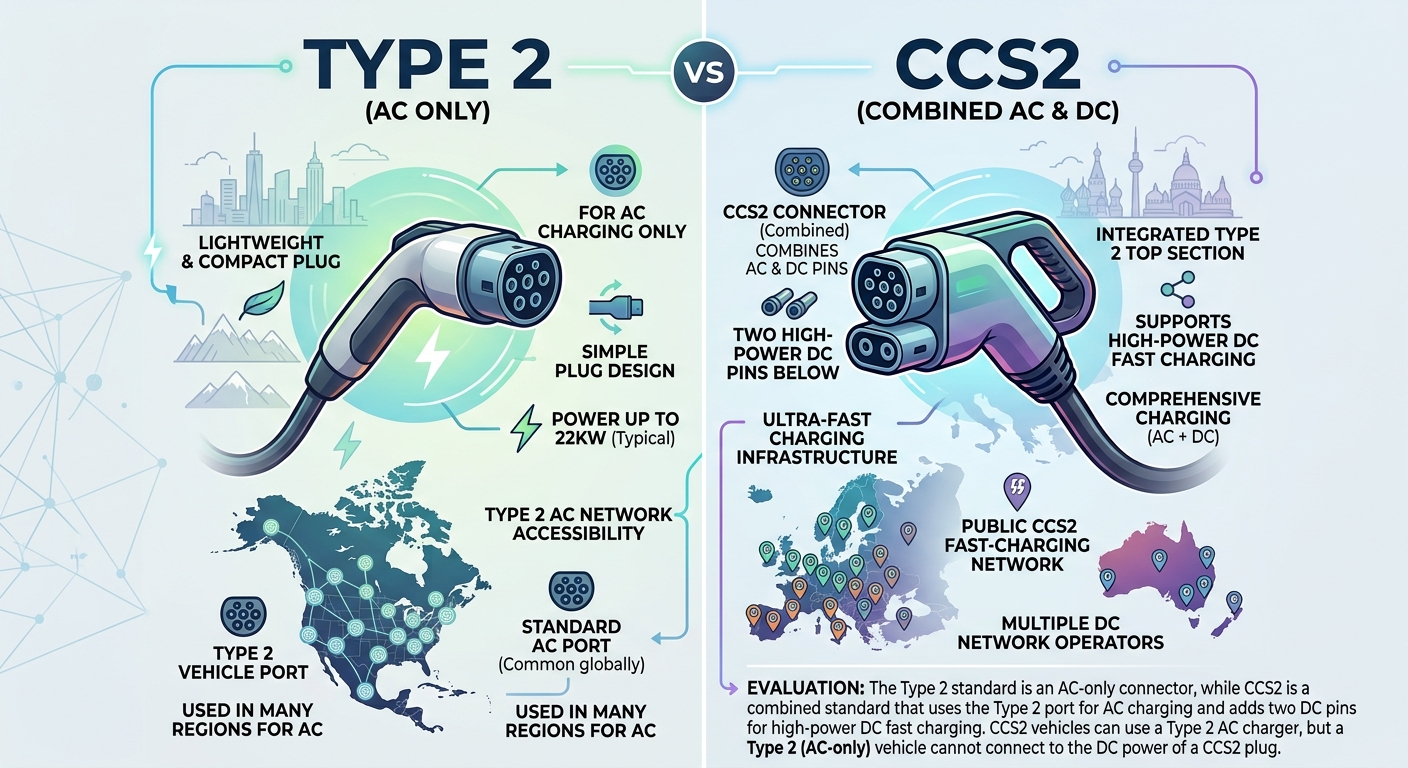
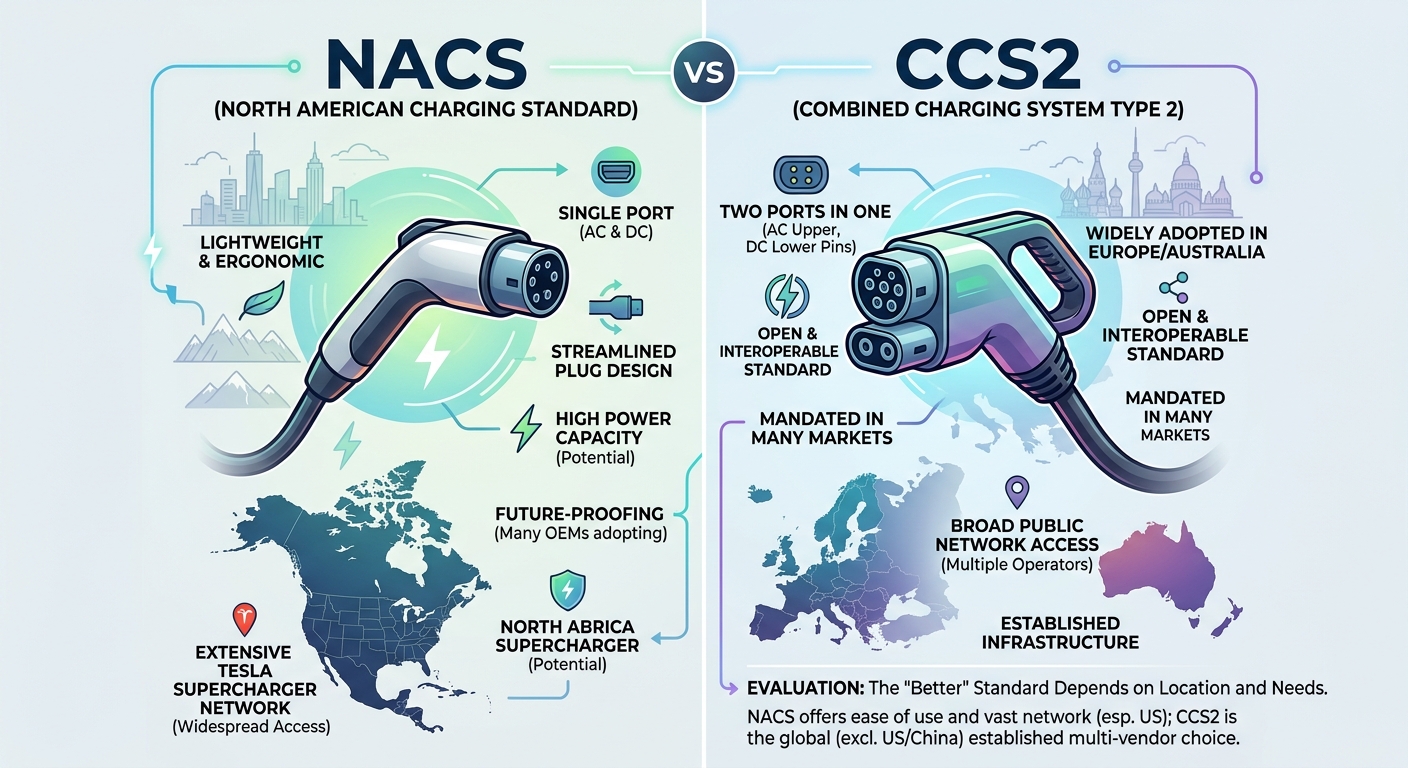
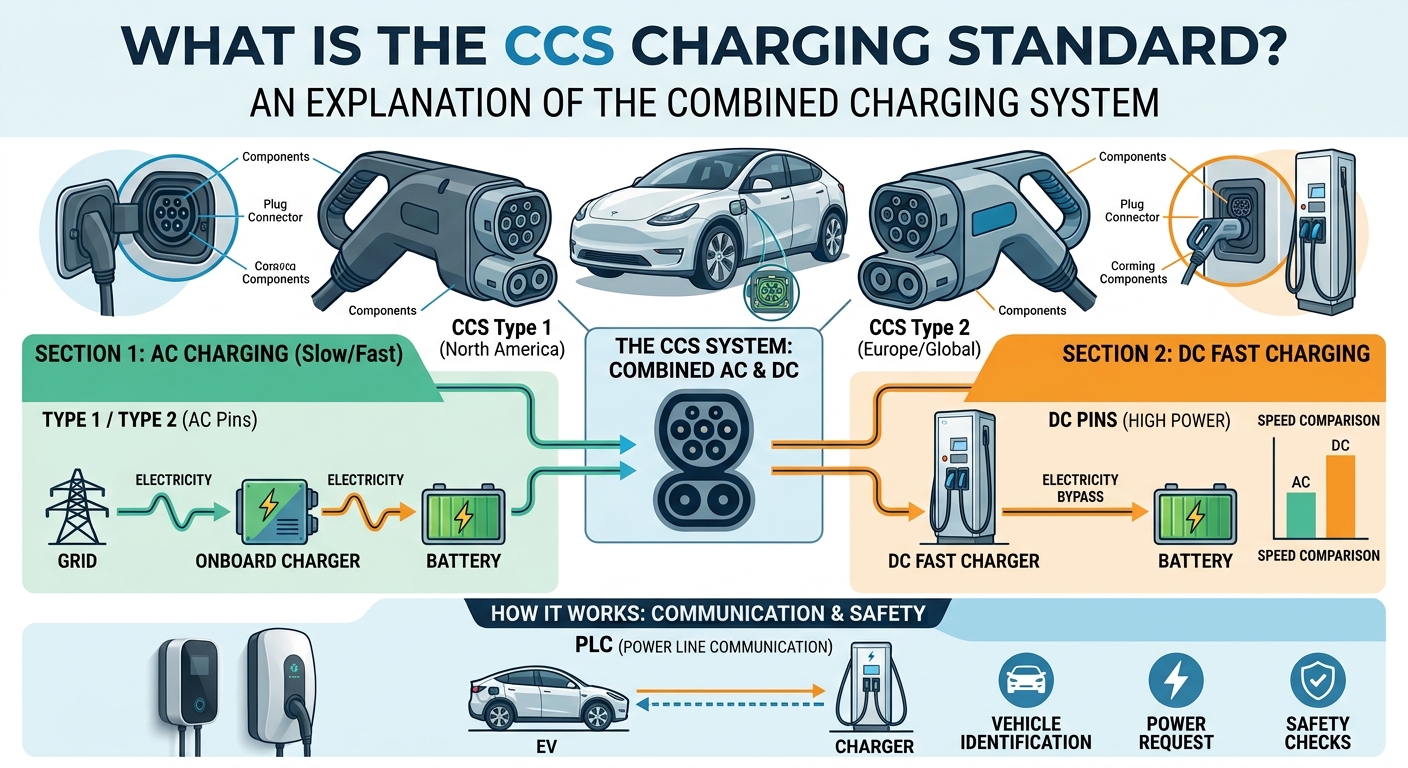
Unlike legacy systems like CCS Type 1—which required separate AC pins on top and bulky DC pins on the bottom—the SAE J3400 standard uses a compact, shared-pin architecture.
1. Shared Power Pin Architecture
SAE J3400 utilizes 5 pins:
-
DC+/L1 Pin: Carries single-phase AC Line 1 during standard home or commercial charging, and switches to positive DC power ($\text{DC+}$) during high-speed fast charging.
-
DC-/L2 Pin: Carries single-phase AC Line 2 (or Neutral) during AC charging, and switches to negative DC power ($\text{DC-}$) during fast charging.
-
CP & PP Pins: Control Pilot (CP) and Proximity Pilot (PP) handle digital signalling, state detection, and safety interlocks.
-
G Pin: Dedicated protective earth grounding line.
To explore how connector formats compare across different models, read our guide on EV charging types.
2. Commercial Grid Integration: Native 277V AC Support
A key enhancement defined in SAE J3400 is native support for 277V single-phase AC charging.
In North America, commercial buildings, parking garages, and fleet yards operate on $480\text{V}/\text{277V}$ three-phase commercial power grids. Legacy Level 2 chargers required step-down transformers to supply 208V or 240V AC. SAE J3400 allows Level 2 chargers to run directly on 277V line-to-neutral power, delivering faster charging speeds at commercial sites while lowering infrastructure installation costs.
Step-by-Step Mathematical Example: Calculating Charging Times Under SAE J3400
To show how SAE J3400 performs across residential, commercial, and DC fast-charging setups, let us calculate charging times for a vehicle with an 85 kWh battery pack (charging from 10% to 80% state of charge).
Given Parameters:
-
Target Charging Energy Required: $85 \text{ kWh} \times (0.80 – 0.10) = 59.5 \text{ kWh}$
-
Residential 240V AC Level 2 (48A output): $11.52 \text{ kW}$
-
Commercial 277V AC Level 2 (48A output): $13.30 \text{ kW}$
-
High-Power DC Fast Charger (SAE J3400 Station): $250 \text{ kW}$ Peak (Average effective output: $170 \text{ kW}$)
Calculation 1: Residential 240V AC Level 2 Charging
Calculation 2: Commercial 277V AC Level 2 Charging
Calculation 3: High-Power DC Fast Charging
Result Breakdown: Using the commercial 277V AC standard cuts home-style AC charging times down significantly, while high-power DC fast charging tops up the battery in roughly 21 minutes.
Communication Protocols and Safety Systems
High-voltage power delivery requires dynamic digital safety measures to protect vehicles, chargers, and users.
1. ISO 15118 Communication Standard
SAE J3400 uses Powerline Communication (PLC) over the Control Pilot line, incorporating ISO 15118 protocols. This enables:
-
Plug & Charge: Vehicles automatically authenticate billing and initiate charging upon plugging in.
-
Bidirectional Energy Flow (V2G / V2H): Vehicle-to-Grid and Vehicle-to-Home power capabilities.
2. Mechanical and Thermal Protection
Because the main power pins carry both AC and DC energy, software-controlled contactor relays ensure that direct high-voltage DC power is never applied unless the physical cable lock is engaged, electrical insulation tests pass, and dynamic vehicle safety checks complete.
To explore modern smart charging features, check out our guide on smart chargers.
Comparison Table: SAE J3400 vs. Legacy Standards
| Feature | SAE J3400 (NACS) | CCS Type 1 (Combo 1) | SAE J1772 (Legacy AC) |
| Primary Region | North America | North America | North America |
| Physical Handle Size | Compact & Ergonomic | Heavy & Bulky | Compact |
| Pin Configuration | 5 Shared Pins (AC/DC) | 7 Pins (Separate AC/DC) | 5 Pins (AC Only) |
| AC Voltage Ratings | 120V / 240V / 277V | 120V / 240V | 120V / 240V |
| Max DC Power Rate | Up to 350 kW – 500 kW+ | Up to 350 kW | Not Supported |
| Communication | Powerline Comm (PLC) | Powerline Comm (PLC) | Analog PWM |
Key Benefits of Industry Standardization
-
Interoperability: Drivers of any EV brand can access nationwide charging networks without carrying multiple adapters.
-
Reduced Infrastructure Costs: Station operators and utilities save on installation costs due to direct 277V AC support and lighter cable assemblies.
-
Enhanced Reliability: Standardization through SAE International enforces strict hardware testing (such as UL safety certifications), resulting in consistent charger uptime.
Summary & Key Takeaways
-
Official Industry Specification: SAE J3400 is the open technical standard for the North American Charging Standard (NACS).
-
Compact & Versatile: Uses a 5-pin design that handles both single-phase AC charging and high-power DC fast charging.
-
Grid Optimized: Features native support for commercial 277V single-phase AC electrical systems.
-
Universal Adoption: Supported by global automakers, charging station operators, and government infrastructure programs across North America.





Leave a Reply