
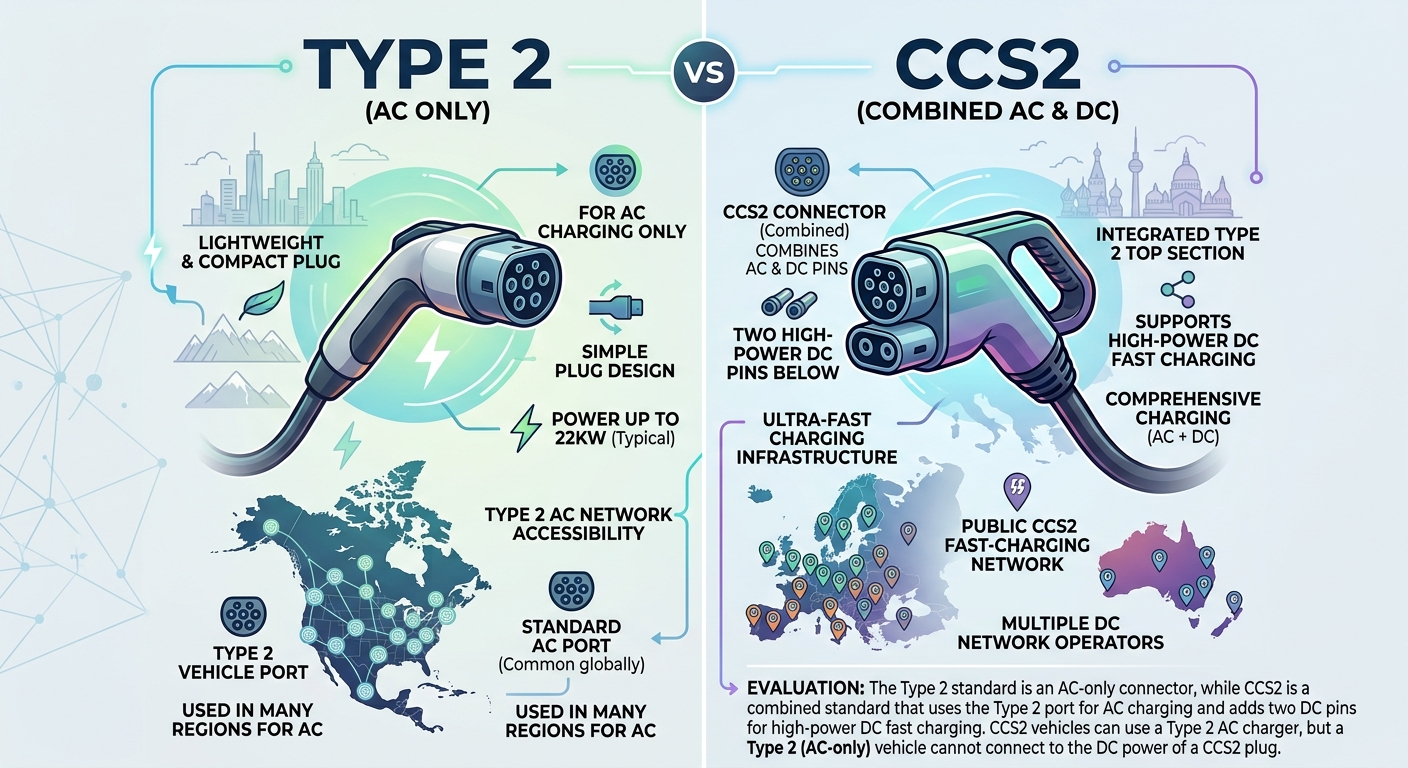
As electric vehicle (EV) adoption expands worldwide, understanding charging port formats is essential for every EV owner. Across Europe, Australia, New Zealand, India, and surrounding markets, two names frequently dominate charging discussions: Type 2 (Mennekes) and CCS2 (Combined Charging System Type 2).
At first glance, the two look almost identical at the top, leading many drivers to ask: Are Type 2 and CCS2 the same thing?
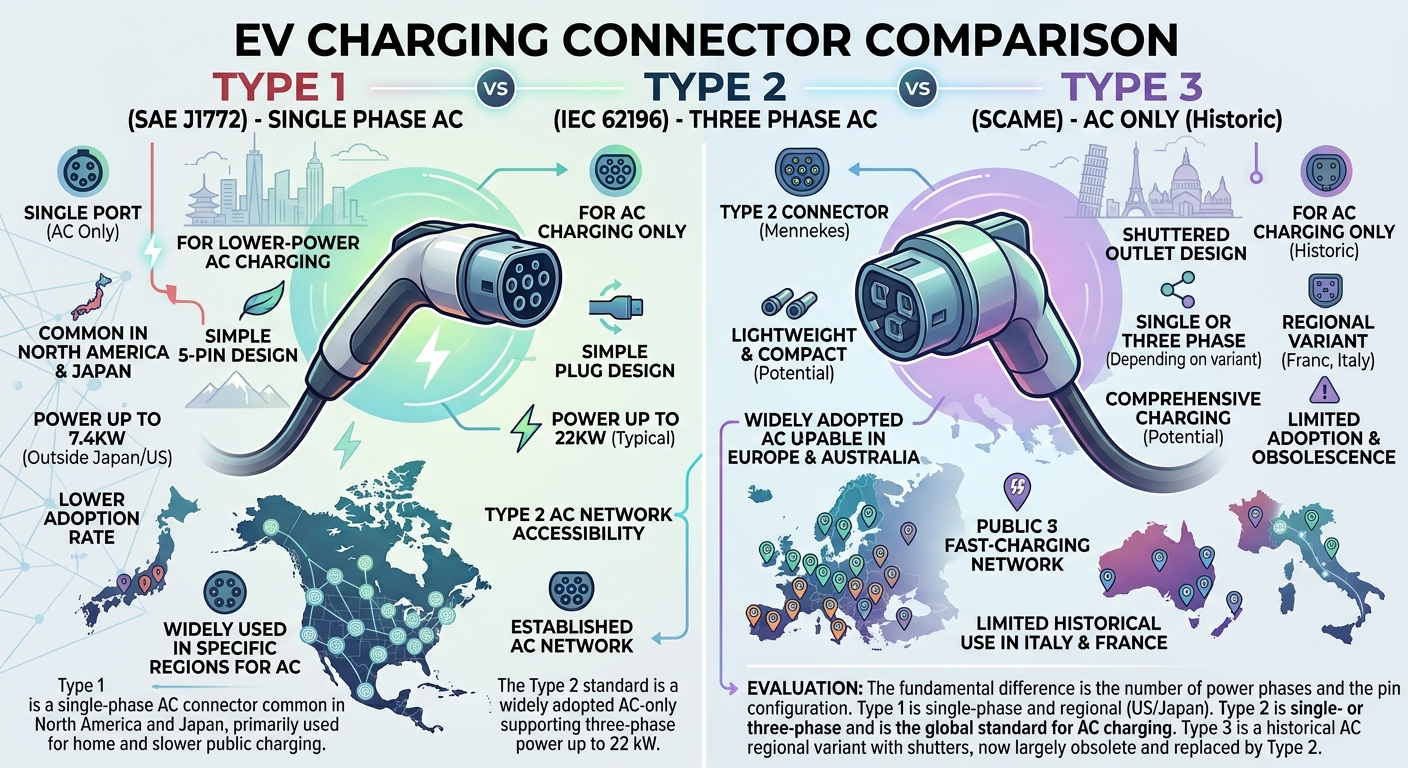
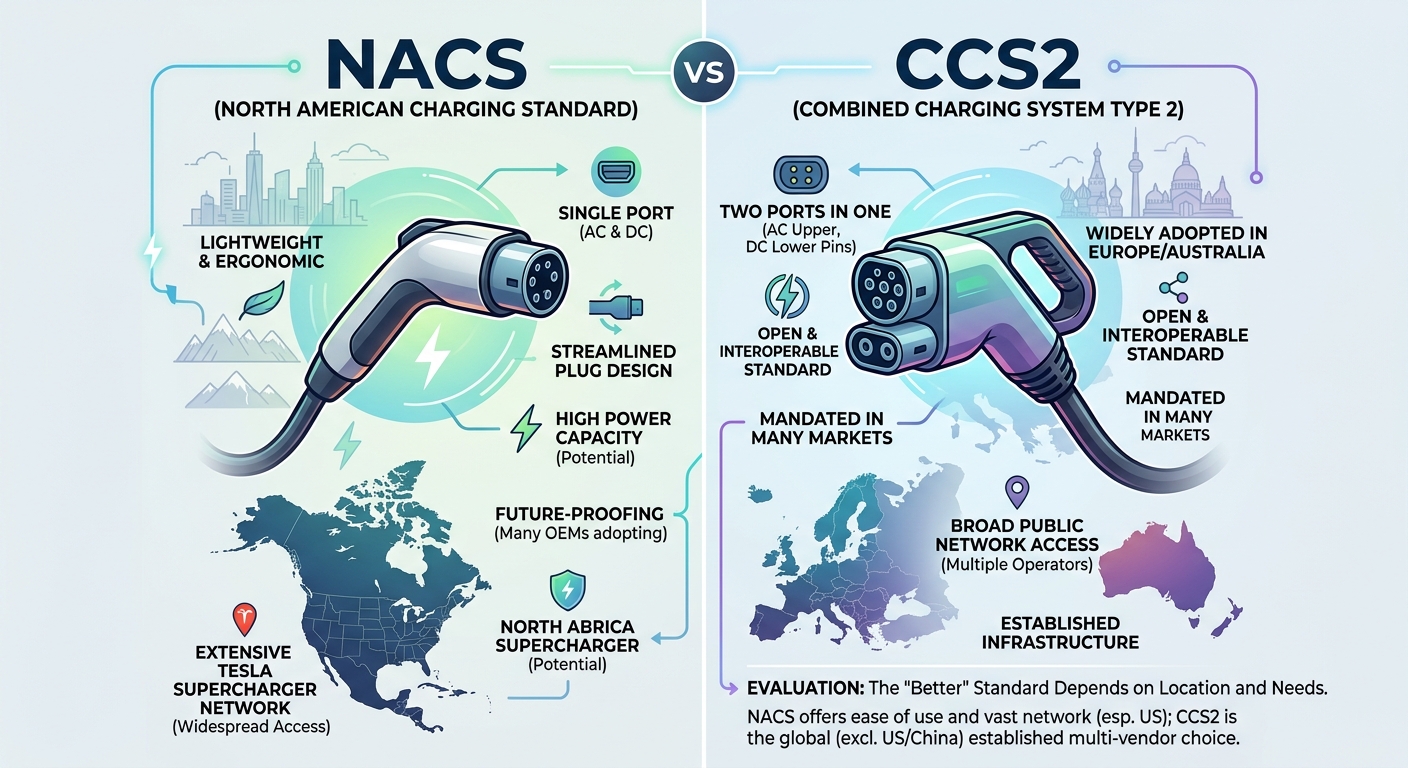
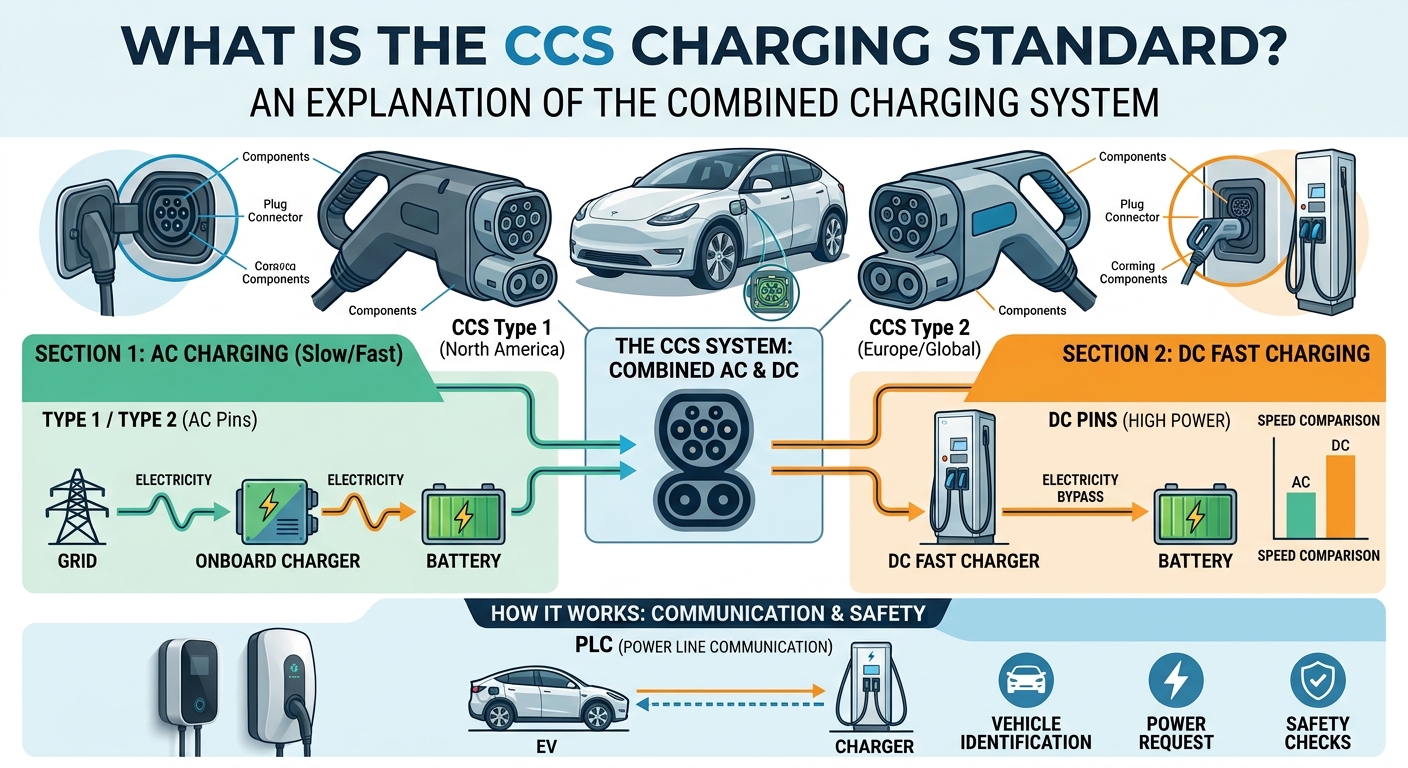
The clear answer is no, Type 2 and CCS2 are not the same, but they are closely related. Type 2 is an AC-only connector designed for daily home and destination charging, whereas CCS2 is a combined connector that adds two high-power DC pins underneath the Type 2 interface to support ultra-fast highway charging.
For deeper insights into charger specifications and home installation guidance, visit EV Charger Advisor.
Type 2 vs. CCS2: Key Structural & Electrical Differences
Understanding how Type 2 and CCS2 differ requires looking closely at their physical pinouts and power handling mechanisms.
1. Type 2 (Mennekes Connector)
-
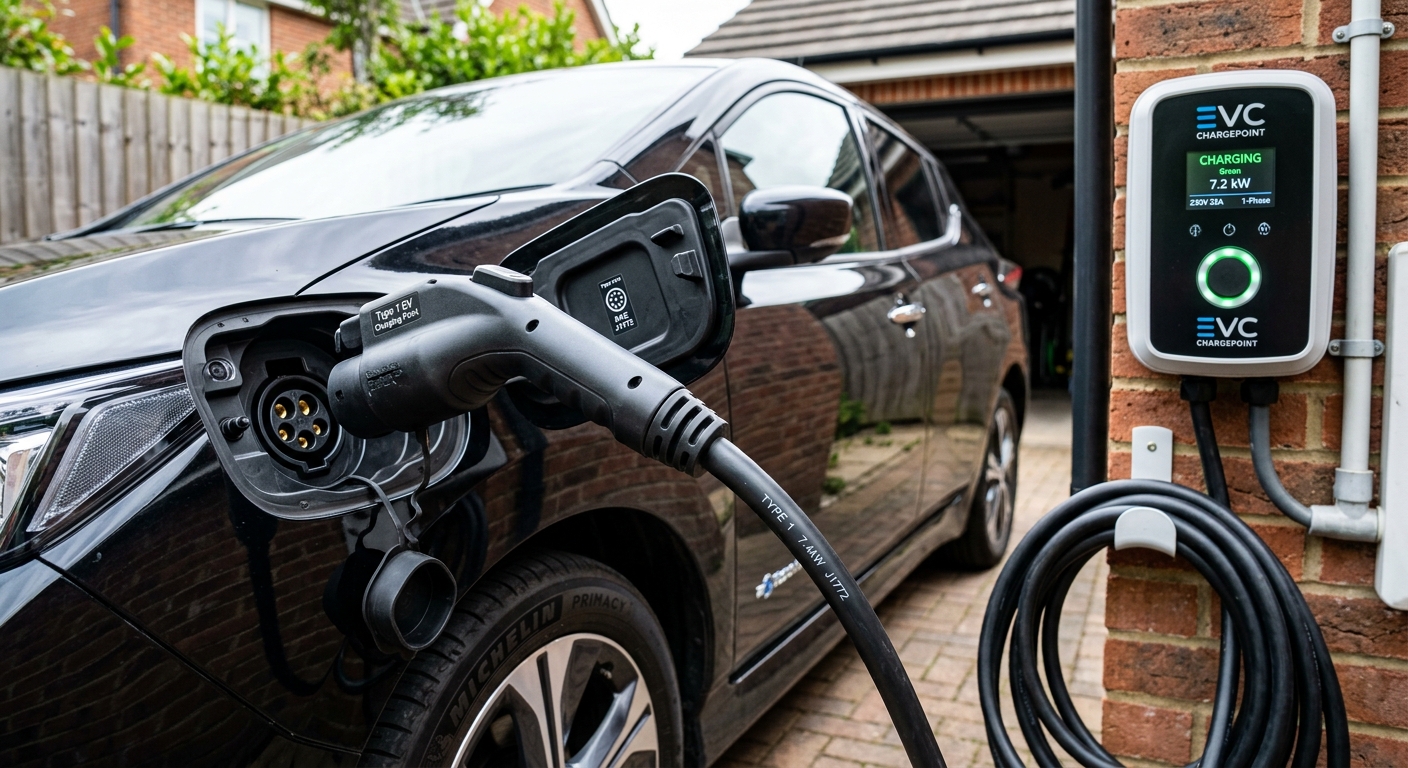
Primary Function: Alternating Current (AC) Charging.
-
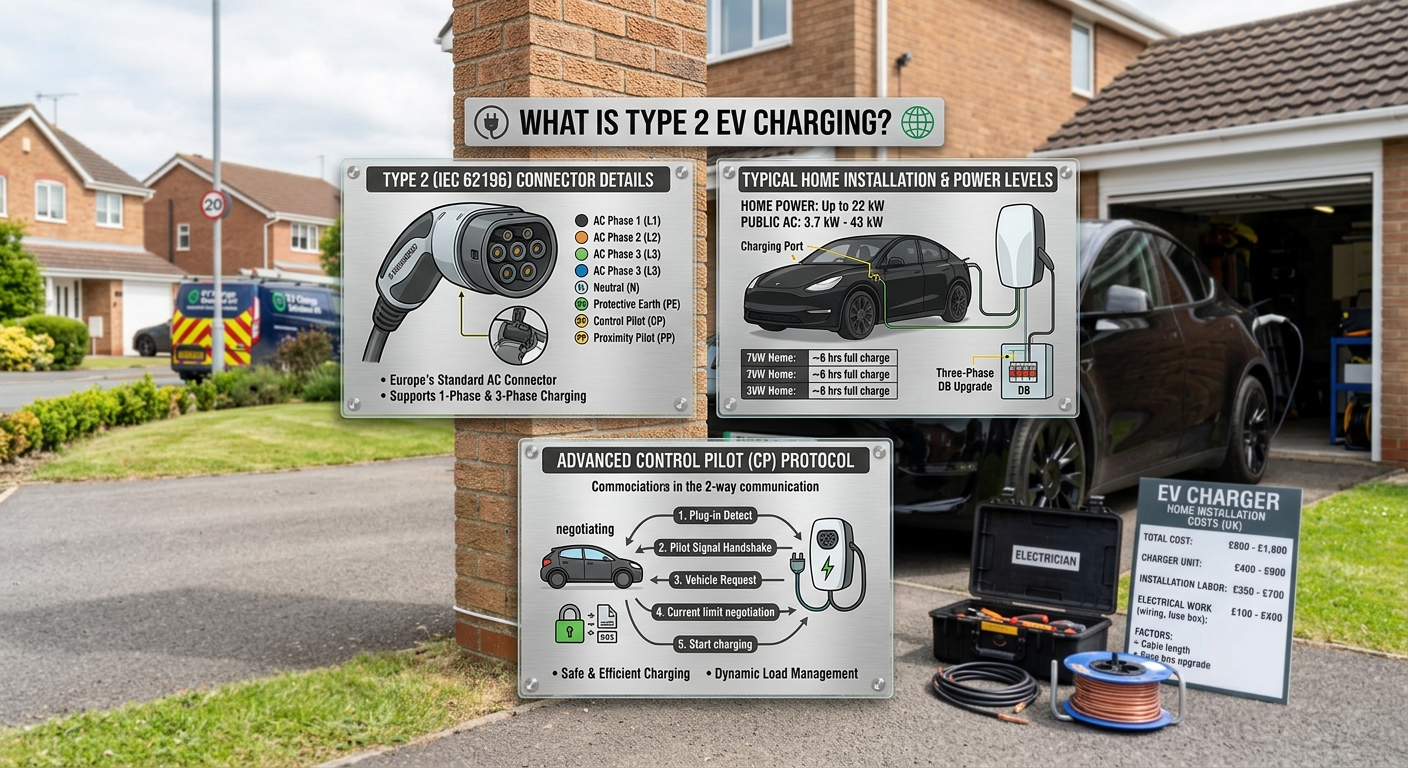
Pin Count: 7 pins (Line 1, Line 2, Line 3, Neutral, Protective Earth, Control Pilot, and Proximity Pilot).
-
Power Output: Typically delivers $3.7 \text{ kW}$ to $22 \text{ kW}$ (supporting both single-phase and three-phase grid connections).
-
Common Locations: Residential home wallboxes, office charging stations, and public street parking spaces.
2. CCS2 (Combo 2 Connector)
-
Primary Function: Direct Current (DC) Ultra-Fast Charging (plus full AC backward compatibility).
-
Pin Count: 9 pins total (7 pins in the top section + 2 large high-current DC pins below).
-
Power Output: Typically ranges from $50 \text{ kW}$ to over $350 \text{ kW}+$.
-
Common Locations: Public highway charging hubs, motorway service plazas, and commercial fast-charging networks.
To learn more about various charging formats globally, explore our comprehensive guide on EV charging types.
Interoperability: Can You Plug a Type 2 Cable into a CCS2 Socket?
One of the greatest engineering advantages of the CCS2 design is backward compatibility.
-
Type 2 Cable into a CCS2 Vehicle Inlet: YES. If your vehicle features a CCS2 combo inlet, you can plug a standard Type 2 AC charging cable directly into the top portion of the port. The lower two DC pins remain exposed and unused while your vehicle accepts AC power through its internal On-Board Charger (OBC).
-
CCS2 Cable into a Type 2 Vehicle Inlet: NO. A vehicle built with an AC-only Type 2 inlet cannot physically or electrically accept a CCS2 plug. Because it lacks the two bottom DC pin receivers and internal DC fast-charging wiring, it cannot take high-power DC fast charging.
Step-by-Step Mathematical Example: Charging Speeds Compared
To visualize the real-world difference between charging via Type 2 AC vs. CCS2 DC fast charging, let us perform a step-by-step mathematical comparison for an electric car with a 70 kWh battery pack (charging from 10% to 80% state of charge).
Given Parameters:
-
Total Energy Needed: $70 \text{ kWh} \times (0.80 – 0.10) = 49 \text{ kWh}$
-
Standard Type 2 AC Home Wallbox (Three-phase 11 kW output): $11 \text{ kW}$
-
Commercial CCS2 DC Fast Charger (150 kW Station): $150 \text{ kW}$ (Average effective charge rate: $115 \text{ kW}$)
Calculation 1: Type 2 AC Home Charging (11 kW)
Calculation 2: CCS2 High-Power DC Fast Charging (150 kW)
Using an effective average charge rate of $115 \text{ kW}$ across the battery’s charging curve:
Result Breakdown: Plugging into a CCS2 DC fast charger reduces your charging stop from over 4 hours down to roughly 25 minutes.
Comparison Table: Type 2 vs. CCS2
| Feature | Type 2 (Mennekes) | CCS2 (Combo 2) |
| Primary Power Mode | Alternating Current (AC) | Direct Current (DC) Fast Charge |
| Pin Configuration | 7 Top Pins | 7 Top Pins + 2 Dedicated DC Pins |
| Grid Power Support | Single-Phase & Three-Phase AC | Off-Board Direct DC Power |
| Maximum Power Output | Up to $22 \text{ kW}$ | Up to $350 \text{ kW}+$ |
| Primary Use Case | Home Wallboxes, Night Charging | Highway Travel, Rapid Charging |
| Plugged Into CCS2 Socket | Yes (Fits natively) | N/A |
Communication & Safety Integration
Both Type 2 and CCS2 utilize digital communications over the Control Pilot (CP) pin.
-
Type 2 Communication: Uses simple Analog Pulse Width Modulation (PWM) signaling to tell the vehicle how much AC current the station can supply safely.
-
CCS2 Communication: Utilizes advanced ISO 15118 Powerline Communication (PLC). This allows the station and vehicle to perform real-time insulation monitoring, dynamic battery state monitoring, and automated Plug & Charge billing.
To explore smart charging options for your home or business, read our guide on smart chargers.
Summary & Key Takeaways
-
Integrated Relationship: CCS2 incorporates the Type 2 port layout in its upper section and adds two DC pins below.
-
AC vs. DC Split: Type 2 handles daily AC charging up to $22 \text{ kW}$, while CCS2 provides rapid DC fast charging up to $350 \text{ kW}+$.
-
Flexible Compatibility: Vehicles with CCS2 inlets can easily accept both Type 2 AC plugs at home and CCS2 DC plugs on road trips.





Leave a Reply