
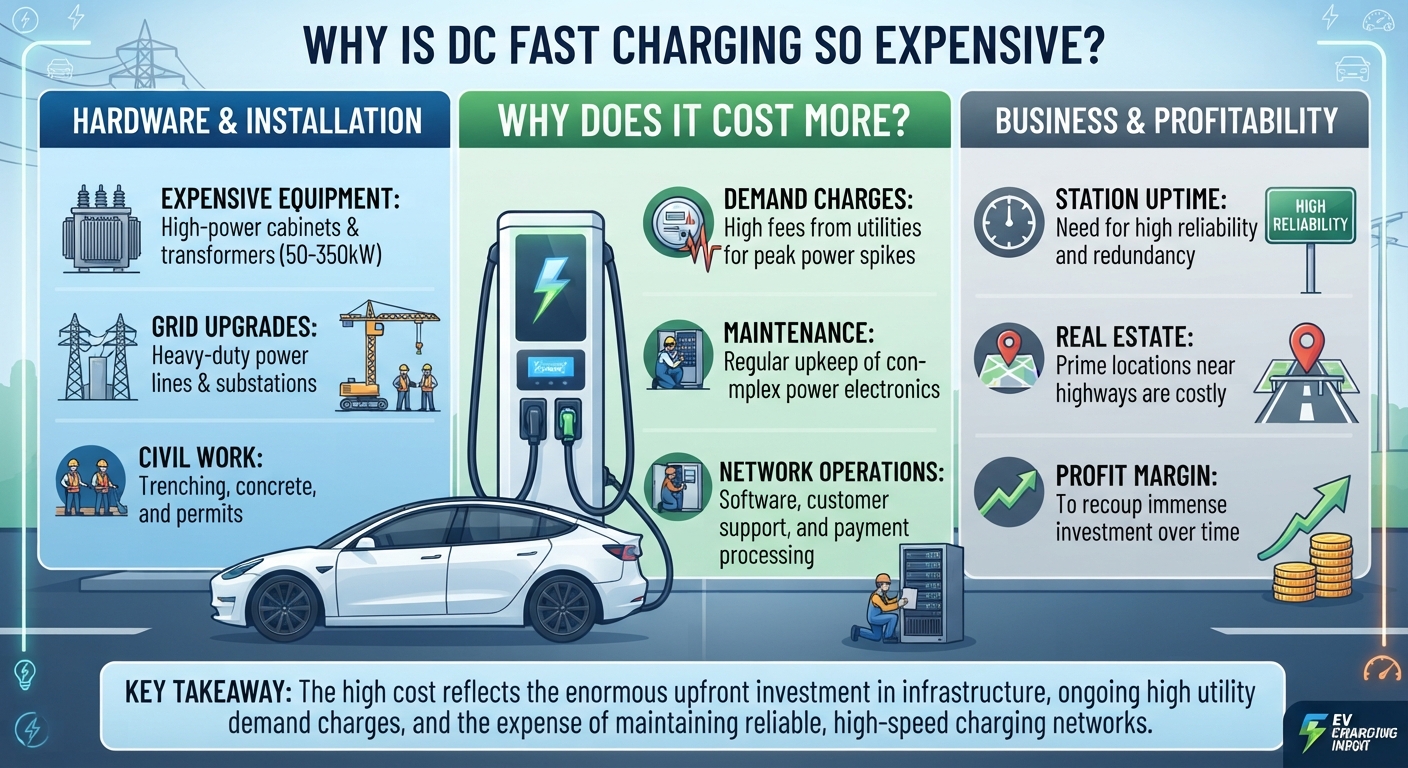
When electric vehicle owners transition from cheap home charging to public highway stations, the immediate jump in cost per kilowatt-hour can come as a surprise. To answer directly: DC fast charging is expensive primarily due to heavy equipment costs, commercial utility and demand charges, and ongoing maintenance overhead that do not apply to home charging.
While residential Level 2 equipment relies on standard household or simple garage circuits, public DC fast chargers (often called Level 3 chargers) operate like miniature industrial substations. They bypass the vehicle’s onboard converter to push immense voltages directly into the battery pack, generating structural and economic realities that drive up session prices.
Here is an extensive, comprehensive guide examining the financial mechanics, heavy utility expenses, and structural variables that make public DC fast charging significantly more expensive than home setups.
1. Heavy Equipment and Upfront Capital Expenditures
The physical hardware required to deliver high-power direct current is remarkably sophisticated and expensive compared to standard residential wall units:
-
Advanced Power Electronics and Safety Systems: A large portion of a DC fast charger’s manufacturing cost is tied up in heavy-duty rectification circuits, isolation transformers, and advanced safety modules designed to handle hundreds of volts safely.
-
Liquid-Cooled Cabling: Ultra-fast chargers ranging from 150 kW to 350 kW push massive electrical currents that generate intense heat. To prevent cables from overheating or melting during a session, integrated liquid-cooling loops are required, drastically increasing hardware acquisition costs.
-
Commercial Site Buildout: Unlike a simple home wallbox installation, a commercial DC fast charging station often requires six-figure site developments, heavy trenching, concrete pads, and protective safety bollards.
To compare these commercial investments with standard residential infrastructure, read more about various charging types.
2. Commercial Utility Rates and Peak Demand Charges
The single largest contributor to recurring operational expenses for public charging operators is the structure of commercial electricity billing:
-
The Impact of Demand Charges: Unlike residential electricity bills that charge strictly for total energy consumed (kilowatt-hours), commercial utility providers levy heavy “demand charges” based on the highest peak power drawn during a billing cycle. When multiple EVs pull hundreds of kilowatts simultaneously, it creates a massive power spike, leading to exorbitant utility fees for the charging network operator.
-
Paying for Unused Capacity: Even when charging stations sit empty overnight or during off-peak hours, the local grid infrastructure must remain provisioned to supply peak loads instantly. Those standby grid capacity costs are ultimately factored into the per-kWh price paid by drivers.
To explore how smart energy management and automated load balancing can mitigate these grid pressures, check out our guide on smart home EV solutions.
3. Ongoing Maintenance, Networking, and Low Utilization
Unlike a home charger that operates reliably for years with virtually zero oversight, public charging networks face harsh operational realities:
-
Vandalism and Weather Wear: Exposed public hardware frequently suffers from weather degradation, physical wear-and-tear, and occasional vandalism, requiring dedicated field service technicians to maintain high station uptime.
-
Software and Payment Processing: Charging station operators must pay recurring fees for cellular data connections, cloud management software, payment gateway compliance, and customer support infrastructure.
-
Low Utilization Volatility: Because most EV drivers do 80% to 90% of their charging cheaply at home, public DC fast chargers primarily serve road-trippers and specific off-grid windows. Low daily utilization means operators must recover fixed capital and maintenance expenses across fewer charging sessions, raising prices per kilowatt-hour.
For comprehensive insights on EV infrastructure planning, safety standards, and long-term advisory services, visit us at EV Charger Advisor.
Summary: What to Keep in Mind
-
Public DC fast charging commands higher prices because it funds industrial-grade equipment, liquid cooling, and complex grid integration.
-
Commercial demand charges and maintenance overhead mean public networks operate under vastly different economic rules than residential wall units.

















Leave a Reply