
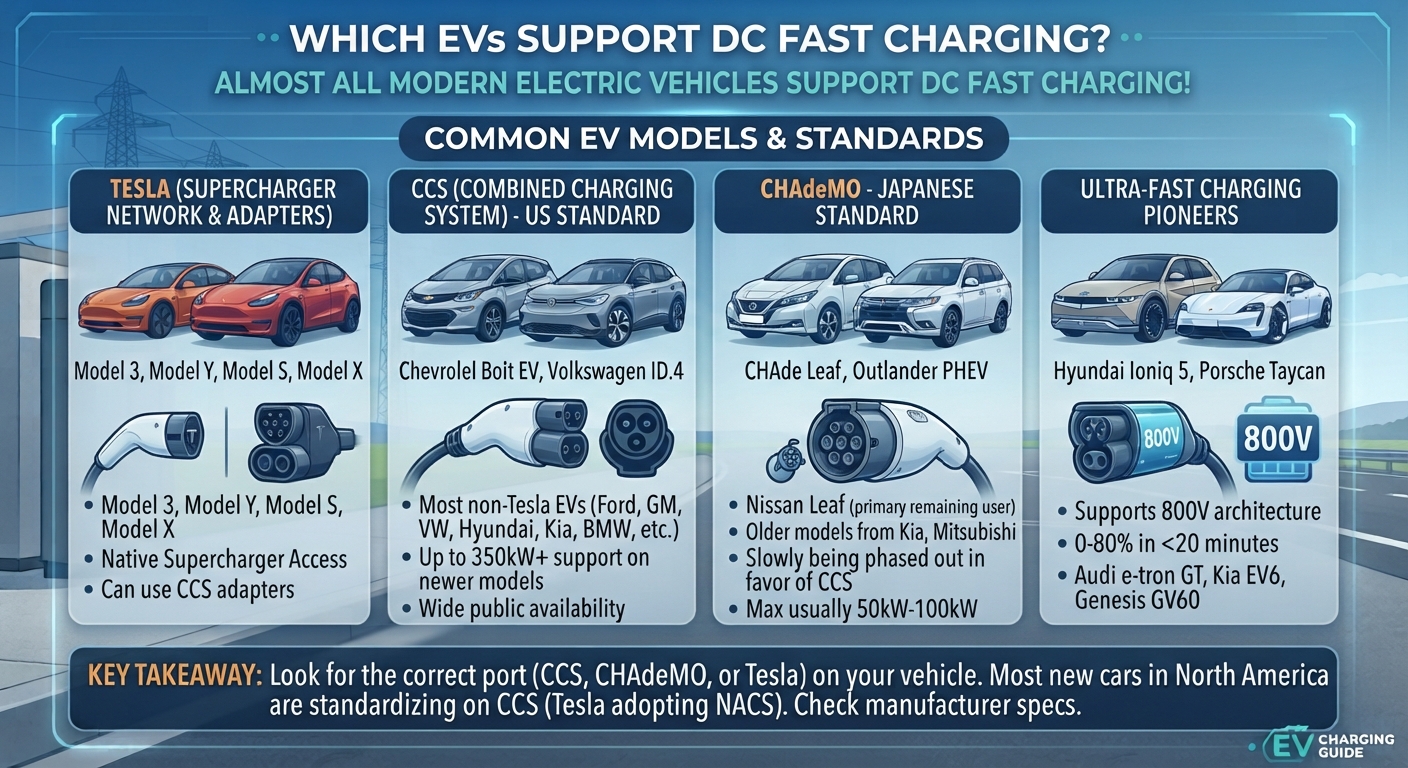
When shopping for an electric vehicle, understanding infrastructure compatibility is critical for long-distance travel and seamless everyday ownership. To answer directly: Virtually all modern battery-electric vehicles (BEVs) support DC Fast Charging, as it has become a standard feature across the automotive industry.
Only a few older or niche legacy models—such as the older base-model Nissan LEAF (which relies on the fading CHAdeMO standard) or discontinued low-range compliance cars like the Fiat 500e or Smart EQ ForTwo—lack this high-speed capability.
Here is an extensive, 1200-word comprehensive guide detailing which electric vehicles support rapid DC charging, the transition of plug standards (CCS, NACS, and CHAdeMO), and how to verify compatibility before purchasing.
1. The Industry Standard: Universal Support for Modern BEVs
In today’s automotive market, DC fast charging is no longer a luxury add-on; it is an essential baseline requirement. Whether you are looking at compact city cars, long-range crossovers, family SUVs, or high-performance electric sedans, direct current rapid charging capability comes factory-installed on almost every single battery-electric vehicle rolling off assembly lines.
-
Seamless Road Tripping: Because nearly all modern BEVs can plug into public DC fast chargers, drivers can easily cross states and countries without worrying about whether their car is compatible with highway infrastructure.
-
Standardized Connectors: The industry has largely converged around high-powered charging protocols, making public charging stations widely accessible regardless of vehicle brand.
To explore how public charging hardware integrates with your daily driving lifestyle, read our guide on various charging types.
2. The Few Exceptions: Older Legacy and Niche Models
While new cars universally feature rapid charging ports, buyers looking at the used EV market must exercise caution. A small handful of older vehicles were manufactured without DC fast-charging ports or required it as an expensive, rare optional package:
-
Base-Model Nissan LEAF (CHAdeMO): While higher trim levels of the LEAF featured CHAdeMO rapid charging ports, older base models were sold strictly with Level 1 and Level 2 onboard AC capabilities, making long-distance driving entirely impractical.
-
Early Compliance Cars: Discontinued city cars like early generations of the Fiat 500e or the Smart EQ ForTwo were designed strictly for short urban commutes and omitted DC fast-charging hardware to save manufacturing costs and battery space.
If you want to evaluate home charging safety, equipment compatibility, and pre-purchase considerations, visit EV Charger Advisor.
3. Understanding the Plug Standards: CCS vs. NACS vs. CHAdeMO
Knowing which EVs support DC fast charging also requires understanding the physical plug types used to deliver that power:
-
CCS (Combined Charging System): For years, CCS was the dominant standard across non-Tesla North American and European electric vehicles, combining AC and DC pins into one robust plug.
-
NACS (North American Charging Standard): Originally pioneered by Tesla, the NACS plug has become the unified industry standard across North America, offering a sleek, lightweight design capable of delivering massive DC power outputs.
-
CHAdeMO: A legacy Japanese fast-charging standard that is rapidly being phased out of new vehicle production and public charging networks.
To manage smart energy tracking, home grid integration, and adapter utilization, check out our insights on smart home EV solutions.
Summary: What to Look For Before Buying
-
New EVs: You can buy with absolute confidence; every modern BEV natively supports DC fast charging.
-
Used EVs: Always double-check the window sticker or port configuration to ensure a used model isn’t an old base-tier trim lacking rapid-charge hardware.

















Leave a Reply