
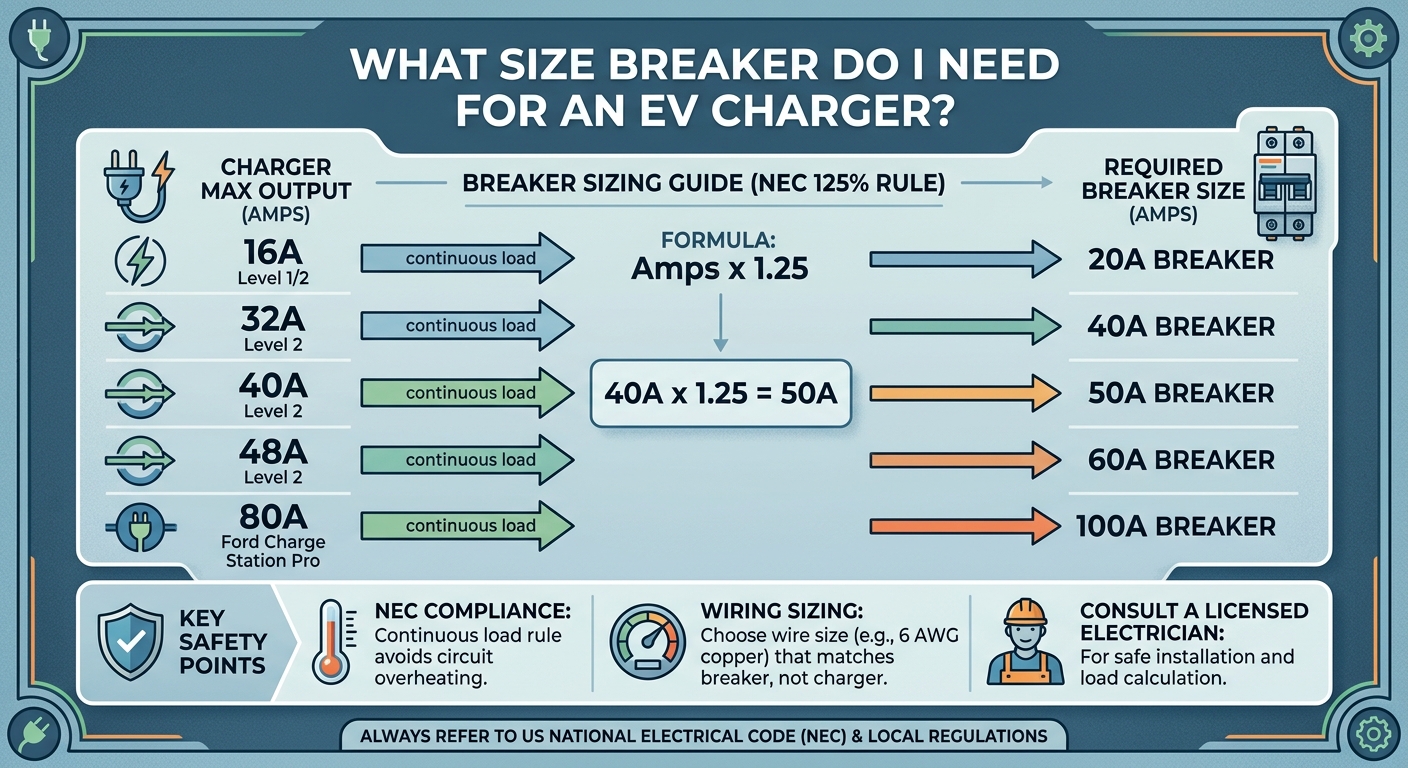
Most Level 2 home EV chargers need a 40 to 60 amp breaker. EV charging is a continuous load, so the breaker must be rated at 125% of the charger’s amperage. That means a 32-amp charger needs a 40-amp breaker, a 40-amp charger needs a 50-amp breaker, and a 48-amp charger needs a 60-amp breaker.
The 125% rule, explained
A continuous load is one that runs at maximum current for three hours or more, and EV charging counts under NEC 625.41. The circuit and its breaker must be sized at 125% of that load. Put another way, the charger should draw no more than 80% of the breaker’s rating.
A common mistake: Installing a 40-amp breaker for a 40-amp charger because the numbers match. A 40-amp continuous load needs a 50-amp breaker.
EV charger breaker size chart
| Charger amps | Power | Minimum breaker | Typical copper wire* | Notes |
|---|---|---|---|---|
| 32A | 7.7 kW | 40A | 8 AWG | Most common Level 2 setup |
| 40A | 9.6 kW | 50A | 8 AWG (conduit) or 6 AWG (NM-B) | Common plug-in on a NEMA 14-50 outlet |
| 48A | 11.5 kW | 60A | 6 AWG | Usually hardwired |
| 60A | 14.4 kW | 80A | 4 AWG | Uncommon, and few cars can use it |
*Wire gauge depends on conductor type, temperature rating and run length. Your electrician sets the final size.
What wire size do I need?
Guidance varies because the cable matters. In conduit, 8 AWG copper rated at 75°C can handle a 50-amp circuit. With NM-B (Romex), which is rated at 60°C, the same circuit typically needs 6 AWG. Long runs may need a heavier gauge to keep voltage drop within the NEC’s recommended 3%.
This isn’t a DIY decision. Your electrician will pick the right wire for your installation.
Plug-in vs hardwired
- Plug-in (NEMA 14-50): Sits on a 50-amp circuit and supports a charger set to no more than 40 amps. You won’t get 48-amp charging from a plug.
- Hardwired: Needed for 48 amps and above, on a 60-amp circuit.
- GFCI: A NEMA 14-50 outlet in a garage or outdoors may require a GFCI breaker. Check your local code.
Does your panel have the capacity?
Before you pick a charger, check three things:
- Breaker space: A 50-amp or 60-amp breaker is a 2-pole breaker and needs two adjacent spaces in your panel.
- Panel capacity: An electrician runs a load calculation to confirm your service can handle the extra load.
- Options if it can’t: Load management, a subpanel or a service upgrade.
Also have the charger commissioned at 80% of the breaker, for example 40 amps on a 50-amp circuit, since many units ship set to their maximum output.
Not sure whether your panel can handle it? Get a licensed installer quote https://evchargeradvisor.online/
Use a dedicated circuit
Your EV charger should have its own dedicated circuit, with no other outlets or appliances sharing it.
Don’t oversize for your car
A bigger breaker only helps if your car can use the extra power. If your car’s onboard charger accepts 32 amps, a 48-amp charger on a 60-amp circuit won’t charge it any faster, and you’ll have paid for capacity you can’t use. Check your car’s maximum AC charging rate first.
Quick checklist
- Find your car’s maximum AC charging rate.
- Choose a charger at or below that limit.
- Multiply the charger’s amps by 1.25 to find the minimum breaker.
- Check panel space and capacity.
- Hire a licensed electrician and confirm local permit requirements.
Next step: Compare Level 2 home chargers https://evchargeradvisor.online/
FAQs
What size breaker do I need for a 40-amp EV charger?
A 50-amp breaker.
What size breaker for a 32-amp EV charger?
A 40-amp breaker.
What size breaker for a 48-amp EV charger?
A 60-amp breaker.
Can I use a 40-amp breaker for a 40-amp EV charger?
No. A continuous load needs a breaker rated at 125%, so a 40-amp charger needs a 50-amp breaker.
What wire size do I need for an EV charger?
Commonly 8 AWG copper in conduit for 40-50 amp circuits or 6 AWG copper with NM-B and for 60-amp circuits. Your electrician decides based on the cable type and run length.
Does an EV charger need a dedicated circuit?
Yes. It should be on its own circuit.
Final thoughts
The rule is simple: charger amps × 1.25 = minimum breaker size. But the wire, panel and local code details are where a licensed electrician earns their fee, so get the installation assessed before you buy.
Ready to choose? See our top home EV chargers https://evchargeradvisor.online/
General information based on US NEC guidance. Local codes vary. Always have a licensed electrician size and install your circuit.

















Leave a Reply