
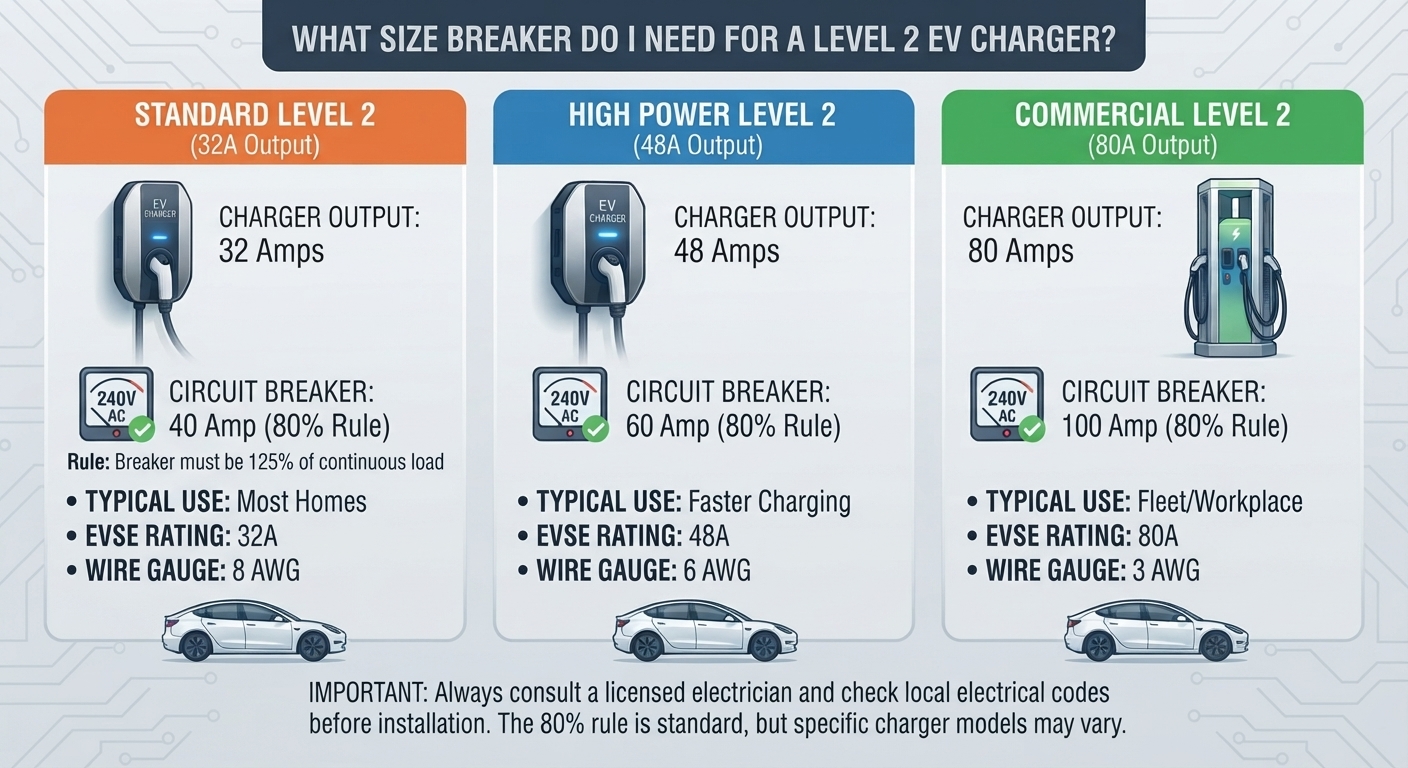
When planning a home installation for your electric vehicle, one of the most critical electrical safety questions you will face is determining the correct circuit breaker size. To answer directly: Most Level 2 electric vehicle (EV) chargers require a 40-amp to 60-amp double-pole circuit breaker, depending on the charger’s rated amperage and output capacity.
Selecting the right breaker is not a guessing game. It requires careful alignment with electrical safety codes, wire gauge capacity, and your home’s main service panel limits. This comprehensive guide breaks down everything you need to know about sizing your EV charger breaker safely and efficiently.
1. Understanding the Golden Rule: The 125% Continuous Load Rule
Before looking at specific breaker sizes, you must understand how electrical codes treat electric vehicle chargers. According to the National Electrical Code (NEC), EV charging stations are classified as continuous loads because they draw maximum electrical current for three hours or more.
To prevent overheating, voltage drops, and potential fire hazards, standard residential circuit breakers cannot be loaded to 100% of their capacity continuously. Instead, electrical regulations mandate the 125% rule:
-
The Formula: Your circuit breaker rating must be at least 125% of your charger’s maximum continuous current draw.
-
The Practical Impact: This means a charger running at a specific amperage cannot be matched with an identical breaker size; the breaker and wiring must be scaled up to the next standard rating.
To see how circuit requirements fit into overall home infrastructure planning, review our guide on various charging types.
2. Common Level 2 Charger Amperage and Breaker Size Breakdown
Different electric vehicles and Level 2 chargers demand varying levels of power. Here is how breaker sizing breaks down across common residential hardware configurations:
-
16-Amp Level 2 Chargers (approx. 3.8 kW):
-
Continuous Load: 16 Amps
-
Required Breaker: 20-Amp double-pole breaker (16A × 1.25 = 20A)
-
Best For: Plug-in hybrids (PHEVs) or smaller battery EVs with slower onboard chargers.
-
-
32-Amp Level 2 Chargers (approx. 7.7 kW):
-
Continuous Load: 32 Amps
-
Required Breaker: 40-Amp double-pole breaker (32A × 1.25 = 40A)
-
Best For: Standard daily commuters wanting a solid, mid-tier residential charging speed.
-
-
40-Amp Level 2 Chargers (approx. 9.6 kW):
-
Continuous Load: 40 Amps
-
Required Breaker: 50-Amp double-pole breaker (40A × 1.25 = 50A)
-
Best For: Most full-battery electric cars, providing a full overnight recharge.
-
-
48-Amp Level 2 Chargers (approx. 11.5 kW):
-
Continuous Load: 48 Amps
-
Required Breaker: 60-Amp double-pole breaker (48A × 1.25 = 60A)
-
Best For: Large battery EVs or households needing the absolute fastest standard residential home charging speed.
-
If you are incorporating smart scheduling features to manage heavy electrical loads during off-peak utility hours, check out our insights on smart home EV solutions.
3. Matching Wire Gauge (Ampacity) to Your Breaker
Sizing your breaker correctly is only half the battle; your supply wiring must match or exceed the ampacity requirements of that breaker:
-
For a 40-Amp Breaker: Typically requires robust copper wiring (such as 8 AWG THHN or equivalent, depending on conduit and temperature ratings).
-
For a 50-Amp Breaker: Generally requires 6 AWG copper wire to safely carry current over distance without excessive thermal buildup.
-
For a 60-Amp Breaker: Demands heavy-duty 6 AWG or 4 AWG copper conductors to handle high continuous power output safely.
Using undersized wire with a large breaker creates a severe fire risk because the wire will overheat long before the breaker trips.
4. Assessing Your Home’s Electrical Panel Capacity
Before calling an electrician to install a new double-pole breaker, you must look at your main service panel’s total capacity:
-
100-Amp vs. 200-Amp Panels: Many older homes feature 100-amp electrical panels. Adding a heavy continuous load like a 50A or 60A EV charger can easily overload the panel, especially when combined with other major household appliances like central air conditioning, electric dryers, or water heaters.
-
Load Management Systems: If your panel lacks physical space or total amperage headroom, you may need a panel upgrade or a smart load-shedding device to regulate power dynamically.
For professional assessments, safety checklists, and complete electrical guidance, explore more at EV Charger Advisor.
Summary: What You Need to Remember
-
Check the Nameplate: Always verify your charger’s exact maximum amperage rating.
-
Apply the 125% Rule: Multiply your charger’s current draw by 1.25 to find your minimum required breaker size.
-
Hire a Licensed Electrician: Because high-voltage 240V lines carry substantial power continuously, professional installation ensures compliance with local building codes and keeps your home safe.

















Leave a Reply