
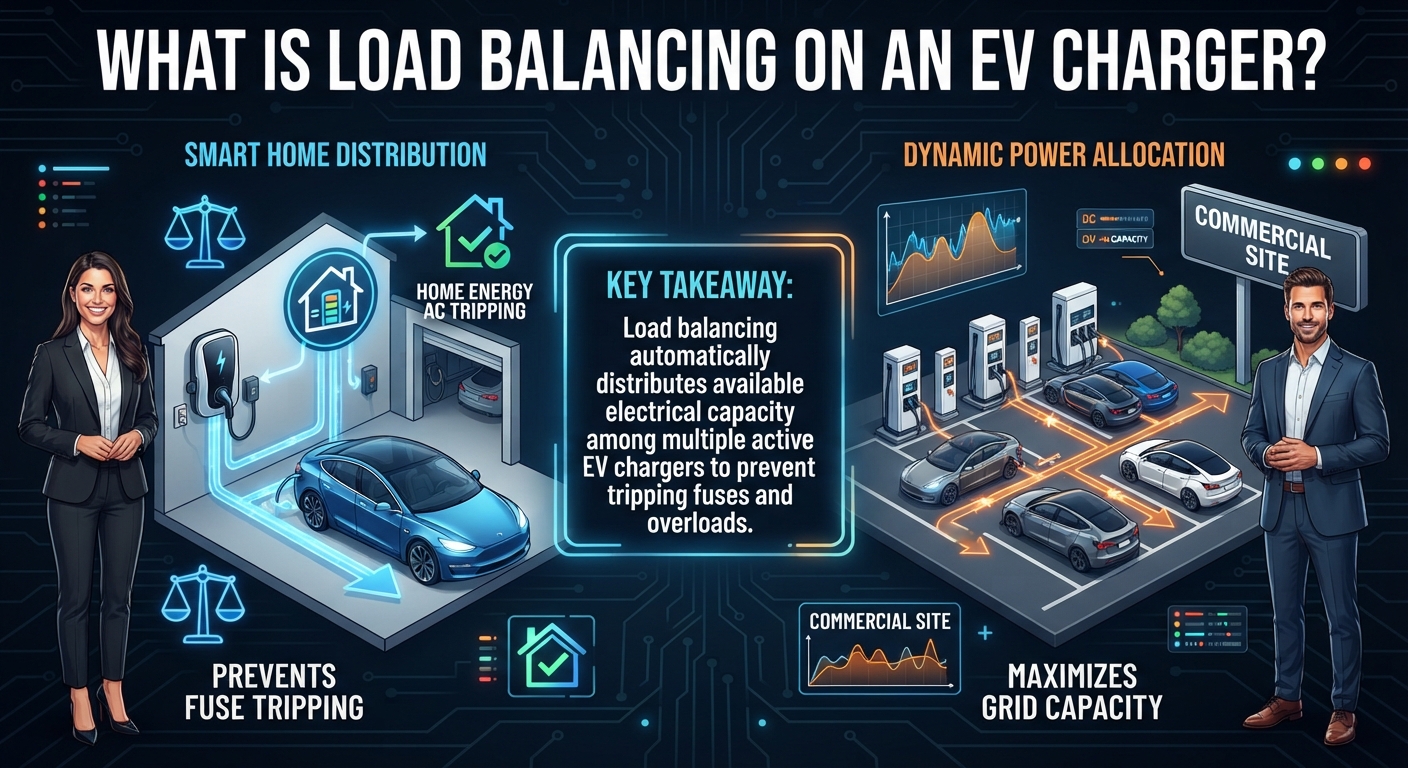
Load balancing automatically shares a limited amount of electrical capacity so your EV charger doesn’t overload your circuit or panel. It can split power between two chargers, or reduce your charger’s output when other appliances are running. It’s often used to add charging to a home without a costly panel upgrade.
Load balancing in plain English
Your home has only so much electrical capacity. A charger can draw a lot of it for hours, so something has to give when the oven, dryer or heat pump runs. Load balancing is the control that decides how much power the charger gets at any moment, and it adjusts that figure automatically.
You may also see it called load management, power sharing, circuit sharing or an energy management system (EMS).
Static vs dynamic load balancing
| Static load management | Dynamic load management | |
|---|---|---|
| How it works | The charger is limited to a fixed maximum current at all times | The charger adjusts in real time based on total household demand |
| CT clamp needed? | No | Yes |
| Efficiency | Moderate, because it’s always restricted | High, because it uses available headroom |
Dynamic management lets the charger run at full speed when the house is quiet, such as overnight, which means faster average charging than a fixed limit.
How dynamic load balancing works
A current transformer (CT) clamp fits around the main incoming cable and measures your total household current in real time. The charger reads that value and adjusts its output to keep total demand within your supply limit. In practice:
- The sensor measures your home’s total load.
- If demand rises, the charger lowers its power.
- If demand falls, the charger ramps back up.
Some systems use a separate energy management device that monitors the panel and temporarily pauses or throttles the charger.
Want a charger with dynamic load management? Compare smart Level 2 chargers https://evchargeradvisor.online/
Sharing power between two chargers
Circuit sharing is the most common approach for multiple EVs: two or more chargers share a single circuit, and the available current is split between them. A typical example is two charging ports sharing a 40-amp circuit, each limited to 20 amps. One manufacturer says its system lets up to four chargers run off a single feeder and breaker.
Smarter systems adapt to what’s plugged in. If only one EV is connected, it can use all the capacity. If two are plugged in, the capacity is split, and when one finishes, the other gets the full amount.
A worked example (my calculation): Two cars share a 40-amp circuit at 20 amps each. That’s about 4.8 kW per car, or roughly 38 kWh over 8 hours. At 3.5 miles per kWh, that’s about 134 miles each overnight, enough for most daily driving.
What the electrical code says
The US National Electrical Code (NEC) section 625.42 allows load management in EV charging. Where an automatic load management system is used, the maximum load on the service and feeder can be the maximum the system permits, instead of the combined ratings of every charger. Newer editions renamed this equipment “energy management system”. Rules vary by jurisdiction, so your electrician and local inspector have the final word.
Does load balancing slow down charging?
It depends on the type:
- Static: The charger is always limited, so charging is slower than at its maximum rating.
- Dynamic: The charger only slows when the house is busy, and runs at full speed otherwise.
- Two cars: Each gets a share, but overnight that’s often enough.
When you need load balancing
- Your panel is tight, so adding a charger would otherwise mean an upgrade.
- You have two or more EVs and one circuit.
- You want to avoid tripping your breaker when the oven, dryer and charger run together.
- You plan to add more chargers later.
When you don’t
- Your panel has plenty of headroom, confirmed by a load calculation.
- You have a single EV and a simple overnight routine.
How it differs from smart charging
Smart charging is the broader idea: scheduling, apps, monitoring and utility programs. Load balancing is one smart feature, focused on power limits. A load calculation, by contrast, is the electrician’s check of what your panel can support.
What to look for when buying
- Static or dynamic, and whether it needs a CT clamp.
- How many chargers it can share power between.
- Compatibility with your panel and your electrician’s design.
- Inspector acceptance, because rules vary locally.
- A dedicated circuit and a licensed installer.
Next step: Get a licensed installer quote https://evchargeradvisor.online/
FAQs
- What is load balancing on an EV charger?
It automatically shares limited electrical capacity so the charger doesn’t overload your circuit or panel. - What’s the difference between static and dynamic load balancing?
Static uses a fixed current limit. Dynamic adjusts in real time based on your home’s demand. - Do I need a CT clamp?
For dynamic load management, yes. It measures your home’s total current. - Can two EV chargers share one circuit?
Yes, with a load management system. Two chargers commonly share a 40-amp circuit at 20 amps each. - Does load balancing slow charging?
Static limits always apply. Dynamic only slows when your home is busy. - Can load balancing avoid a panel upgrade?
Often, yes, but your electrician should run a load calculation first. - Is load balancing allowed by code?
NEC 625.42 permits it, but local rules vary.
Final thoughts
Load balancing lets you charge within your home’s limits, whether that’s one tight panel or two cars. Confirm your capacity with an electrician, then choose the type that fits.
Ready to plan it? See our top smart home chargers https://evchargeradvisor.online/
General information based on US NEC guidance. Local codes vary. Always have a licensed electrician assess your installation.

















Leave a Reply