
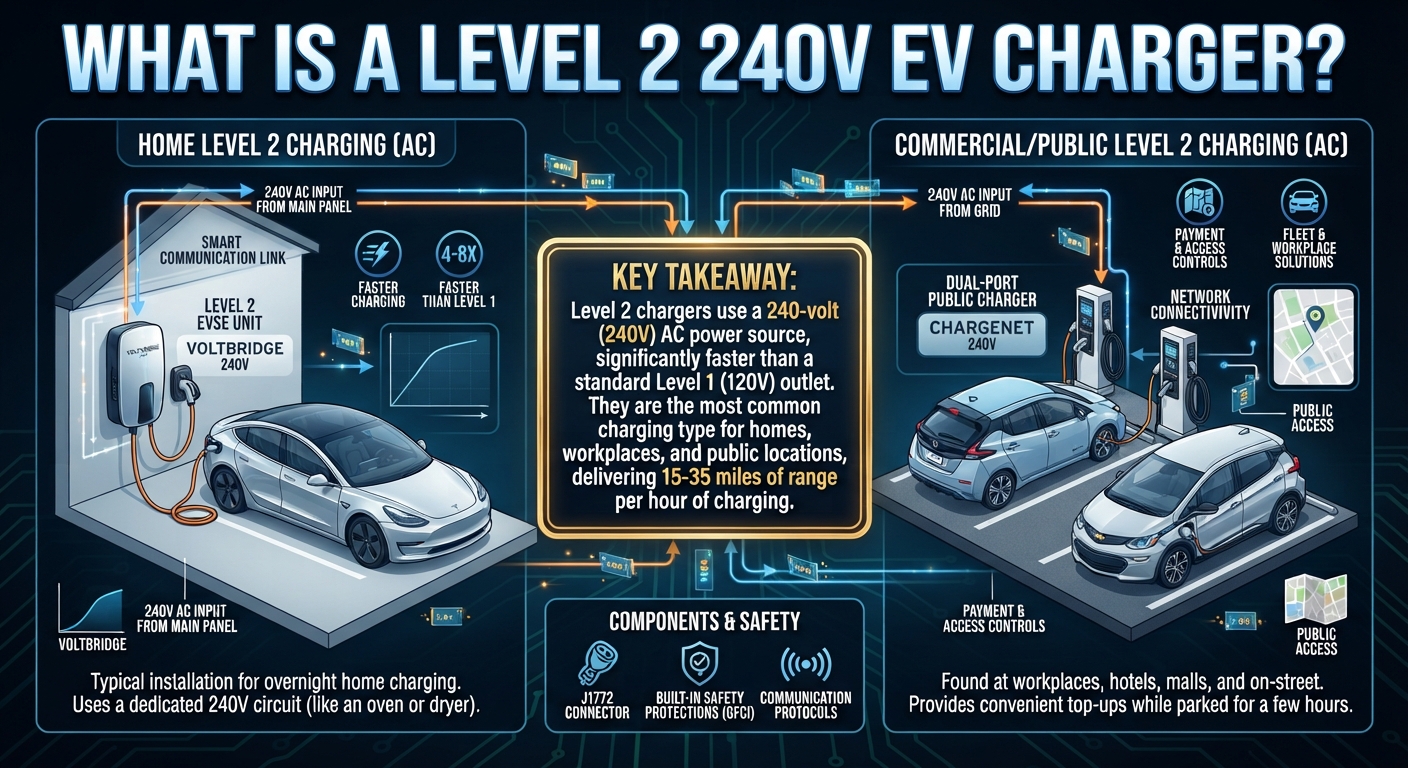
A Level 2 EV charger is a charging station that runs on a 240-volt circuit, the same kind of power used by an electric dryer or oven. It supplies AC power to your car at roughly 3.8 to 11.5 kW for most homes. That typically adds about 15 to 45 miles of range per hour, which is enough to refill most EVs overnight. A standard wall outlet (Level 1) is several times slower.
If you are deciding whether to stay on a regular outlet or upgrade, this guide explains how Level 2 works, how fast it really is, what it costs and what your home needs.
Level 2 EV Charger at a Glance
| Feature | What to know |
|---|---|
| Voltage | 240V AC |
| Typical power | 3.8–11.5 kW (up to 19.2 kW on high-amp units) |
| Common amperage | 16A, 24A, 32A, 40A, 48A |
| Range added per hour | Roughly 15–45 miles, depending on charger and car |
| Typical full charge | About 4–10 hours |
| Connector | J1772 (most non-Tesla EVs) or NACS/Tesla-style port, with adapters available |
| Best for | Daily home, workplace and apartment/condo charging |
How a Level 2 Charger Works
The box on your wall is technically called EVSE (electric vehicle supply equipment). It does not “charge” the battery directly. It safely delivers 240V AC power and communicates with your car. The car’s onboard charger then converts that AC power to DC and fills the battery.
This matters for one reason: your car’s onboard charger sets the speed limit. If you buy a 48-amp charger but your EV accepts only 7.2 kW, you will charge at 7.2 kW. Check your vehicle’s maximum AC charging rate before paying for more charger than you can use.
Level 1 vs Level 2 vs Level 3 (DC Fast Charging)
| Level 1 | Level 2 | Level 3 (DC Fast) | |
|---|---|---|---|
| Power source | 120V household outlet | 240V circuit | High-power DC station |
| Typical power | ~1.4 kW | 3.8–11.5 kW | 50–350 kW |
| Range per hour | ~3–5 miles | ~15–45 miles | Hundreds of miles per hour |
| Where | Home | Home, work, public | Public corridors |
| Install needed | Usually none | Dedicated circuit | Not for homes |
Level 2 is the sweet spot for daily use. It is far faster than a wall outlet, and it is gentler and cheaper than relying on public fast charging.
How Long Does Level 2 Charging Take?
Use this simple formula: hours ≈ kWh you need ÷ charger kW (add about 10% for charging losses).
Example: adding 40 kWh to your battery.
| Charger | Approx. time |
|---|---|
| Level 1 (1.4 kW) | ~28 hours |
| Level 2, 32A (7.7 kW) | ~5 hours |
| Level 2, 48A (11.5 kW) | ~3.5 hours |
Most drivers do not need a full charge every night. If you drive about 30 to 40 miles a day, even a modest Level 2 charger restores that in an hour or two.
Do You Need a Level 2 Charger?
A Level 2 charger is usually worth it if:
- You drive more than 30–40 miles most days
- Level 1 charging leaves you short by morning
- You have a plug-in hybrid or EV with a larger battery
- You want to charge during cheaper off-peak utility hours
- You have a garage, driveway or dedicated parking spot
You may be fine on Level 1 if you drive very little, have a long parking window every night, and a plug-in hybrid with a small battery.
What You Need Before Installing One
- A dedicated 240V circuit. The charger should not share a circuit with other loads.
- Enough electrical panel capacity. An electrician does a load calculation to confirm your panel can handle it.
- The right breaker size. EV charging is a continuous load, so the breaker is sized at 125% of the charger’s amperage:
| Charger amperage | Breaker size |
|---|---|
| 16A | 20A |
| 24A | 30A |
| 32A | 40A |
| 40A | 50A |
| 48A | 60A |
- A compatible connector. Confirm whether your EV uses J1772 or a NACS port, and whether you need an adapter.
- Permits and a licensed electrician. Rules vary by city and utility, so always confirm locally.
Plug-In vs Hardwired Level 2 Chargers
- Plug-in (NEMA 14-50 or similar outlet): easier to install or move, usually capped at 40A on a 50A circuit. Good for renters and flexible setups.
- Hardwired: wired directly into the circuit, supports up to 48A or more, and is often considered cleaner for permanent outdoor or garage installs.
Neither is “better” for everyone. Pick based on your car’s charging rate, your panel and how permanent the setup should be.
How Much Does a Level 2 Charger Cost?
Total cost has three parts:
- The charger: commonly a few hundred dollars up to roughly $800 for most home units.
- Installation labor: varies with the distance from your panel to the parking spot.
- Electrical upgrades: a panel upgrade, new wiring, trenching or permits can raise the total significantly.
A simple install near your panel is far cheaper than a long run or a panel upgrade. The only reliable number is a written quote for your home. Get one before you buy the hardware.
Running cost: multiply the kWh you add by your electricity rate. At $0.15/kWh, adding 30 kWh costs about $4.50. Time-of-use plans can lower this if you charge overnight.
Rebates and Incentives
The federal 30C home-charger tax credit ended for chargers placed in service after June 30, 2026. Some state, local and utility rebates may still apply. Check your utility’s EV page and your state energy office before you buy, because programs change often.
How to Choose the Right Level 2 Charger
- Amperage: match your car’s onboard charger and your panel, not the biggest number on the box.
- Connector: J1772 or NACS, plus adapter needs.
- Cord length: measure from the charger location to your car’s charge port.
- Smart features: Wi-Fi, scheduling and energy reports help you charge off-peak.
- Safety listing: look for UL or ETL certification.
- Weather rating: choose an outdoor-rated unit if it will be exposed.
- Warranty and support: check coverage length and who handles service.
Is Level 2 Charging Safe?
When the charger is certified and installed to code by a licensed electrician, Level 2 charging is considered safe for daily home use. Avoid extension cords and adapters not approved for EV charging, and stop and call an electrician if a plug or outlet gets unusually hot.
Level 2 Charging for Renters, Condos and Apartments
You may still have options. Ask your landlord or HOA about shared chargers, a dedicated parking spot with an outlet, or workplace and public Level 2 stations. A portable plug-in Level 2 unit can work where a 240V outlet is already available and permitted.
Not Sure Which Level 2 Charger Fits Your Home?
The right charger depends on your EV, your panel and your parking setup. If you want a clear recommendation, get help choosing the right Level 2 charger before you buy.
Frequently Asked Questions
- What is a Level 2 240V EV charger?
It is a home, workplace or public charging station that uses a 240-volt circuit to charge an electric vehicle much faster than a standard 120V outlet. - How fast is a Level 2 EV charger?
Most add about 15 to 45 miles of range per hour. Actual speed depends on the charger’s amperage and your car’s onboard charger. - How long does it take to charge an EV with Level 2?
Usually about 4 to 10 hours for a full charge, depending on battery size and charger power. - What is the difference between Level 1 and Level 2 charging?
Level 1 uses a 120V outlet and adds around 3 to 5 miles per hour. Level 2 uses 240V and is several times faster. - Do I need a special outlet for a Level 2 charger?
Yes. You need a dedicated 240V circuit, either an outlet such as NEMA 14-50 for plug-in units or a hardwired connection. - What size breaker does a Level 2 charger need?
Size it at 125% of the charger’s amperage. For example, a 40A charger needs a 50A breaker, and a 48A charger needs a 60A breaker. - How much does it cost to install a Level 2 charger?
It varies with charger price, wiring distance and whether a panel upgrade is needed. Get a written quote from a licensed electrician. - Can I install a Level 2 charger myself?
Electrical work involves safety and code requirements, and permits may be required. Using a licensed electrician is strongly recommended. - Will a Level 2 charger work with any EV?
Most can charge any EV with the right connector. Check whether your car uses J1772 or NACS and whether you need an adapter. - Is a 48-amp charger always better?
No. If your EV’s onboard charger accepts less, you will not charge faster, and you may pay more for the install. - Is there still a federal tax credit for home chargers?
The federal 30C credit ended for equipment placed in service after June 30, 2026. Check state and utility programs. - Can renters use Level 2 charging?
Often yes, with landlord approval or shared and public Level 2 chargers.
Final Thoughts
A Level 2 240V EV charger is the most practical way to charge at home for most drivers. Match the charger to your car’s onboard charger, confirm your panel and circuit, and get a written install quote before buying. Still have questions? Talk to us about your setup and we will point you in the right direction.

















Leave a Reply