
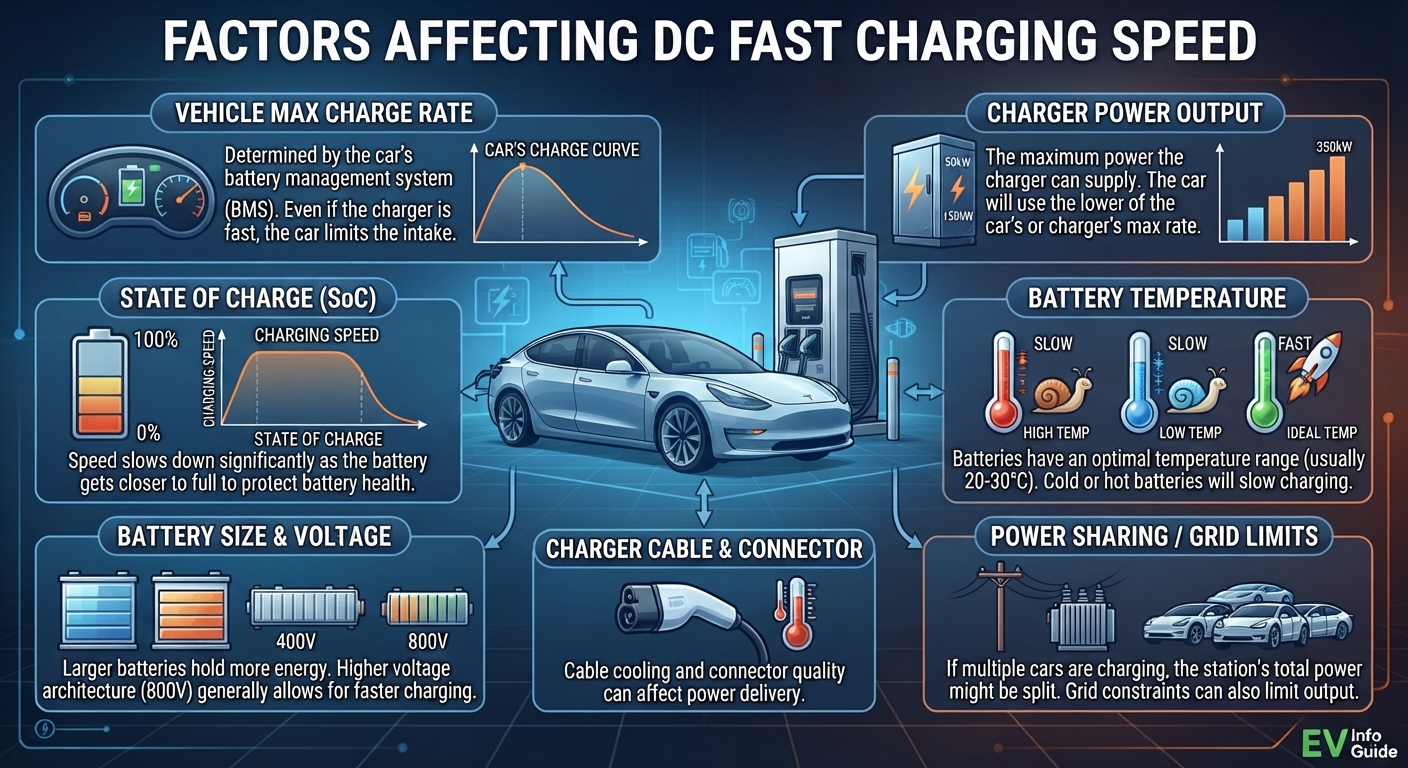
When transitioning to electric vehicle ownership, one of the most eye-opening experiences for new drivers is pulling up to a public DC fast charging station and discovering that their car isn’t charging nearly as fast as the highway billboard or charger label promised. To answer directly: DC fast charging speed depends on a combination of your vehicle’s technical limits, battery conditions, station output, and the surrounding environment.
While direct current (DC) fast charging is designed to transform hours of waiting into a brief 20-to-40-minute stop, actual charging performance is governed by a complex dance of chemistry, physics, and electrical engineering. Understanding these hidden variables can save you time, prevent range anxiety, and help you master long-distance road trips.
DC fast charging velocity, how your car’s battery management system protects itself, and how you can optimize every charging session.
1. Vehicle Architecture and Onboard Limitations
The primary bottleneck in any high-speed charging session is often the electric vehicle itself. No matter how powerful a public charging stall might be, your car will only accept as much electricity as its internal architecture is engineered to handle.
-
Peak Power Intake Caps: Every EV model has a certified maximum kilowatt (kW) intake limit. For instance, a budget city hatchback might max out at 50 kW or 80 kW, while a high-end luxury sedan or modern electric truck might support peak rates of 250 kW, 300 kW, or even 350 kW. If your vehicle caps at 150 kW, plugging into a 350 kW ultra-fast stall will yield zero speed benefits because the vehicle itself regulates the intake.
-
Voltage Architectures (400V vs. 800V Systems): Traditional EVs utilize a 400-volt electrical architecture. Newer, high-end platforms leverage 800-volt (or higher) systems. An 800V architecture can pull massive amounts of power while generating significantly less heat, allowing for drastically faster charging times and lighter cables. If a 400V car plugs into a high-powered shared charger, it may require an onboard DC-to-DC boost converter, which can further limit overall speed.
To understand how high-voltage public infrastructure contrasts with residential hardware, read more about various charging types.
2. Battery State of Charge (SoC) and Charging Curves
Unlike filling a gas tank—which flows at a consistent rate from empty to full—electricity enters a lithium-ion battery in a rolling curve known as a charging profile.
-
The Sweet Spot (10% to 80%): When your battery is deeply depleted (e.g., between 10% and 30% state of charge), its internal chemical resistance is very low. This allows the car to safely accept the maximum possible power intake from a fast charger, resulting in blazing-fast energy transfer.
-
The 80% Throttling Wall: As the battery fills up and crosses the 80% threshold, internal resistance spikes dramatically. To protect the lithium-ion cells from catastrophic overheating, dendrite formation, and permanent chemical damage, the vehicle’s Battery Management System (BMS) forces an aggressive power reduction (throttling). Pushing from 80% to 100% can often take just as long as going from 10% to 80%, which is why seasoned EV drivers unplug and move on once they hit 80% on long road trips.
3. Thermal Management: Battery Temperature and Weather
Temperature is arguably the single most influential environmental factor affecting charging speed. Lithium-ion batteries are like living organisms; they have a very strict comfort zone.
-
The Cold Weather Trap: In freezing winter conditions, the chemical reactions inside a battery slow down dramatically. If you plug a freezing cold EV into a 350 kW DC fast charger without preparation, the car’s computer will detect the low temperature and severely restrict incoming power (sometimes crawling at single-digit kW speeds) to prevent destroying the battery cells. Many modern EVs feature battery preconditioning—a feature that automatically warms up the pack via navigation input before you arrive at a fast charger.
-
The Heat Management Challenge: Conversely, extreme summer heat combined with the immense friction of high-speed charging can cause the battery pack to overheat. If internal sensors register temperatures nearing safety limits, the BMS will throttle charging speeds to cool the pack down using liquid-cooling loops.
To explore how smart thermal tracking, energy distribution, and home energy optimization intersect with vehicle maintenance, check out our guide on smart home EV solutions.
4. Public Station Power Output and Grid Limitations
The hardware you plug into plays a massive role in your charging velocity, and external power sharing can catch drivers off guard.
-
Station kW Ratings: Public DC fast chargers generally range from 50 kW legacy units up to 150 kW, 250 kW, and 350 kW ultra-fast corridors. Matching your car’s maximum intake to the station’s capacity ensures optimal performance.
-
Power Sharing and Split Cabinets: Many modern charging stations feature paired stalls (e.g., Stall 1A and 1B) tied to a single power cabinet. If another vehicle pulls up and plugs into the adjacent stall while you are charging, the station’s total output may split dynamically between both cars, instantly cutting your charging speed in half.
For comprehensive insights on EV infrastructure planning, battery safety standards, and expert advisory services, visit us at EV Charger Advisor.
Summary: How to Maximize Your Charging Speed
-
Precondition Your Battery: Always use your vehicle’s built-in navigation to route to a fast charger so the car can warm or cool the pack beforehand.
-
Unplug at 80%: Avoid staying past the 80% mark on road trips to save time and prevent bottlenecking other drivers.

















Leave a Reply