
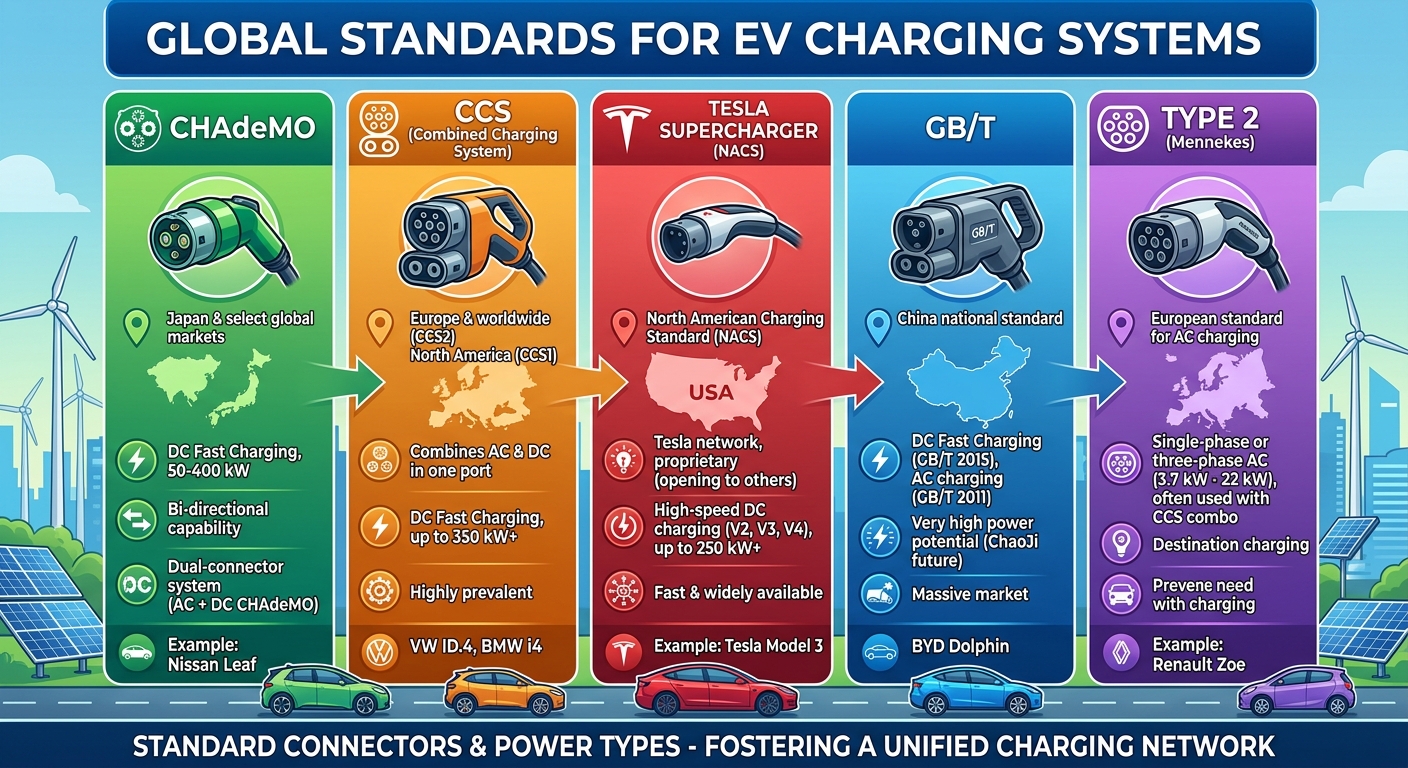
The main standards for EV charging systems fall into five groups: connector standards (J1772, Type 2, CCS, NACS/J3400, CHAdeMO, GB/T), charging levels and modes (SAE J1772 levels and IEC 61851 modes), communication protocols (ISO 15118 and OCPP), product safety standards (such as UL 2202 and UL 2231), and installation codes (such as the NEC in the US and BS 7671 in the UK). Which ones apply to you depends mostly on where you live and which car you drive.
Why Do EV Charging Standards Matter?
Standards make sure that a car, a charger and the building’s wiring can work together safely. They cover things like plug shape, how the car and charger talk to each other, how much power can flow and how users are protected from shock and fire. Without them, you’d need a different charger for every car brand.
One thing to know up front: standards, codes and protocols are not the same. A standard describes how equipment should be built. A code (like the NEC) says how it must be installed. A protocol defines how devices exchange data.
1. Connector Standards: Which Plug Fits Which Car?
This is the group most drivers run into first.
| Standard | Also called | Used for | Where it’s common |
|---|---|---|---|
| SAE J1772 | Type 1 | AC charging (Level 1 and Level 2) | North America, Japan |
| IEC 62196-2 | Type 2 | AC charging | Europe and many other regions |
| CCS1 | Combined Charging System 1 | AC plus DC fast charging (J1772 plus two DC pins) | North America |
| CCS2 | Combined Charging System 2 | AC plus DC fast charging (Type 2 plus two DC pins) | Europe and many other regions |
| NACS / SAE J3400 | Tesla connector | AC and DC in one compact plug | North America |
| CHAdeMO | DC fast charging | Japan, some older cars elsewhere | |
| GB/T | AC and DC charging | China |
Tesla opened its connector design to other manufacturers in November 2022. It is now being standardized as SAE J3400, and many North American automakers have announced support for it. Existing CCS1 cars aren’t obsolete, and adapters help bridge the gap. For more detail, see our charging types guides.
2. Charging Levels and Modes: How Fast Does It Charge?
Different regions describe charging speeds in different ways.
North America (SAE J1772 levels):
- Level 1: a standard household outlet, slowest.
- Level 2: 240-volt AC, the usual home and workplace option.
- DC fast charging: high-power DC, mainly at public stations.
Europe and international (IEC 61851 modes):
- Mode 1 and Mode 2: AC charging from a normal socket, with Mode 2 adding a protection device in the cable.
- Mode 3: AC charging from a dedicated EV charger with control and safety functions.
- Mode 4: DC fast charging from an external charger.
The terms are close cousins. Read more in our Level 1, Level 2 and DC fast charging guides.
3. Communication Standards: How Do the Car and Charger Talk?
Behind every charging session there’s a digital conversation.
- IEC 61851 control signaling. Handles the basic handshake. The charger tells the car how much current it can supply, and the car confirms it’s connected and ready.
- ISO 15118. A higher-level standard for secure communication between car and charger. It enables Plug and Charge, where the car authenticates automatically with no card or app.
- DIN SPEC 70121. Defines communication for DC charging with CCS.
- OCPP (Open Charge Point Protocol). Lets a charger talk to a back-office management system for remote monitoring, firmware updates and smart charging.
- OCPI. Supports roaming and data exchange between charging networks.
If you’re choosing a smart charger, it’s worth asking whether it supports OCPP, since that makes it easier to manage and switch between software platforms.
4. Safety Standards: Is the Charger Safe to Use?
Product safety standards focus on preventing electric shock and fire.
- UL 2202, UL 2231 and related UL standards (North America) cover safety certification for charging equipment, including isolation, ground-fault protection and shock prevention.
- IEC 61851 and IEC 62196 also set safety and electrical performance requirements for equipment and connectors.
When you buy a charger, look for the certification marks recognized where you live, such as UL or ETL in North America. Avoid unlisted equipment.
5. Installation Codes: How Must It Be Wired?
Installation rules are set by local electrical codes, not by the charger maker.
- United States: the National Electrical Code (NEC), including Article 625, covers EV charging equipment and installation.
- United Kingdom: installers follow the BS 7671 wiring regulations, which include requirements for EV charging installations.
- Other countries: have their own wiring rules, and local authorities may add requirements.
These rules affect circuit size, protection devices, cable sizing and whether a permit is needed. A licensed electrician should handle the installation. For help sizing a circuit, read how many amps you need for a Level 2 EV charger.
Which Standards Apply Where?
| Region | Typical connectors | Typical levels or modes | Key codes |
|---|---|---|---|
| North America | J1772, CCS1, NACS (J3400) | Level 1, Level 2, DC fast | NEC, UL listings |
| Europe | Type 2, CCS2 | IEC 61851 Mode 3 and 4 | IEC standards, national wiring rules |
| Japan | J1772 (AC), CHAdeMO (DC) | AC and DC fast | Local regulations |
| China | GB/T | AC and DC | National standards |
What Should an EV Owner Check?
- Your car’s charge port type. It decides which plug you need.
- Your charger’s connector and certification. Make sure it matches your car and carries a recognized safety mark.
- Smart features and protocols. If you want scheduling or remote management, check for OCPP or similar support.
- Local installation rules. Ask your electrician about permits and code requirements.
- Adapter support. If your car and a public station use different plugs, confirm that an adapter is available for your model.
Frequently Asked Questions
What are the main standards for EV charging?
Connector standards (J1772, Type 2, CCS, NACS/J3400, CHAdeMO, GB/T), charging levels and modes (SAE J1772 and IEC 61851), communication protocols (ISO 15118, OCPP), safety standards (UL) and local installation codes.
What is the difference between J1772 and Type 2?
Both are AC connectors. J1772 (Type 1) is used mainly in North America and Japan. Type 2 is used in Europe and many other regions.
What is the difference between CCS1 and CCS2?
CCS1 adds two DC pins to the J1772 plug. CCS2 adds them to the Type 2 plug. They aren’t interchangeable.
What is IEC 61851?
An international standard for conductive EV charging systems. It covers electrical characteristics, safety, charging modes and basic control signaling.
What is the difference between IEC 61851 and IEC 62196?
IEC 61851 defines how charging works and how it stays safe. IEC 62196 defines the physical connectors and sockets.
What is ISO 15118?
A communication standard between EVs and chargers. It supports secure authentication and Plug and Charge.
What is OCPP?
Open Charge Point Protocol, a standard way for chargers to communicate with management software.
Is NACS the same as SAE J3400?
J3400 is the SAE standardization of the NACS connector that Tesla developed.
Final Takeaway
EV charging standards work in layers: the plug, the charging level or mode, the digital communication, the product safety rules and the local installation code. For most owners, the most important checks are the plug type, safety certification and a licensed electrician who knows your local code.
Have a question about your charging setup? Contact us, or browse our charger guides and charging types articles.

















Leave a Reply