
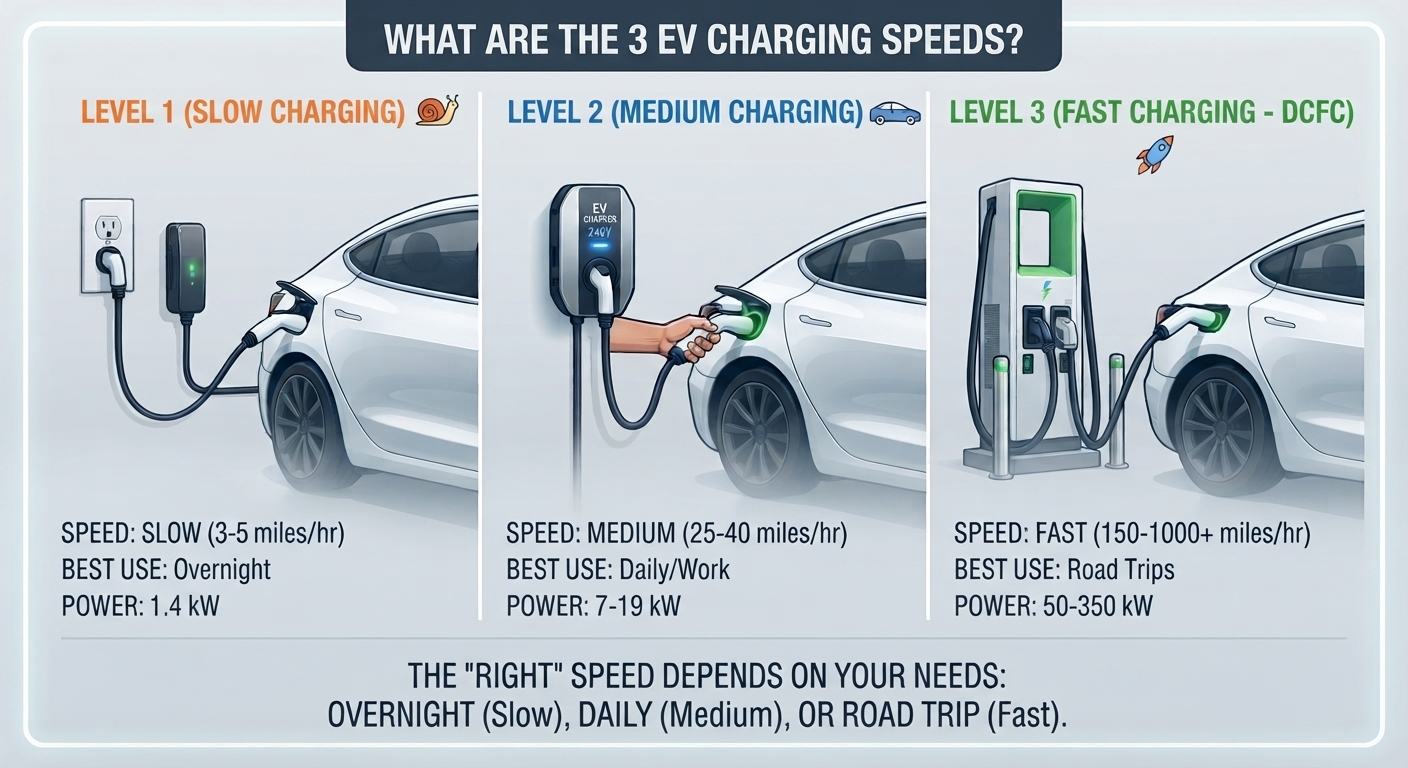
Transitioning to an electric vehicle (EV) is an exciting milestone, but understanding how power delivery works can initially feel overwhelming. Whether you are setting up your garage infrastructure or planning a long road trip, knowing how power goes from the grid into your car’s battery pack is essential. To give you a direct and definitive answer: There are three main levels of electric vehicle charging speeds, categorized by power output and voltage: Level 1, Level 2, and Level 3 (DC Fast Charging).
Each tier serves a distinct purpose, offering different power outputs, installation requirements, and charging durations. A comprehensive understanding of these technologies will help you optimize your daily fueling routine, protect your battery health, and minimize electricity costs.
Let’s dive deep into a complete breakdown of the three EV charging speeds, how they operate, and which one fits your driving lifestyle.
1. Level 1 Charging: The Standard Household Plug (120V)
Level 1 charging is the most basic and accessible method for powering an electric vehicle. It utilizes a standard, everyday household electrical outlet (NEMA 5-15) delivering 120 volts of alternating current (AC).
-
How It Works: Every electric vehicle comes standard with a portable Level 1 cord set (often called a “trickle charger”). One end plugs directly into any standard wall socket in your garage or exterior wall, while the other plugs into your vehicle’s charge port. No special equipment, electrical permits, or professional wiring are required.
-
Power Output and Speed: Level 1 typically delivers between 1.4 kW to 1.9 kW of power (roughly 12 to 16 amps). This translates to a sluggish recovery rate of about 2 to 5 miles of driving range per hour plugged in.
-
Charging Duration: To completely refill a standard 75 kWh battery pack from empty, Level 1 can take anywhere from 40 to 50+ hours.
Who Is Level 1 Best For?
Level 1 is ideal for drivers with very short daily commutes (under 30 to 40 miles round trip), owners of plug-in hybrid electric vehicles (PHEVs) with smaller battery packs, or renters who cannot modify their home’s electrical panel. Because it involves zero installation fees, it serves as an excellent zero-cost temporary or backup solution. However, for full battery-electric vehicles (BEVs) driven daily, its slow pace can be limiting.
2. Level 2 Charging: The Residential and Public Sweet Spot (240V)
Level 2 charging is the gold standard for home ownership and everyday public charging stations. Operating on 240 volts of alternating current (AC)—the exact same high-voltage standard used by heavy household appliances like electric dryers and ovens—Level 2 drastically cuts down charging times.
-
How It Works: Level 2 setups require a dedicated 240V circuit and a mounted wall unit (EVSE) or a hardwired connection installed by a licensed electrician.
-
Power Output and Speed: Output typically ranges from 7 kW to 19.2 kW (drawing anywhere from 32 to 80 amps, depending on your home circuit and vehicle compatibility). This accelerates the refueling process, adding roughly 15 to 30+ miles of range per hour.
-
Charging Duration: A standard Level 2 home setup can completely replenish a depleted EV battery from 0% to 100% in 4 to 10 hours, making overnight charging exceptionally convenient.
To explore the deeper mechanics of hardware variants and power setups, check out our detailed guide on various charging types. Furthermore, modern Level 2 systems often feature integrated software management, allowing you to schedule charging windows during cheap utility hours. To learn more about software optimization and automated scheduling, explore our resource on smart home EV solutions.
Who Is Level 2 Best For?
Level 2 is mandatory for almost all full electric vehicle owners who want seamless daily convenience. It guarantees that your vehicle wakes up with a full battery every single morning, completely eliminating range anxiety for daily driving tasks.
3. Level 3 Charging: DC Fast Charging (DCFC) for Road Trips
Level 3 charging, widely known as DC Fast Charging (DCFC) or direct current fast charging, represents the heavy artillery of the EV fueling ecosystem. It is designed entirely for rapid highway refueling and long-distance travel, rather than residential use.
-
How It Works: Unlike Level 1 and Level 2 (which deliver AC power that your car’s internal charger must convert into DC energy), Level 3 chargers bypass your car’s onboard converter entirely. They convert AC power to DC inside the massive external charging cabinet itself, pumping high-voltage direct current straight into your vehicle’s battery pack.
-
Power Output and Speed: DC Fast Chargers deliver staggering power outputs ranging from 50 kW to 350 kW+. Depending on how much power your specific car model can accept, a DC fast charger can add 100 to 200+ miles of range in just 15 to 30 minutes.
-
Charging Duration: Most modern EVs can charge from 10% to 80% capacity in roughly 20 to 45 minutes, making it ideal for quick pit stops during long road trips.
Who Is Level 3 Best For?
DC fast chargers are located along major interstate corridors, highway travel plazas, and urban commercial centers. They are built for drivers on long-distance journeys or commercial fleet operators who cannot afford hours of downtime. Because of the massive electrical infrastructure required (and the high cost of installation), DC fast chargers are not installed in residential homes.
Summary Table: Comparing the 3 EV Charging Speeds
| Feature | Level 1 (Slow) | Level 2 (Standard) | Level 3 (DC Fast) |
| Voltage | 120V AC (Standard outlet) | 240V AC (Appliance circuit) | 400V–800V DC (Industrial grid) |
| Power Output | 1.4 kW – 1.9 kW | 7 kW – 19.2 kW | 50 kW – 350+ kW |
| Range Added | 2 – 5 miles per hour | 15 – 30+ miles per hour | 100 – 200+ miles in 15–30 mins |
| Full Charge Time | 40 – 50+ hours | 4 – 10 hours | 20 – 45 mins (10%-80%) |
| Location | Home garage | Home, workplace, public | Highway corridors, commercial |
| Installation Cost | $0 (Plug & play) | $500 – $2,000+ | Commercial grade only |
Final Thoughts: Which Speed Do You Need?
Navigating the world of electric vehicles becomes much simpler once you categorize these three tiers based on your daily routine. For everyday commuting and overnight home replenishment, balancing cost and speed with a standard setup is ideal.
If you want to evaluate your home budget, electrical panel capacity, and long-term savings potential, check out our core insights, guides, and expert recommendations at EV Charger Advisor.

















Leave a Reply