
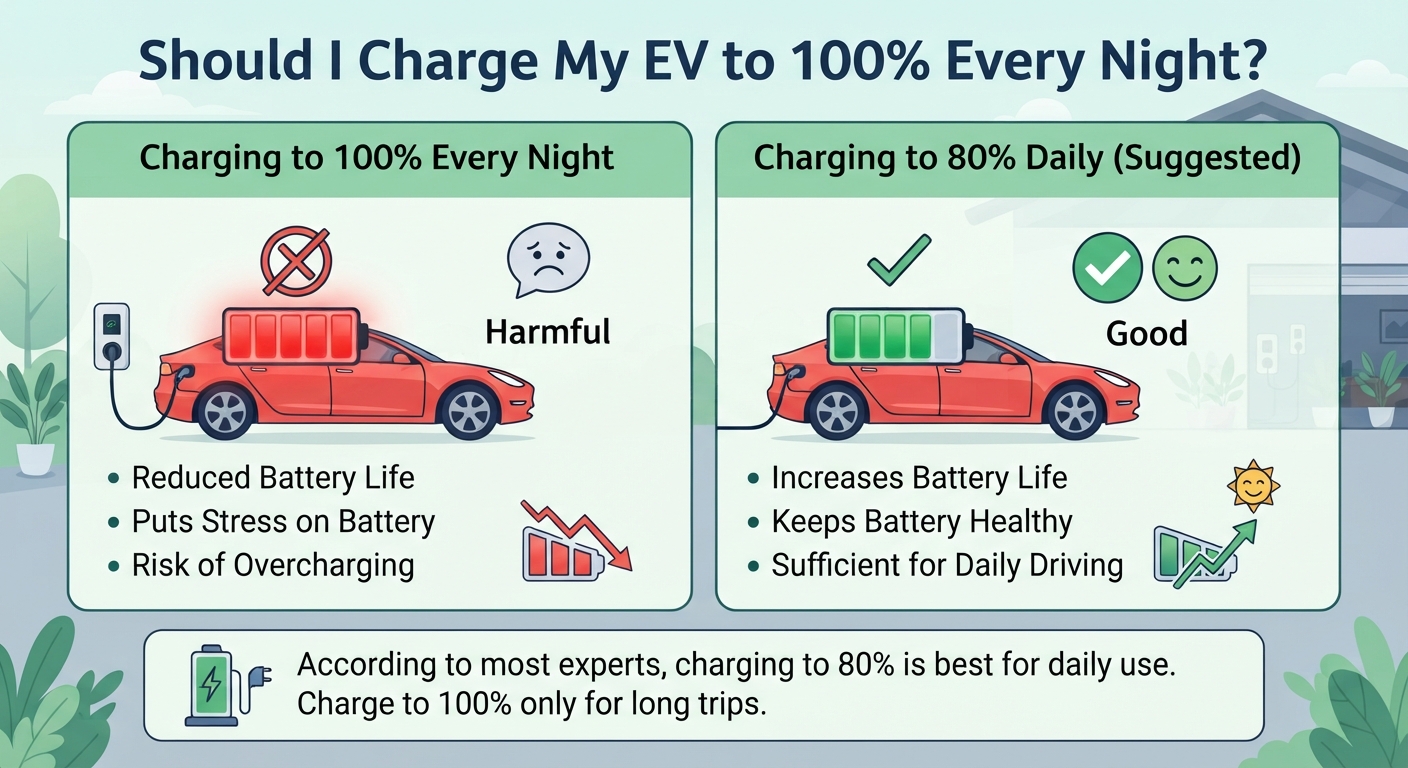
When transitioning to electric vehicle ownership, one of the most common habits drivers carry over from smartphones and consumer electronics is the urge to plug their vehicle in every evening and fill the battery completely. To answer your question directly: No, you should not charge your electric vehicle to 100% every night unless your car uses a specific battery type that requires it.
While charging to full capacity sounds ideal for maximizing your daily driving range, doing so nightly can accelerate the long-term degradation of your lithium-ion battery pack. Modern electric vehicles are engineered with complex battery management systems (BMS), but understanding the chemistry behind daily charging cycles will help you preserve your vehicle’s health, range capacity, and resale value over the years.
Here is an in-depth exploration of why limiting your daily charge matters, how battery chemistry works, and how you can optimize your home charging routine.
1. The Core Battery Science: Why 100% State of Charge (SoC) Creates Stress
To understand why nightly 100% charging is discouraged by almost every major automotive manufacturer, you need to look inside the battery cells. Most modern electric vehicles utilize lithium-ion chemistry, broadly categorized into Nickel Manganese Cobalt (NMC) and Lithium Iron Phosphate (LFP).
-
Chemical Stress at High Voltage: When a lithium-ion battery sits near its maximum state of charge (above 80% to 90%), the internal voltage is at its peak. This high electrical pressure places physical and chemical stress on the cathode and anode materials.
-
The “Sweet Spot” (20% to 80%): Keeping your battery within the middle operational window—typically daily charging capped at 80%—drastically reduces the mechanical degradation of the internal structure.
-
The LFP Exception: If your specific EV features an LFP battery (common in standard-range variants of popular models), manufacturers actually recommend charging to 100% once a week to help the car accurately calibrate its state-of-charge meter, though avoiding it daily is still standard practice for long-term health.
To explore how these different battery types interact with various residential power outputs, read our guide on charging types.
2. Daily Driving Realities vs. Maximum Capacity
Many drivers worry that stopping at 80% will leave them stranded or unprepared for unexpected trips. However, looking at everyday statistics reveals a different picture:
-
Average Daily Commutes: Most drivers travel less than 40 miles per day, which consumes only about 15% to 20% of a standard EV battery capacity.
-
The Redundancy of Full Charges: If your car has a 300-mile range, waking up with 240 miles (80% charge) is more than enough for weekly errands and standard commutes without ever stressing the upper limits of the cells.
-
Resale Value Protection: Batteries are the single most expensive component of an electric vehicle. Minimizing degradation means your vehicle retains a higher battery health percentage (SOH) over a 5-to-10-year ownership period, protecting your investment.
If you want to automate these charging limits so your car stops at 80% automatically every night, you can configure your preferences using insights from our smart home EV solutions guide.
3. When Should You Charge to 100%?
While nightly 100% charging is unnecessary and harmful over time, there are specific scenarios where filling the battery completely is entirely appropriate:
-
Road Trips and Long Distance Travel: If you are embarking on a long highway journey the next morning, charging to 100% right before departure ensures you start with maximum range.
-
Infrequent Driving Schedules: If you only drive your vehicle once a week, you can time your full charge to finish right before you leave, minimizing the time the battery spends sitting idle at maximum voltage.
-
LFP Battery Calibration: Following your automaker’s specific guidelines to balance the cells periodically.
For comprehensive advice on setting up your home garage safely, managing your electricity bills, and choosing the right equipment, explore resources at EV Charger Advisor.
Summary: Best Practices for Your Charging Routine
-
Daily Routine: Set your vehicle’s onboard charging limit to 80% (or 90% depending on manufacturer recommendations) for everyday local driving.
-
Reserve 100%: Only charge to 100% when you have an immediate, long-distance trip planned for the following morning.
-
Avoid Deep Depletion: Try not to let your battery drop below 10% or 20% regularly, as extreme lows combined with extreme highs cause the most rapid cellular wear.

















Leave a Reply