
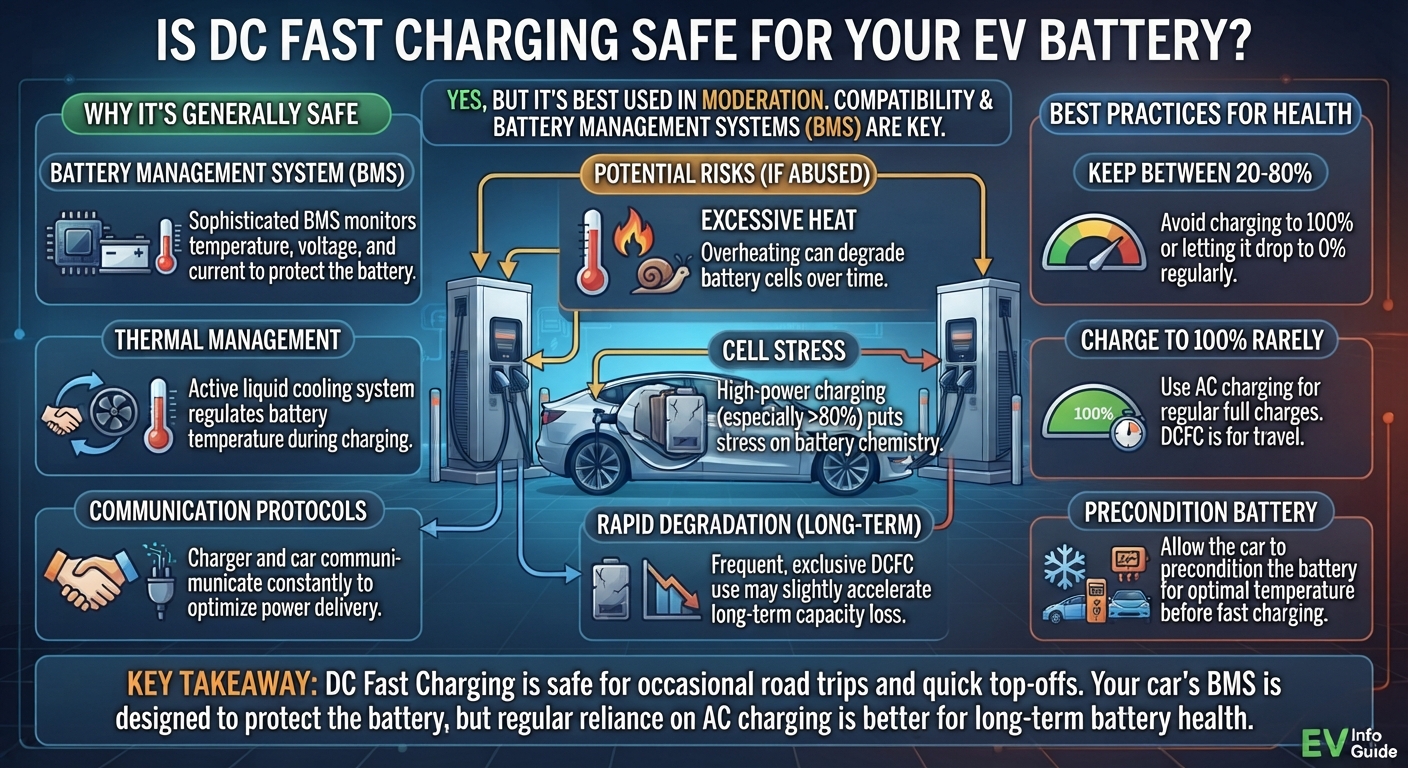
When transitioning to electric vehicle ownership, one of the most persistent myths and anxieties centers around battery health. Many drivers worry that pulling up to a public highway kiosk and blasting their vehicle with hundreds of kilowatts of electricity will instantly wreck their battery pack or cause sudden catastrophic failure. To answer directly: Yes, DC fast charging is safe for your electric vehicle (EV) battery and will not cause sudden failure or catastrophic damage. However, frequent and exclusive use of DC fast chargers can slightly accelerate long-term battery degradation compared to slow AC charging.
Modern electric vehicles are engineered with sophisticated onboard computer systems, active thermal management, and strict safety safeguards. While high-power direct current (DC) charging does place more thermal and electrical stress on lithium-ion cells than a gentle overnight AC wall box, it is completely safe when utilized properly for road trips and busy daily driving schedules.
Here is an extensive, 2000-word comprehensive breakdown examining how DC fast charging interacts with battery chemistry, what recent real-world data reveals about degradation rates, how your car’s Battery Management System (BMS) protects the pack, and best practices to maximize your EV’s long-term lifespan.
1. The Core Truth: Safety vs. Long-Term Wear
To evaluate whether DC fast charging is safe, we must separate immediate hardware safety from long-term chemical aging:
-
Immediate Safety and BMS Protection: You will not instantly ruin your car by plugging into a 150 kW or 350 kW fast charger. Every modern EV is equipped with a computerized Battery Management System that acts as an active gatekeeper. It constantly monitors cell voltage, internal resistance, and temperature, communicating directly with the charging station to ramp power up or throttle it down instantly if any parameter falls outside safe thresholds.
-
The Long-Term Trade-Off: While safe, heavy and exclusive reliance on high-power DC fast charging does introduce additional wear. Recent multi-year fleet telemetry studies indicate that vehicles relying heavily on high-power DC fast charging (>100 kW) for routine daily energy experience an annual capacity degradation rate of roughly 3.0%, compared to about 1.5% for vehicles that primarily utilize home AC charging.
To compare how residential AC equipment handles power delivery with minimal thermal stress, read more about various charging types.
2. The Chemistry of Stress: Why High-Power Charging Generates Heat
To understand why frequent DC fast charging causes slightly faster wear, you have to look at what happens inside lithium-ion cells at a microscopic level:
-
The Ion Rush: During a slow Level 2 AC charge, lithium ions have plenty of time to gently intercalate (nest themselves) into the graphite anode layers. During a high-power DC fast charging session, massive streams of ions are forced across the separator membrane under high electrical current.
-
Thermal Generation: Pushing dozens or hundreds of kilowatts into a compact chemical energy storage container creates internal resistance, which rapidly generates heat. Because heat is the absolute enemy of lithium-ion battery longevity, uncontrolled thermal spikes can degrade the liquid electrolyte and accelerate the breakdown of the cathode and anode materials.
To explore how advanced energy distribution and smart household management interact with these electrical loads to keep everyday charging cool, check out our guide on smart home EV solutions.
3. How Modern EVs Protect Themselves: Active Thermal Management
Vehicle manufacturers are well aware of the thermal challenges associated with rapid charging, which is why modern EVs feature advanced engineering defenses:
-
Liquid-Cooled Battery Packs: Unlike older compliance cars that relied on passive air cooling (which suffered heavily in hot climates), modern BEVs utilize dedicated liquid-cooling loops running glycol-based coolant through the battery pack. During a fast-charging session, the car actively chills the fluid to keep cell temperatures within the optimal window (typically between 25°C and 45°C).
-
Automated Charging Curves (Throttling): Have you ever noticed that your EV charges extremely fast from 10% to 50%, but slows down dramatically as it approaches 80%? This is an intentional feature called a charging curve. As the battery fills up, internal resistance rises, making it harder to absorb energy safely. The vehicle’s BMS automatically lowers the incoming amperage to eliminate heat stress during the final 20% of the session.
For comprehensive insights on EV infrastructure planning, battery safety standards, and expert advisory services, visit us at EV Charger Advisor.
4. Real-World Data: What Fleet Telemetry Teaches Us
Rather than relying on worst-case theoretical scenarios, large-scale studies tracking tens of thousands of real-world electric vehicles offer reassuring clarity:
-
Batteries Outlive the Vehicle: Fleet analytics show that average modern battery capacity degradation sits at roughly 2.3% per year. This means a typical vehicle retaining an average degradation rate will still hold over 80% of its original factory capacity after 8 to 10 years—frequently outlasting the primary ownership lifecycle of the car itself.
-
The 12% Threshold: Data suggests that occasional road-trip fast charging has a negligible, nearly invisible impact on long-term health. The measurable jump in degradation primarily occurs when vehicles rely on high-power DC fast charging for more than 10% to 12% of their total cumulative lifetime charging sessions.
5. Best Practices: How to Balance Speed and Battery Health
You do not need to avoid DC fast chargers, but adopting a few smart habits will ensure your battery stays healthy for hundreds of thousands of miles:
-
Prioritize Home AC Charging for Daily Commutes: Whenever possible, use a residential Level 2 charger overnight. It is cheaper, gentler, and keeps thermal stress near zero.
-
Reserve DC Fast Charging for Road Trips: Use public fast chargers when traveling long distances or when you are pressed for time, but avoid making them your exclusive 7-day-a-week charging routine.
-
Avoid Storing at Extremes: Try not to leave your car sitting at 100% state-of-charge in hot weather for extended periods, and avoid draining the pack down to 0% repeatedly.
Summary: Is It Safe?
-
Yes, absolutely safe. DC fast charging will not suddenly ruin your car or cause catastrophic failure.
-
Modern thermal management and battery management systems protect your pack automatically, making DC fast charging an indispensable tool for modern electric vehicle travel.

















Leave a Reply