
When transitioning to electric vehicle ownership, understanding home electrical specifications can feel like learning a brand-new language. One of the most frequently asked questions by new EV owners is: Is 240V a Level 2 EV charger?
To give you a direct and accurate answer: Yes, a 240-volt (240V) power supply or outlet is what powers a Level 2 EV charger. While the 240V outlet itself is simply a high-capacity electrical source (the same kind used by heavy household appliances like electric dryers or ovens), it serves as the essential foundational infrastructure required to deliver Level 2 charging speeds to your electric vehicle.
However, a 240V outlet and a Level 2 EV charger are two distinct components that work together. Let’s dive deep into how 240V power operates, why it is mandatory for Level 2 setups, and how it transforms your home charging experience.
1. The Core Relationship: What Makes a Charger “Level 2”?
To understand how residential charging speeds are categorized, we have to look at electrical voltage standards:
-
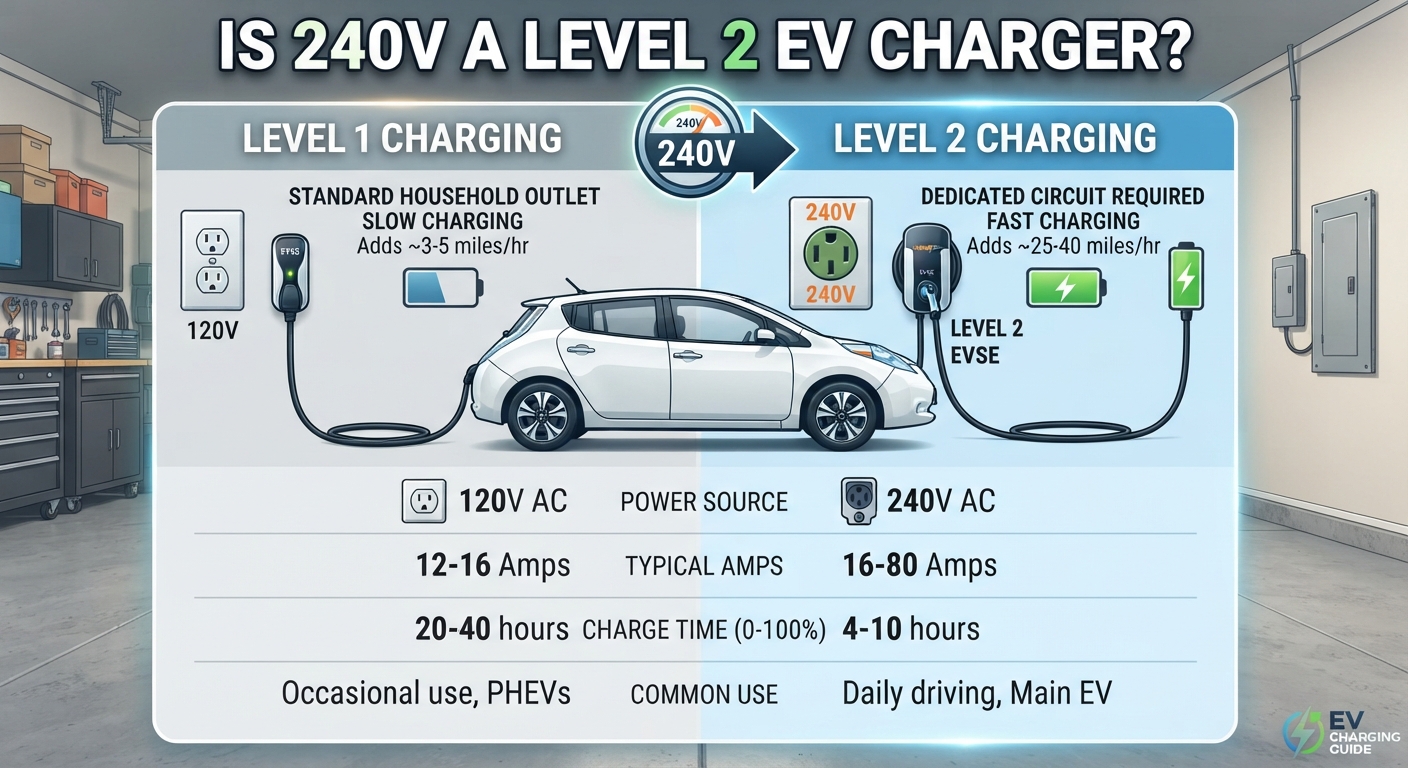
Level 1 Charging (120V): Uses a standard, everyday household three-prong outlet. It delivers a slow trickle of power, typically adding only 2 to 5 miles of range per hour. It requires zero electrical modifications but can take 40 to 50 hours to fully charge a depleted EV battery.
-
Level 2 Charging (240V): Steps up the voltage to 240 volts, matching the heavy-duty circuits found in North American homes. By doubling the voltage and utilizing higher amperage (usually 16 to 80 amps), Level 2 equipment delivers significantly faster energy flow.
Because standard residential grids in North America supply 120V to normal wall sockets, tapping into 240V power requires a dedicated circuit installed by a professional electrician. Without this 240V supply, true Level 2 charging speeds are physically impossible.
To explore how these different infrastructure tiers compare in daily usage, read more about various charging types.
2. Is a 240V Outlet the Same as a Level 2 Charger?
This is where many homeowners get confused. A 240V outlet (such as a NEMA 14-50 or NEMA 6-50 receptacle) is just a specialized wall socket. On its own, it cannot charge a car safely without an intermediary device.
A complete Level 2 charging setup consists of three main elements:
-
The 240V Electrical Circuit: A dedicated heavy-duty breaker and wiring running from your home’s main electrical panel to your garage or parking spot.
-
The EVSE (Electric Vehicle Supply Equipment): Commonly called the “charger” or wall unit, this box plugs into the 240V outlet (or is hardwired directly to the circuit). It acts as a smart safety gate, managing communication between your home’s grid and the car’s battery.
-
The Onboard Charger (OBC): Built directly inside your electric vehicle, this component takes the 240V AC power supplied by the EVSE and converts it into DC power to actually store inside the battery pack.
For homeowners looking to integrate these components cleanly into automated home energy networks, you can explore advanced options detailed in our guide on smart home EV solutions.
3. Benefits of Upgrading to a 240V Level 2 Setup
Investing in a 240V home infrastructure unlocks massive efficiency and lifestyle benefits:
-
Blazing Fast Speeds: While Level 1 leaves you waiting days, a 240V Level 2 setup adds 20 to 40 miles of range per hour, reducing full charge times down to just 4 to 8 hours.
-
Overnight Convenience: You can plug your car in right before bed and wake up to a 100% charged battery every single morning, completely bypassing public charging stations.
-
Utility Cost Savings: Because 240V chargers replenish your battery quickly, you can easily program your vehicle to charge exclusively during late-night hours when local utility companies offer deeply discounted off-peak electricity rates.
4. What Do You Need to Install a 240V Level 2 Charger?
Before buying hardware or calling an electrician, you must evaluate your home’s electrical capacity:
-
Panel Capacity: Most modern homes feature 200-amp electrical panels capable of supporting a 240V dedicated circuit. Older homes with 100-amp panels may require a panel upgrade to handle the continuous load.
-
Plug-in vs. Hardwired: You can choose a plug-in unit (using a 240V outlet like a NEMA 14-50) for flexibility, or a hardwired unit, which is permanently wired into your breaker box for maximum weather resistance and safety.
If you are trying to weigh equipment costs, installation requirements, and long-term savings, visit our main resource hub at EV Charger Advisor.
Summary: The Bottom Line
-
Yes, 240V power is the backbone of Level 2 charging. You cannot achieve Level 2 speeds without a 240V electrical source.
-
Upgrading to a 240V dedicated circuit turns your home into a private fueling station, saving you time, eliminating range anxiety, and maximizing your EV ownership experience.

















Leave a Reply