
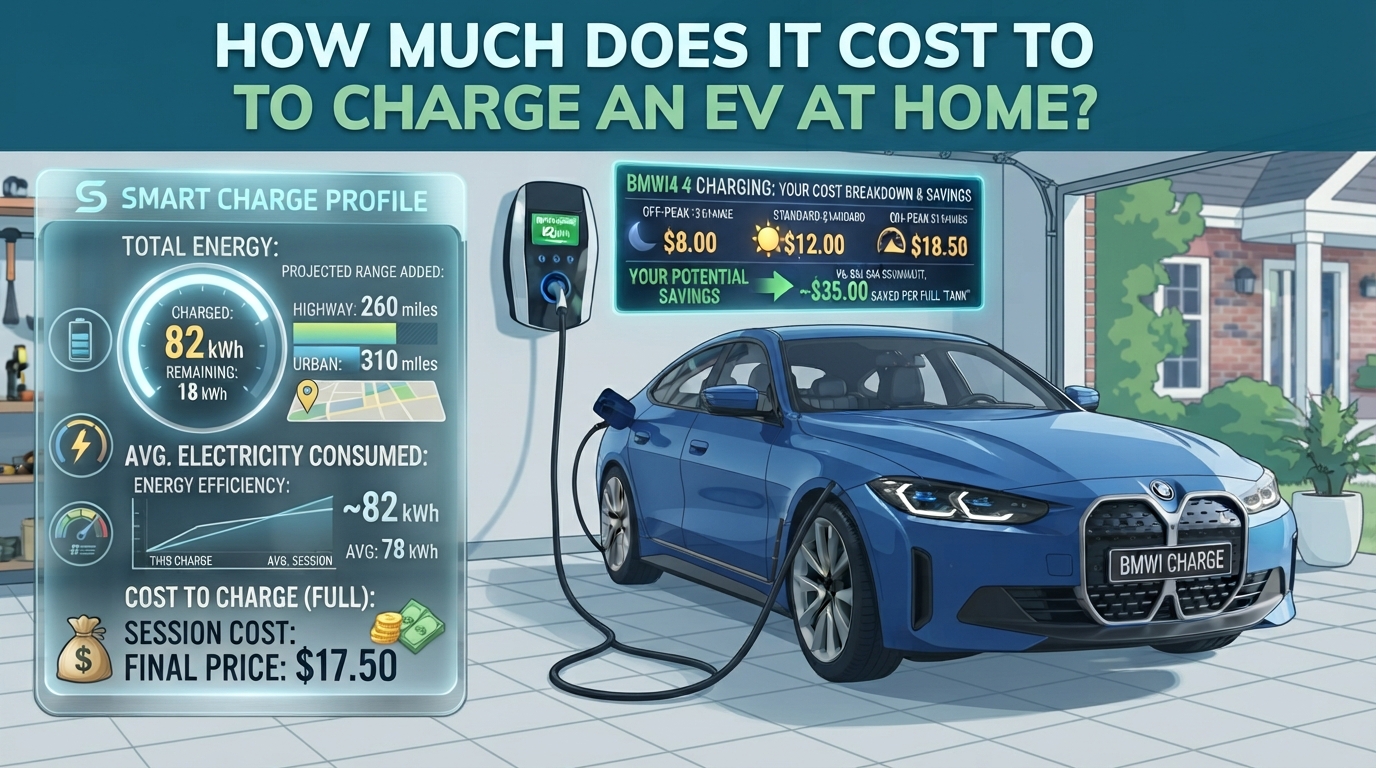
Charging an EV at home costs about 5 to 6 cents per mile in the US. For a typical driver covering 1,000 miles a month, that’s roughly $55 a month, based on an average residential rate of about 18 cents per kilowatt-hour (kWh). A full charge of a 75 kWh battery costs about $13.50.
Prices are in US dollars and reflect 2026 averages. Your actual cost depends on your electricity rate, so use the formulas below with your own numbers. They work in any country.
The Simple Formula for Home EV Charging Cost
Cost per mile = (your EV’s kWh per 100 miles ÷ 100) × your electricity rate per kWh
Most EVs use between 24 and 43 kWh per 100 miles. A typical crossover uses about 30.
Example: 30 kWh per 100 miles at $0.18 per kWh = $5.40 per 100 miles, or about 5.4 cents per mile. Add roughly 10% for energy lost during charging and you land close to 6 cents per mile.
By vehicle type, at 18 cents per kWh:
- Efficient sedan (about 24 kWh/100 mi): about $4.30 per 100 miles
- Typical crossover (about 30 kWh/100 mi): about $5.40 per 100 miles
- Electric pickup (about 43 kWh/100 mi): about $7.70 per 100 miles
How Much Does a Full Charge Cost?
Multiply your battery size by your electricity rate. At 18 cents per kWh:
| Battery size | Cost for a full charge (0–100%) |
|---|---|
| 40 kWh | About $7.20 |
| 60 kWh | About $10.80 |
| 75 kWh | About $13.50 |
| 100 kWh | About $18.00 |
These figures are before charging losses. Most drivers don’t charge from empty to full, so a typical top-up costs less.
How Much Does Home Charging Cost per Month and per Year?
Your electricity rate makes the biggest difference. This table assumes an EV that uses 30 kWh per 100 miles and 12,000 miles per year.
| Example rate | Cost per 100 miles | Per month (1,000 miles) | Per year (12,000 miles) |
|---|---|---|---|
| Low-rate area (about 12¢/kWh) | $3.60 | $36 | $432 |
| US average (about 18¢/kWh) | $5.40 | $54 | $648 |
| High-rate area (about 30¢/kWh) | $9.00 | $90 | $1,080 |
| Very high-rate area (about 42¢/kWh) | $12.60 | $126 | $1,512 |
Rates vary widely by state. Recent federal data put the lowest state averages near 12 cents per kWh and the highest above 40 cents, so check your own bill.
Why Your Cost May Be Higher or Lower
- Your electricity rate. Look at the price per kWh on your bill. This matters more than anything else.
- Time-of-use pricing. Many utilities charge less at night. If you charge overnight on a time-of-use or EV plan, your cost can drop.
- Tiered pricing and fixed fees. Extra EV usage can push you into a higher pricing tier on some plans.
- Your vehicle’s efficiency. A compact sedan uses far less energy per mile than a large truck or SUV.
- Weather and driving style. Cold weather, highway speeds and heavy loads all raise energy use.
- Charging losses. Roughly 10% of the energy from the wall is lost as heat.
Home Charging vs. Public Charging
Home charging is usually the cheapest way to charge. Public fast chargers often cost 30 to 48 cents per kWh. At 30 kWh per 100 miles, that works out to about $9 to $14.40 per 100 miles, compared with about $5.40 at home.
As a comparison, a 30-mpg gas car at roughly $3.50 a gallon costs about 12 cents per mile. That’s more than double typical home EV charging. Learn more about the options in our DC fast charging articles.
Does Level 1 or Level 2 Change the Cost?
Mostly no. You pay for the energy you use, measured in kWh, whatever the charger. What changes is speed. A Level 1 outlet is slow, and a Level 2 charger is much faster. The main extra cost of Level 2 is the one-time installation. See our guides on how much it costs to install an EV charger and how many amps you need for a Level 2 EV charger.
How to Calculate Your Own Home Charging Cost
- Find your rate. Check your electric bill for the price per kWh.
- Find your EV’s efficiency. Look up its kWh per 100 miles (EPA rating).
- Multiply. Efficiency ÷ 100 × your rate = cost per mile.
- Multiply by your miles. Cost per mile × monthly miles = monthly cost.
- Add about 10% for charging losses.
How to Lower Your Home Charging Cost
- Charge off-peak. Ask your utility about time-of-use or EV rate plans.
- Schedule charging. Most EVs and smart chargers let you set a start time.
- Check utility rebates. Some utilities offer rebates or special EV rates.
- Drive efficiently. Smooth driving and moderate speeds use less energy.
- Precondition while plugged in. Heating or cooling the car on grid power saves battery energy.
- Avoid unnecessary full charges. Charge only what you need for the day.
Is Charging at Home Worth It?
For most owners, yes. It’s cheaper per mile than gas and public fast charging, and you wake up to a full battery. If you’re deciding whether to install a faster charger, read is installing a Level 2 EV charger worth it?
Frequently Asked Questions
How much does it cost to charge an EV at home?
About 5 to 6 cents per mile at the US average rate, or roughly $55 a month for 1,000 miles.
How much does it cost to fully charge an EV at home?
It depends on the battery. At 18 cents per kWh, a 60 kWh battery costs about $10.80 and a 75 kWh battery about $13.50.
How much does it cost to charge an EV for a month?
Around $55 for 1,000 miles at the national average. It can range from about $36 to over $120 depending on your rate.
Is it cheaper to charge an EV at home than at a public charger?
Usually yes. Public fast charging often costs significantly more per kWh than home electricity.
Is it cheaper to charge an EV at night?
It can be, if your utility offers time-of-use or EV rates with lower overnight prices.
Does charging an EV raise my electric bill a lot?
It raises it by the cost of the extra kWh. For 1,000 miles a month, that’s about 300 kWh, or around $55 at average rates.
Does a Level 2 charger cost more to use than a regular outlet?
No. You pay for the same kWh. Level 2 just charges faster.
How can I calculate my EV charging cost?
Multiply your EV’s kWh per 100 miles by your electricity rate, divide by 100, then multiply by the miles you drive.
Final Takeaway
At average US rates, charging at home costs about 5 to 6 cents per mile, or around $55 a month. Your rate, vehicle and charging schedule decide the final number, so run the formula with your own bill.
Have a question about your setup? Contact us, or browse our Level 2 charging articles and Level 1 charging guides.
Disclaimer: Costs are estimates and vary by location, utility plan and vehicle. Check your own electricity rate for an accurate figure.

















Leave a Reply