
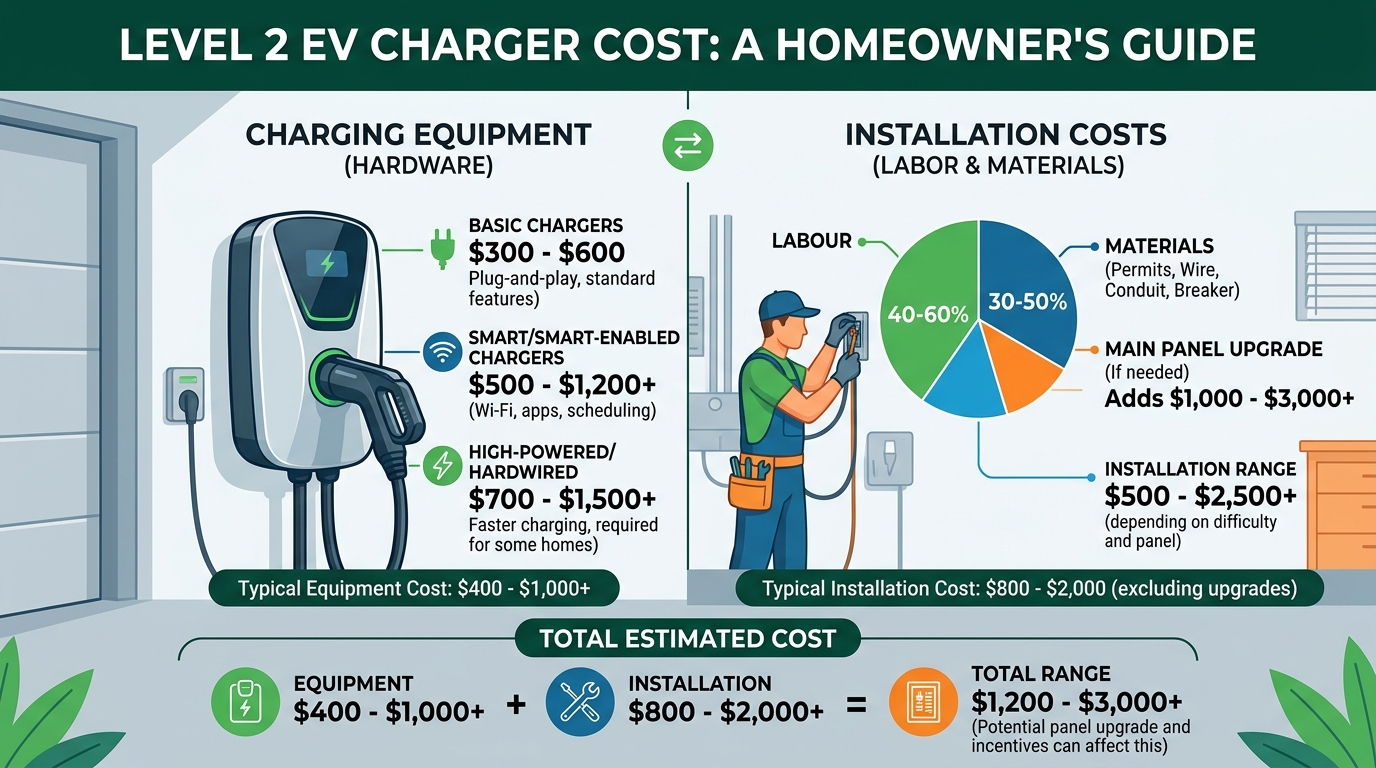
When transitioning to electric vehicle ownership across Europe, installing a reliable home or destination charging solution is one of the most practical investments you can make. To answer directly: A Level 2 EV charger in Europe costs between €350 and €1,200 for the hardware unit alone, while complete professional installations typically range from €800 to €3,200 depending on power ratings, three-phase electrical requirements, and smart connectivity features.
While basic single-phase 7.4 kW home wallboxes remain accessible for standard residential garages, high-power 11 kW and 22 kW three-phase systems—widely utilized across European households and commercial destinations—demand a larger financial and electrical commitment.
Here is an extensive, comprehensive 2000-word guide detailing hardware pricing tiers across European markets, professional installation labor, electrical safety certifications, regional grants, and total cost of ownership.
1. Hardware Unit Cost Breakdown Across Europe
The physical charging box—often referred to as an EVSE or wallbox—represents the first major component of your total expenditure. Across the European market, hardware pricing varies heavily based on power delivery capacity and smart software integration:
-
Basic Single-Phase Units (3.7 kW to 7.4 kW): Ranging from €350 to €600, these entry-level wallboxes are designed for standard single-phase home grids. They connect to 230V supplies and provide a reliable, steady stream of overnight power suitable for plug-in hybrids (PHEVs) and standard battery-electric vehicles (BEVs). Popular models in this tier include basic variants from Wallbox, Easee, and Rolec.
-
Smart-App Enabled Residential Units (7.4 kW to 11 kW): Priced between €600 and €1,200, these units add Wi-Fi connectivity, Bluetooth app control, solar panel integration, and dynamic load-balancing capabilities. Models like the Tesla Wall Connector, Ohme Home Pro, and Myenergi Zappi dominate this category, allowing European homeowners to track energy usage and schedule charging sessions during cheap tariff windows.
-
Commercial and Heavy-Duty Three-Phase Units (22 kW): Ranging from €2,500 to €5,500+, these heavy-duty units are engineered for multi-unit dwellings, commercial fleets, and public destination parking lots. They require a robust three-phase AC supply (400V) and feature advanced RFID authorization, OCPP (Open Charge Point Protocol) backend connectivity, and commercial billing software.
To understand how residential AC charging infrastructure compares to public DC fast-charging networks, read more about various charging types.
2. Professional Installation Labor and Electrical Materials
Purchasing the wallbox hardware is only the first step. In almost every European nation, hiring a certified electrician is legally mandatory to ensure safety compliance, validate insurance coverage, and secure local electrical certificates:
-
Standard Labor Costs (€300 to €800+): If your distribution board is close to your parking space and your home’s electrical capacity is modern, a certified electrician can complete a standard installation in 3 to 5 hours. Labor fees typically occupy this baseline range across major European countries like Germany, France, Spain, and the UK.
-
Cabling and Protective Materials (€150 to €500): Running high-grade armored cables (such as NYY-J or XLPE cables), installing PVC conduits, and mounting dedicated Type A or Type B RCD circuit breakers in your main fuse box add immediate material expenses. Long cable runs from the meter box to a detached garage or outdoor driveway can push material costs toward the higher end of this spectrum.
-
Legalization and Certification (€80 to €200): In many European jurisdictions (such as Spain’s Boletín Eléctrico or standard safety sign-offs in Germany and the UK), official certification of the new electrical circuit is legally required to finalize the installation and validate equipment warranties.
To explore how advanced energy distribution, load management, and smart household automation interact with these electrical loads, check out our guide on smart home EV solutions.
3. Country-Specific Variations and Three-Phase Grid Realities
The total cost of deploying a Level 2 charger in Europe is heavily influenced by regional electrical grids and local market dynamics:
-
The Dominance of Three-Phase Power: Unlike North American homes that predominantly rely on split-phase 240V grids, many European homes—particularly in Germany, Austria, Switzerland, and Scandinavia—feature standard three-phase 400V electrical supplies. This allows homeowners to install 11 kW or 22 kW chargers, cutting full vehicle charging times down to just 3 to 6 hours.
-
National Price Discrepancies: While countries in Eastern and Southern Europe may see slightly lower labor rates, strict electrical regulations and high equipment import taxes in Western and Northern Europe can elevate total turnkey installation packages above €2,500.
For comprehensive insights on EV infrastructure planning, safety standards, and expert advisory services, visit us at EV Charger Advisor.
4. Government Subsidies, Grants, and Tax Incentives
To accelerate the adoption of electric mobility, various European governments and regional municipalities offer financial incentives that dramatically reduce the net out-of-pocket cost for homeowners:
-
National and Regional Grants: Programs such as Spain’s Plan MOVES III, regional grants in Germany (KfW historical schemes and state-level incentives), and UK OZEV workplace and residential schemes have historically offered cash rebates or tax deductions covering 30% to upwards of 70%—and in some rural districts, 80%—of the total purchase and installation invoice.
-
Navigating Subsidy Requirements: Most subsidy programs mandate that the charger must be “smart” (capable of grid communication and load management) and installed by a certified, licensed professional electrician to qualify for reimbursement.
Summary: What to Expect When Budgeting
-
Budget between €350 and €1,200 for hardware alone, depending on whether you choose a basic single-phase plug or an advanced three-phase smart unit.
-
Expect total turnkey installation costs (including labor, cables, circuit breakers, and certification) to land between €800 and €3,200 across most European regions.

















Leave a Reply