
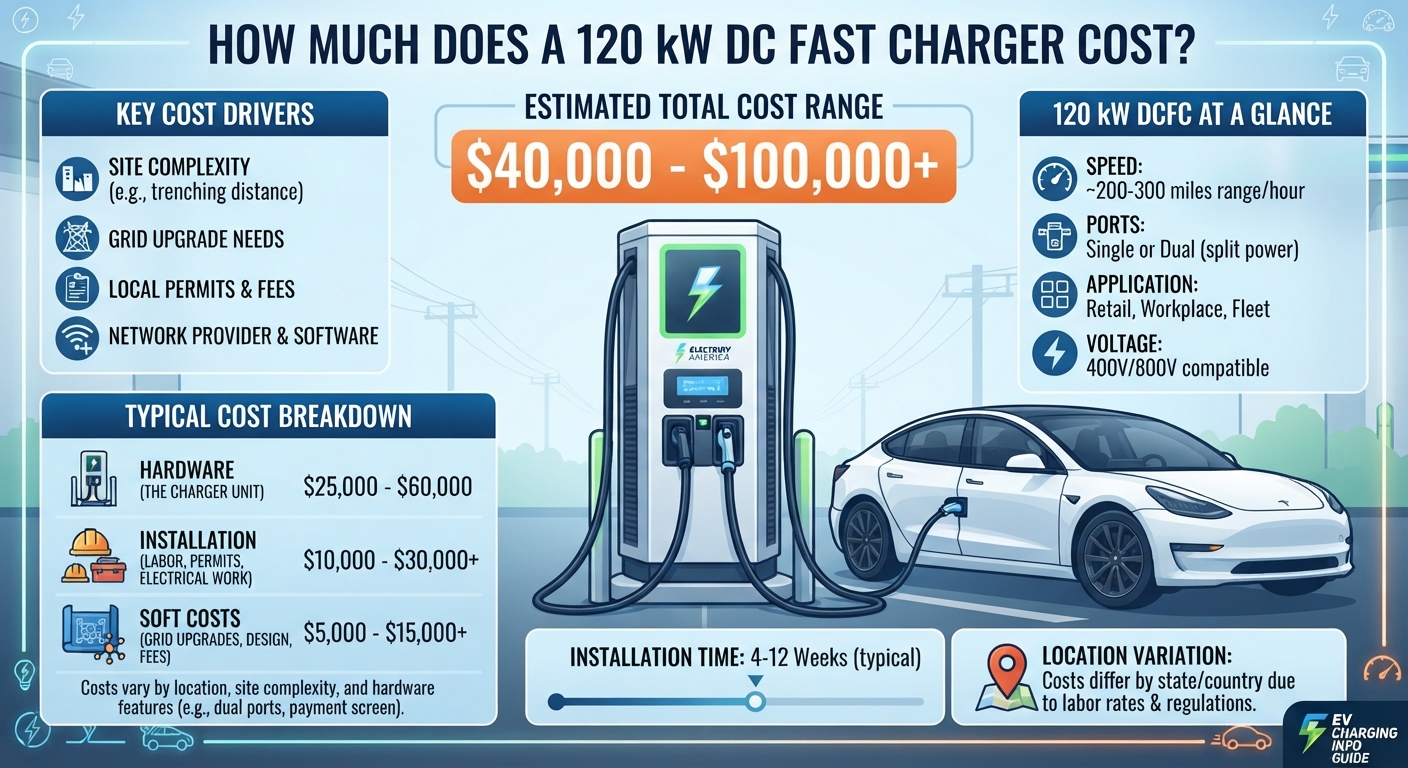
When business owners, commercial property managers, fleet operators, or retail investors look into expanding their infrastructure with high-speed public energy solutions, understanding capital expenditure is critical. To answer directly: A 120 kW DC fast charger hardware unit generally costs between $8,000 and $20,000 USD when sourcing directly from global commercial manufacturers.
However, looking at the hardware price tag alone only tells part of the financial story. For an end-user or business deploying a fully operational public station, the total procurement, civil engineering, electrical installation, permitting, and software integration costs typically range anywhere from $35,000 to $75,000+ per station.
Deploying a commercial-grade direct current fast-charging (DCFC) station is a massive infrastructure undertaking. Unlike residential Level 2 chargers that plug into standard 240V household outlets, 120 kW rapid chargers require industrial-scale engineering. Below is an extensive, thorough breakdown of every financial component, hardware variable, installation expense, and ongoing operational fee associated with deploying a 120 kW commercial EV charging hub.
1. Hardware Breakdown: Analyzing Unit Costs ($8,000 to $20,000)
The physical charging cabinet—often comprising power conversion modules, liquid-cooling systems, heavy-duty cables, CCS/NACS connectors, touchscreens, and payment terminals—represents your initial capital outlay.
-
Entry-Level & Direct-Import Commercial Cabinets: Basic 120 kW DC fast chargers sourced from overseas manufacturers can sometimes start around $8,000 to $12,000. However, buyers must account for expensive international shipping freight, import tariffs, customs clearance fees, and the absence of localized warranty support.
-
Tier-1 Branded Commercial Hardware: Premium hardware built by reputable global manufacturers typically commands between $15,000 and $20,000+ per unit. These premium cabinets offer rugged weatherproofing, high uptime reliability ratings, integrated credit card processing terminals (required by many state laws), and compliance with strict UL and safety certifications.
To understand how high-power commercial equipment differs from standard residential setups, read our guide on various charging types.
2. Civil Works and Infrastructure Construction ($10,000 to $25,000)
Buying the physical charger is only the first step. Preparing the physical site to safely host an industrial electrical appliance requires heavy civil engineering:
-
Trenching, Concrete, and Bollards: Contractors must excavate the ground to run heavy underground conduits, pour reinforced concrete pads capable of supporting heavy cabinets, and install protective steel safety bollards to prevent vehicle collisions.
-
ADA Compliance and Lighting: Public stations require accessible parking spaces, proper striping, wheelchair clearance ramps, and overhead lighting for nighttime safety, adding significant labor and material expenses to the initial project phase.
3. Electrical Upgrades and Transformer Costs ($15,000 to $30,000+)
The single largest hidden cost in commercial EV charging deployment is grid connectivity. A 120 kW charger pulls an immense amount of continuous electrical current:
-
Utility Service Capacity: Most standard commercial buildings or retail parking lots do not have enough spare electrical capacity to feed 120 kW on demand.
-
Dedicated Transformers and Switchgear: Property owners frequently have to pay local utility companies to install a dedicated commercial transformer, heavy-duty switchgear, and robust distribution panels. Depending on how far the grid lines are from the parking spot, utility interconnect fees alone can skyrocket.
For insights on managing commercial energy loads and site efficiency, explore our resources on smart home EV solutions.
4. Software, Networking, and Ongoing Operational Costs
Once the charger is physically bolted down and powered up, maintaining operations involves recurring software and administrative fees:
-
Cloud Network SaaS Subscriptions: Remote diagnostics, billing processing, RFID card authentication, and driver mobile apps require annual software licensing fees, typically costing hundreds of dollars per port each year.
-
Commercial Demand Charges: Commercial utility billing structures often include peak demand fees—financial penalties levied by utility companies based on the maximum kW drawn at any single moment. If station utilization is low, these monthly demand charges can severely drain profitability.
To evaluate broader infrastructure budgets, safety standards, and project consulting, visit EV Charger Advisor.
Summary: Total Financial Investment
-
Expect a total turnkey project cost between $35,000 and $75,000+ per 120 kW station once civil work, permits, and electrical upgrades are fully completed.
-
Always conduct a thorough utility interconnection feasibility study before purchasing hardware to avoid unexpected high-voltage grid connection fees.

















Leave a Reply