
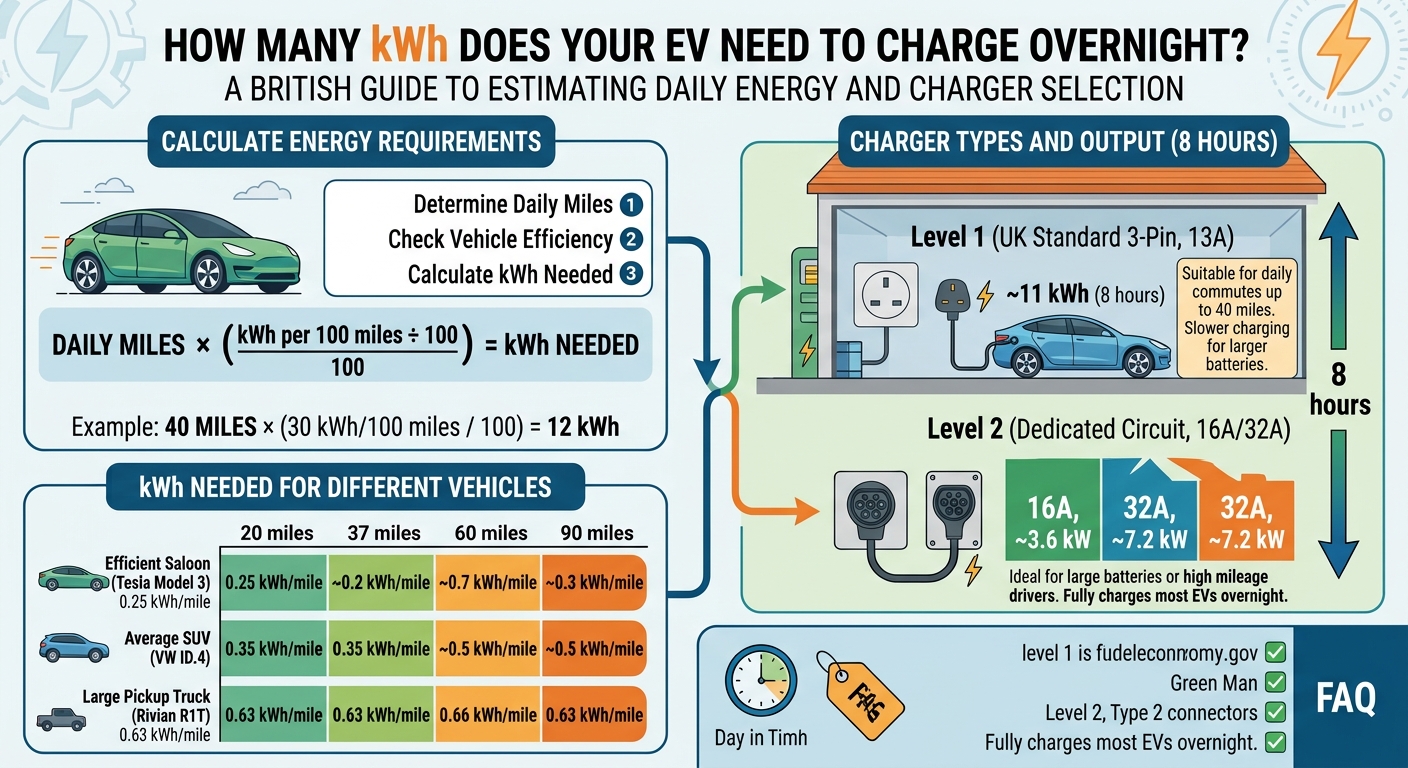
Most drivers need about 10-15 kWh overnight, enough to cover roughly 37 miles of daily driving in an average EV. Your own number can range from under 10 kWh for an efficient car to over 20 kWh for a large truck. Here’s how to work it out.
The formula
Daily miles × kWh per 100 miles ÷ 100 = kWh needed
For example, 40 miles a day in a car that uses 30 kWh per 100 miles needs 12 kWh. That’s your energy budget for the night, not your battery’s total capacity.
The average American drives about 37 miles a day, and the average EV uses about 0.35 kWh per mile, which works out to roughly 13 kWh a day. An efficient EV using 0.25 kWh per mile would need about 9 kWh, while a big electric pickup at 0.63 kWh per mile would need about 23 kWh.
You’ll find your car’s kWh per 100 miles rating on fueleconomy.gov.
kWh needed by daily miles
| Daily miles | Efficient EV (0.25 kWh/mi) | Average EV (0.35 kWh/mi) | Large truck/SUV (0.63 kWh/mi) |
|---|---|---|---|
| 20 | 5 kWh | 7 kWh | 13 kWh |
| 37 | 9 kWh | 13 kWh | 23 kWh |
| 60 | 15 kWh | 21 kWh | 38 kWh |
| 90 | 23 kWh | 32 kWh | 57 kWh |
Figures are rounded and based on the formula above.
How much can your charger deliver overnight?
Energy delivered is simply charger power × hours. Over an 8-hour night:
| Charger | Power | kWh delivered in 8 hours |
|---|---|---|
| Level 1 (120V outlet) | ~1.4 kW | ~11 kWh |
| 32A Level 2 | 7.7 kW | ~62 kWh |
| 40A Level 2 | 9.6 kW | ~77 kWh |
| 48A Level 2 | 11.5 kW | ~92 kWh |
These are my calculations. Your car’s onboard charger can also cap the real rate.
You can also work backwards. If you need 13 kWh in an 8-hour window, you need about 1.6 kW of average charging power (13 ÷ 8).
Is Level 1 enough?
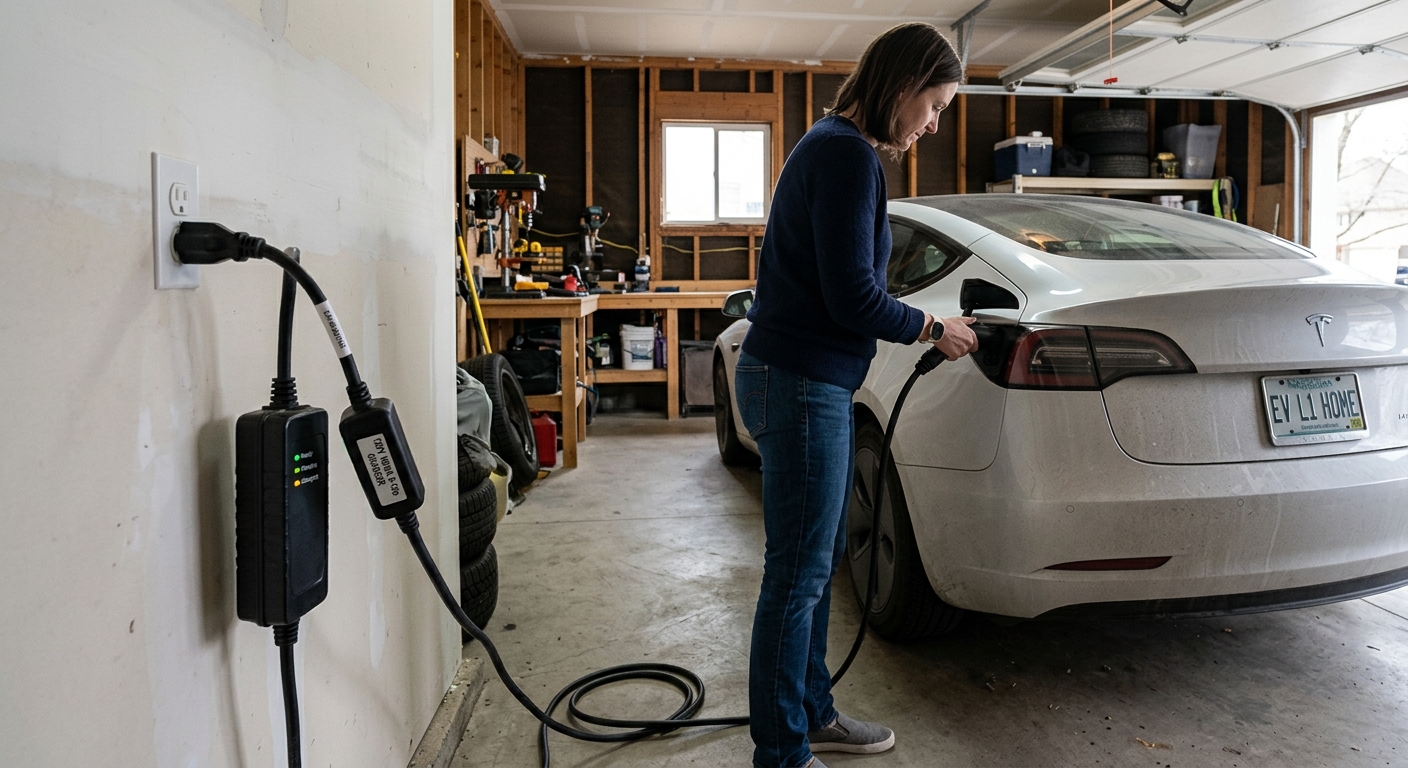
For some drivers, yes. The Department of Energy says many owners can meet their daily driving needs with overnight Level 1 charging, provided there’s a suitable outlet. At about 11 kWh per 8-hour night, Level 1 is borderline for an average driver, comfortable for an efficient car on a short commute, and not enough for 60+ miles a day.
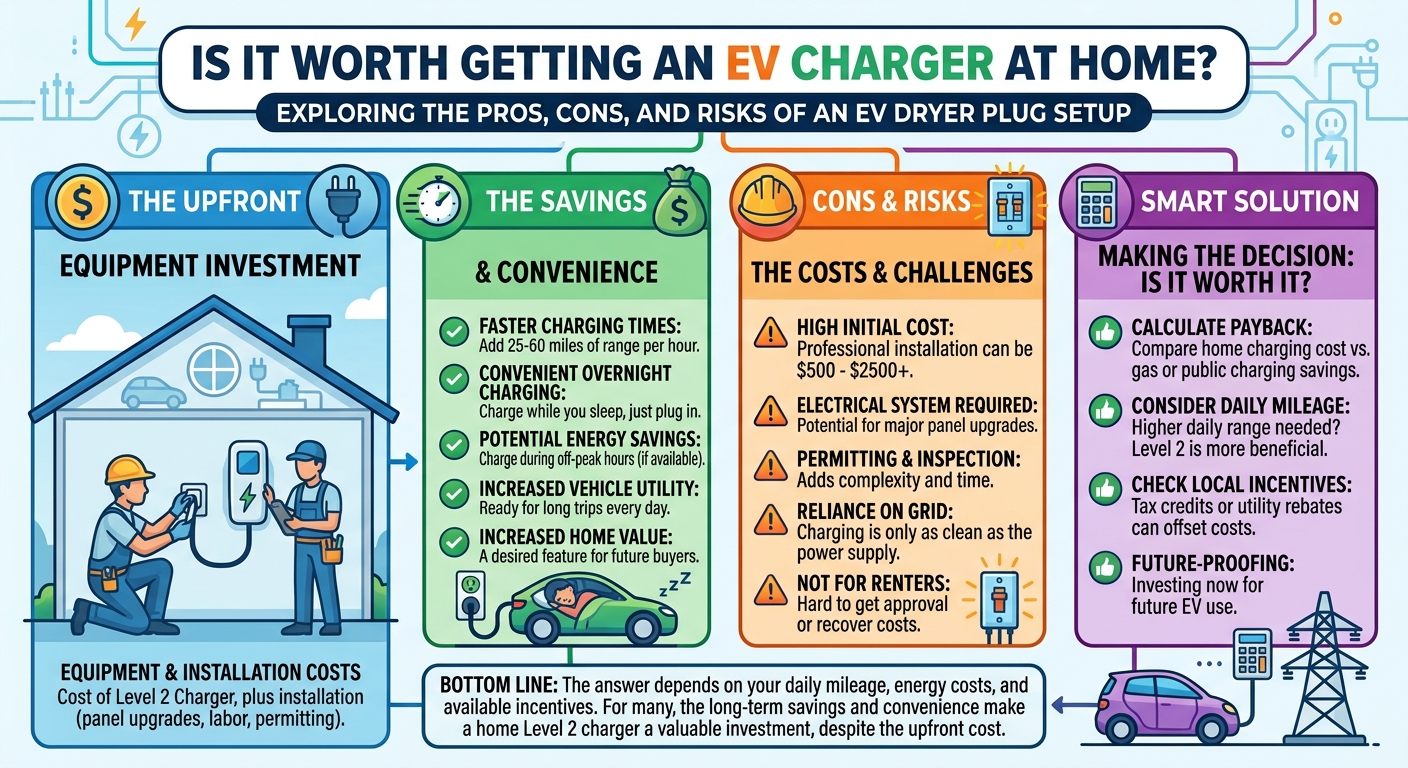
If you drive a lot, own a large vehicle, or want a safety margin on busy days, Level 2 is the safer choice.
Not sure which fits your driving? [CTA: Compare Level 2 home chargers → INSERT VERIFIED URL]
What if you want a full charge?
Most EV batteries range from about 40 kWh to over 100 kWh. A Tesla Model Y, for example, needs about 67-90 kWh from the wall for a full charge, depending on trim. On Level 2, many 11.5 kW-capable models can fill up overnight in about 8 hours.
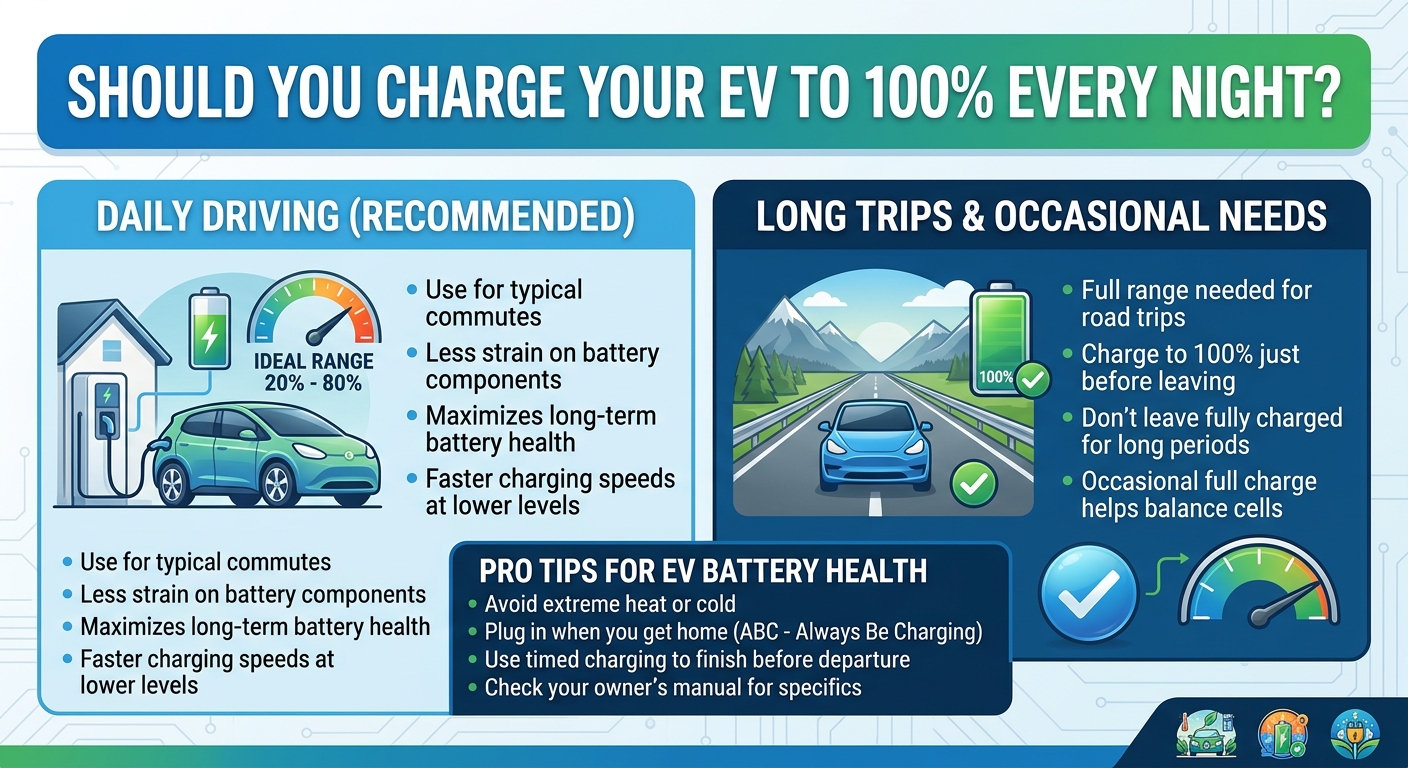
You rarely need that for daily driving, though. Top up what you used the day before and keep the full charge for road trips.
What does a night’s charging cost?
Multiply the kWh you need by your electricity rate. Your rate plan matters: on one California utility, peak pricing is about six times its overnight price, so scheduling your charge for off-peak hours can cut your cost significantly.
Quick checklist
- Find your car’s kWh per 100 miles on fueleconomy.gov.
- Multiply by your daily miles and divide by 100.
- Divide by your overnight hours to get the power you need.
- Compare that to what Level 1 or Level 2 can deliver.
- Check your rate plan for off-peak savings.
Next step: Get a licensed installer quote https://evchargeradvisor.online/
FAQs
How many kWh does it take to charge an EV overnight?
About 10-15 kWh for an average driver, depending on your daily miles and your car’s efficiency.
How many kWh does an EV use per mile?
Typically 0.25-0.63 kWh per mile, with 0.35 as a common average.
How many kWh to fully charge an EV?
It depends on battery size, from about 40 to over 100 kWh. A Tesla Model Y needs roughly 67-90 kWh from the wall.
Can I charge overnight on a regular outlet?
Often yes, if your daily driving is modest. Level 1 delivers about 11 kWh in 8 hours.
How long does 13 kWh take on a Level 2 charger?
About 1.7 hours at 7.7 kW (my calculation).
How do I calculate my overnight kWh?
Multiply your daily miles by your car’s kWh per 100 miles, then divide by 100.
Final thoughts
Most drivers only need a modest 10-15 kWh a night, so even a basic setup can cover daily driving. Work out your number first, then choose the charger that fits it.
Ready to choose? See our top home EV chargers https://evchargeradvisor.online/
General information only. Have a licensed electrician assess your home before installing a charger.





Leave a Reply