
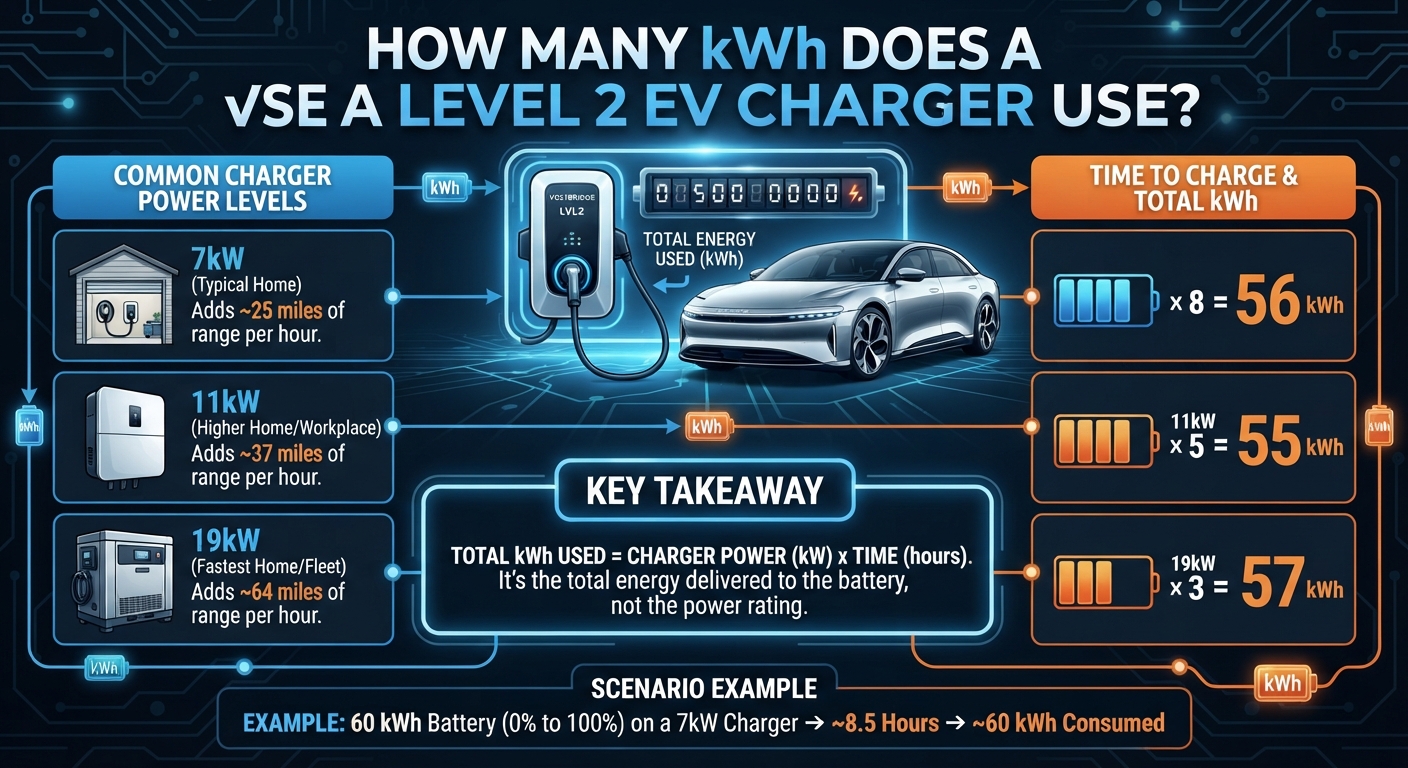
A Level 2 EV charger uses about 3.8 to 11.5 kWh for every hour it runs, depending on its amperage. A common 32-amp charger draws about 7.7 kWh per hour, and a 48-amp charger draws about 11.5 kWh per hour. Over a month, a typical driver adds roughly 150 to 450 kWh to the home’s bill. That works out to about $22 to $68 at $0.15 per kWh. Your real number depends on how far you drive, your car’s efficiency and your electricity rate.
This guide shows how to work out your own usage, what it costs, and how to keep it low.
How Many kWh a Level 2 Charger Uses per Hour
A Level 2 charger runs on 240 volts. Its power in kilowatts (kW) tells you how many kilowatt-hours (kWh) it uses in one hour at full output.
Formula: kW = volts × amps ÷ 1,000, and kWh = kW × hours.
| Charger amperage | Power | kWh used per hour | Approx. cost per hour at $0.15/kWh |
|---|---|---|---|
| 16A | 3.8 kW | ~3.8 kWh | ~$0.57 |
| 24A | 5.8 kW | ~5.8 kWh | ~$0.87 |
| 32A | 7.7 kW | ~7.7 kWh | ~$1.15 |
| 40A | 9.6 kW | ~9.6 kWh | ~$1.44 |
| 48A | 11.5 kW | ~11.5 kWh | ~$1.73 |
| 80A | 19.2 kW | ~19.2 kWh | ~$2.88 |
These are maximum figures. Your car’s onboard charger sets the real limit. If a 48A charger is connected to a car that accepts only 7.2 kW, you will use about 7.2 kWh per hour, not 11.5.
How Many kWh Does It Take to Charge an EV?
Charging does not use the battery’s size in kWh exactly, because some energy is lost as heat. Expect to draw roughly 10% more from the wall than the battery stores.
| Energy added to battery | Approx. kWh from the wall | Approx. cost at $0.15/kWh |
|---|---|---|
| 20 kWh | ~22 kWh | ~$3.30 |
| 40 kWh | ~44 kWh | ~$6.60 |
| 60 kWh | ~66 kWh | ~$9.90 |
| 80 kWh | ~88 kWh | ~$13.20 |
Most drivers do not charge from empty to full. You only need to replace what you drove.
How Much Electricity Does Charging Add per Month?
Most EVs use roughly 0.25 to 0.35 kWh per mile, measured at the wall. Using 0.30 kWh per mile as a middle figure:
| Miles driven per month | Approx. kWh used | Approx. cost at $0.15/kWh |
|---|---|---|
| 500 | ~150 kWh | ~$22.50 |
| 1,000 | ~300 kWh | ~$45 |
| 1,500 | ~450 kWh | ~$67.50 |
To find your own number, multiply your monthly miles by your car’s kWh-per-mile figure, then multiply by your electricity rate in dollars per kWh. Your utility bill shows the rate, and many cars show efficiency on the dashboard.
Does the Charger Itself Use Electricity When Idle?
Yes, but very little. A plugged-in Level 2 charger with Wi-Fi or a display draws a small standby load, usually only a few watts. That adds up to a small amount per month compared with the energy used to charge the car. If you want to know the exact figure for a model, check the manufacturer’s specifications.
Does a Faster Level 2 Charger Use More Electricity?
Not for the same charge. A 48A charger draws more power per hour than a 32A charger, but it finishes sooner. The total kWh needed to add 40 kWh to your battery is about the same either way.
What changes is the load on your home. A higher-amp charger pulls more power at once, which matters for your panel and breaker, and for any time-of-use rates you are on. It does not make your total energy bill much different for the same driving.
What Affects How Many kWh Your Charger Uses?
- Charger amperage: sets the maximum draw.
- Car’s onboard charger limit: caps the speed you can actually use.
- Battery size and how empty it is: a bigger gap to fill means more kWh.
- Driving habits: highway speeds and heavy loads raise kWh per mile.
- Cold weather: batteries are less efficient in the cold, and some energy goes to warming them.
- Charging losses: about 10% extra is normal.
- Your electricity rate: the same kWh can cost very different amounts by region and plan.
How to Lower Your Level 2 Charging Costs
- Charge off-peak. If your utility offers time-of-use rates, schedule charging for the cheapest hours. Most smart chargers and many cars let you do this.
- Ask about EV rates and rebates. Some utilities offer special EV plans or incentives, and these change often.
- Right-size the charger. A 32A to 48A charger is enough for most drivers, and a bigger one does not reduce your kWh.
- Precondition while plugged in. Warming the cabin on grid power saves battery energy in cold weather.
- Track your usage. Smart chargers and utility apps show real kWh, which helps you spot waste.
- Drive efficiently. Moderate speeds and proper tire pressure cut kWh per mile.
If you are not sure which size makes sense for your driving and your home, you can see which charger size fits your EV and budget before you spend money on hardware or wiring.
Will a Level 2 Charger Raise Your Electric Bill a Lot?
It will raise it, but usually by less than the gas it replaces. A home using around 10,000 kWh a year might add about 3,600 kWh for 1,000 miles of driving a month. That is a meaningful increase, but the cost per mile is often well below what the same distance costs in a gas car. Your savings depend on local electricity and fuel prices.
Frequently Asked Questions
- How many kWh does a Level 2 EV charger use?
It uses about 3.8 to 11.5 kWh per hour for most home units, depending on amperage and what your car accepts. - How many kWh does a 32-amp Level 2 charger use per hour?
About 7.7 kWh per hour at full output. - How many kWh does a 48-amp Level 2 charger use per hour?
About 11.5 kWh per hour at full output. - How many kWh does it take to fully charge an EV?
Roughly the battery’s capacity plus about 10% for charging losses. A 60 kWh battery filled from empty draws around 66 kWh from the wall. - How much does it cost to run a Level 2 charger for an hour?
At $0.15 per kWh, about $1.15 for a 32A charger and about $1.73 for a 48A charger. Your rate may differ. - How much does a Level 2 charger add to my electric bill each month?
Often about $22 to $68 for 500 to 1,500 miles of driving at $0.15 per kWh, though it varies by car and rate. - Does a Level 2 charger use electricity when the car is not charging?
Only a small standby amount, usually a few watts. - Does a faster charger use more kWh?
It draws more power per hour, but it finishes sooner, so total kWh for the same charge is about the same. - Is Level 2 charging cheaper than Level 1?
Per kWh, the electricity cost is about the same. Level 2 can be slightly more efficient because it spends less time running the car’s systems during a charge, and it is far faster. - How can I find my exact kWh usage?
Check your smart charger’s app, your car’s charging history or your utility’s usage data.
Final Thoughts
A Level 2 charger uses as many kWh per hour as its power rating, but what matters for your bill is how far you drive and what you pay per kWh. If you want a setup that fits your car, your panel and your rates, ask us how to set up efficient home charging and we will help you plan it.





Leave a Reply