
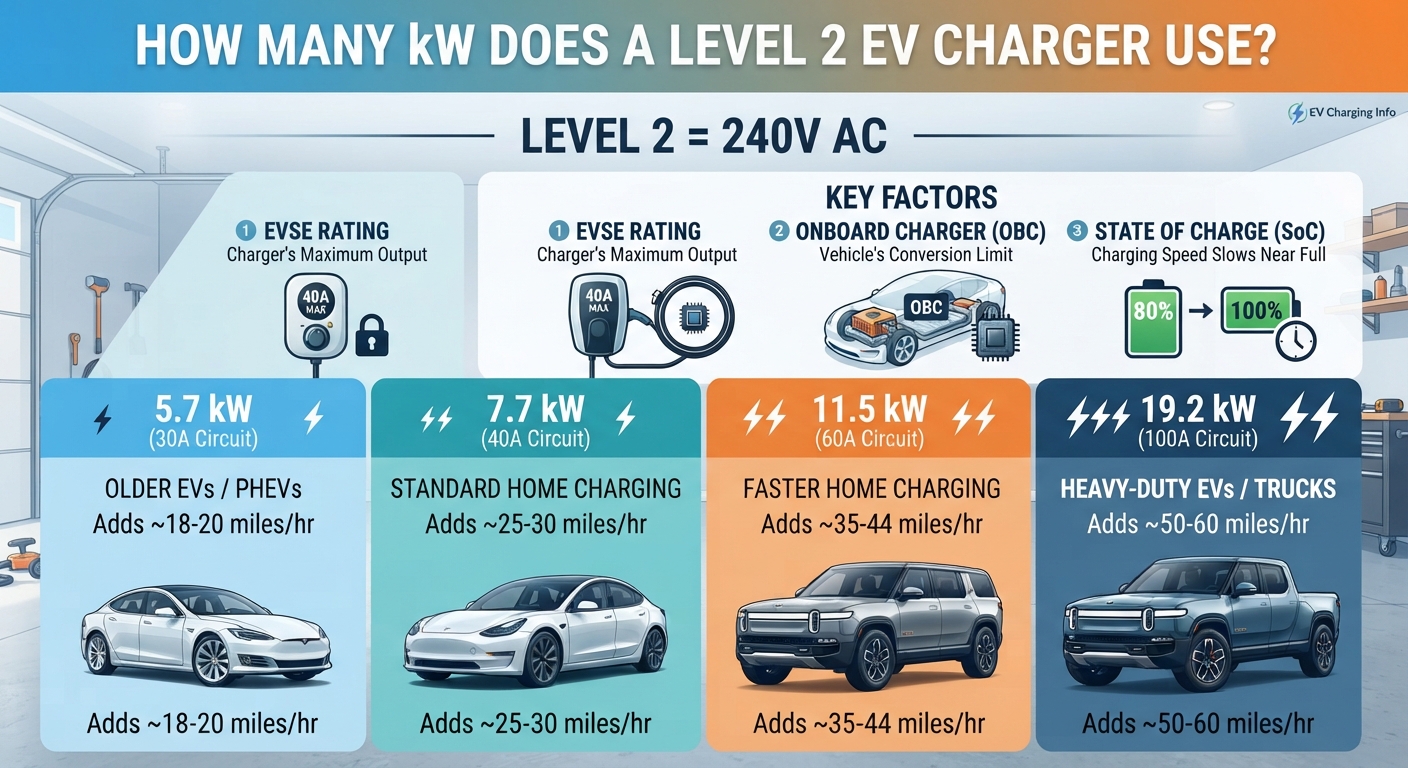
Transitioning to electric vehicle ownership at home opens up a world of convenience, but it also introduces new electrical terminology. If you are looking for a quick and direct answer: A Level 2 electric vehicle (EV) charger typically uses between 3.3 kW and 19.2 kW of power in North America, and up to 22 kW in Europe and the UK.
Understanding these power ratings is essential before calling an electrician or purchasing hardware. The actual amount of electricity your home system draws depends heavily on your vehicle’s onboard charger capacity, your home’s electrical panel rating, and the amperage of the charging unit you install.
Here is a comprehensive deep dive into how kilowatt (kW) ratings work, what options are available, and how they impact your home energy consumption.
1. Understanding Kilowatts (kW) vs. Amps and Volts
To truly grasp how much power a Level 2 charger uses, it helps to understand the basic mathematical equation behind electrical power:
-
Volts ($V$): Level 2 charging in North America operates on residential 240 volts (similar to a heavy-duty household appliance like an electric clothes dryer or oven). In Europe and the UK, residential systems operate on 230 volts single-phase (or up to 400 volts three-phase).
-
Amps ($A$): Amperage measures the electrical current flowing through the circuit. Common Level 2 home chargers range from 16 amps up to 80 amps.
-
Kilowatts ($kW$): Kilowatts represent the actual rate of energy delivery (Volts $\times$ Amps $\div$ 1,000). For example, a 240V circuit running at 40 amps delivers roughly $9.6$ kW of power to your vehicle.
To explore how different equipment variants affect your home setup, check out our detailed guide on various charging types.
2. Breakdown of Common Level 2 Power Tiers
Not all Level 2 chargers pull the same amount of power. They generally fall into distinct power tiers based on amperage output:
-
Lower-Tier Level 2 (16A to 24A / 3.8 kW to 5.8 kW):
Often installed on a 20-amp or 30-amp breaker. These are typically used for plug-in hybrid electric vehicles (PHEVs) or smaller battery electric cars where ultra-fast turnaround isn’t strictly necessary.
-
The Sweet Spot / Standard Tier (32A to 40A / 7.7 kW to 9.6 kW):
Running on a dedicated 40-amp or 50-amp circuit, this tier represents the most popular home installation choice. It adds about 20 to 30 miles of range per hour and can easily replenish most standard EV batteries overnight.
-
High-Power Tier (48A to 80A / 11.5 kW to 19.2 kW+):
Requiring heavy-duty 60-amp to 100-amp circuits, these units are designed for large electric pickup trucks (like the Ford F-150 Lightning or Rivian R1T) or vehicles equipped with dual onboard chargers capable of accepting massive amounts of alternating current (AC) power.
3. The Role of Your Vehicle’s Onboard Charger (OBC)
A common misconception is that installing a powerful 19.2 kW charger means your car will automatically charge at that maximum speed. However, your EV can only pull as much power as its built-in onboard charger (OBC) allows.
-
If your car’s internal OBC has a maximum acceptance limit of 7.2 kW, connecting it to a high-end 19.2 kW charger will result in the car capping the power draw at 7.2 kW.
-
Conversely, if your car can handle 11.5 kW (48 amps) and you plug it into a 7.2 kW (32 amp) charger, it will safely charge at the lower 7.2 kW rate.
Matching your charging hardware specifications to your vehicle’s technical limits prevents you from paying for expensive electrical upgrades you cannot utilize. For smart energy tracking and automated load balancing, explore our insights on smart home EV solutions.
4. How kW Usage Affects Your Electric Bill and Grid Load
Drawing more kilowatts does not inherently mean you pay more for the total electricity consumed; a 75 kWh battery requires 75 kWh of energy to fill regardless of whether it is pumped in slowly or quickly. However, higher kW draws impact your infrastructure in other ways:
-
Electrical Panel Strain: Pulling 11.5 kW or 19.2 kW continuously for hours draws substantial current. Older homes with 100-amp service panels may require a costly upgrade to 200-amp service to handle high-kW loads safely.
-
Time-of-Use (TOU) Rates: Because higher-kW chargers replenish batteries rapidly (often in 4 to 8 hours), they allow you to schedule your entire charging cycle during deep off-peak window hours when utility rates are at their lowest.
If you are designing your home charging strategy, reviewing overall budget limits, or evaluating long-term savings, visit EV Charger Advisor for expert recommendations.
Summary: Choosing the Right kW Output
-
Select a 7 kW to 9.6 kW (32A to 40A) charger if you want the ideal balance of fast overnight turnaround, standard electrical panel compatibility, and cost-effective installation for daily commuting.
-
Consider a 11.5 kW to 19.2 kW unit only if your specific EV model explicitly features a high-capacity onboard charger and your household electrical infrastructure is rated to support heavy continuous loads.

















Leave a Reply