
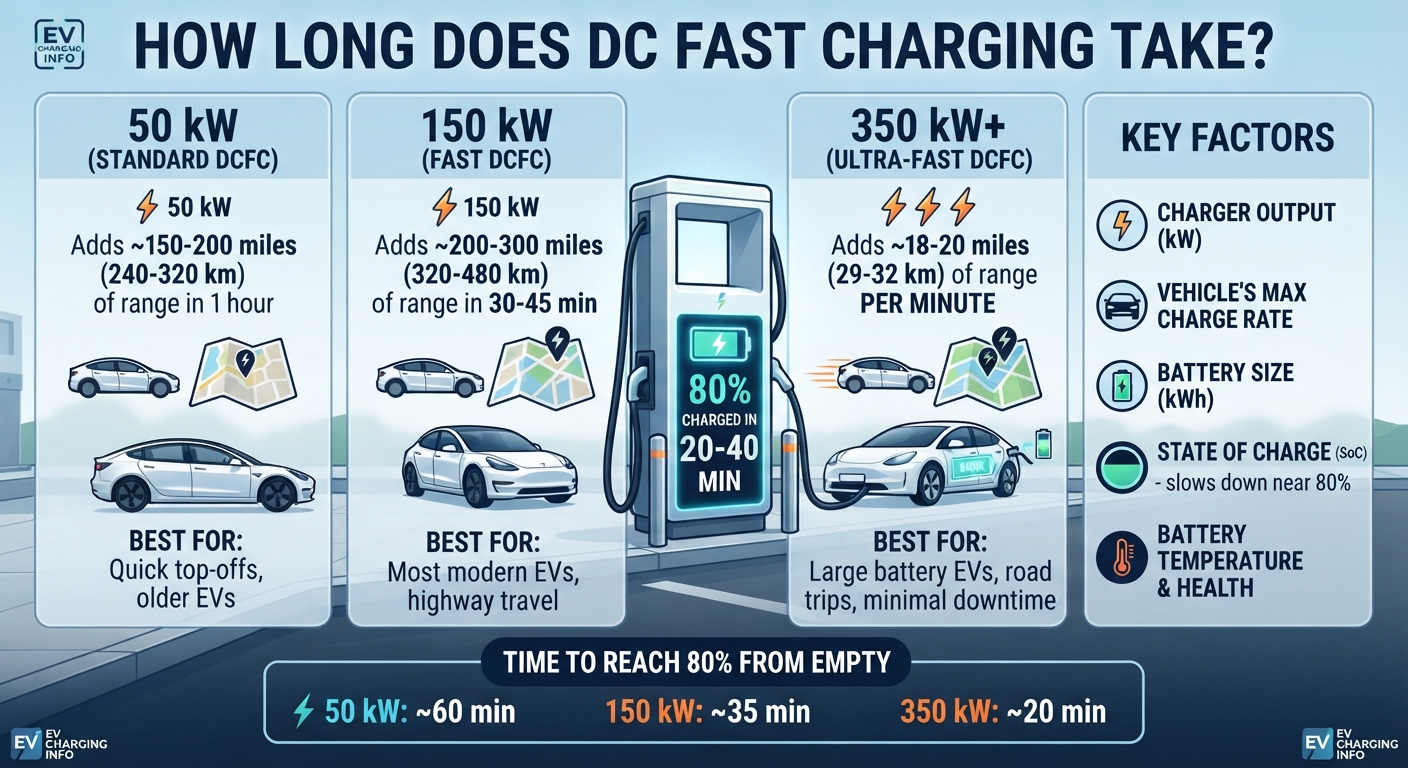
When planning long-distance road trips or evaluating public infrastructure options for your electric vehicle, understanding rapid charging speeds is essential. To answer directly: DC fast charging typically takes 20 to 40 minutes to charge an electric vehicle (EV) from 10% to 80% capacity, depending on the charger speed and the vehicle’s capabilities.
Unlike overnight home plugs, direct current (DC) fast chargers bypass your car’s internal onboard inverter to pump high-voltage electricity straight into the battery pack, transforming hours of waiting into a brief rest stop.
Here is an extensive, 1000-word breakdown of everything you need to know about DC fast charging speeds, real-world variables, and how to maximize your road trip efficiency.
1. The Core Benchmark: 20 to 40 Minutes (10% to 80%)
When you pull up to a public DC fast charging station (often called Level 3 or ultra-fast chargers), the session dynamics differ drastically from standard home equipment:
-
The 80% Rule: Most modern electric vehicles drastically throttle their charging speed once the battery reaches 80% capacity. This is an automated safety feature designed to prevent overheating and preserve long-term battery health. Pushing from 80% to 100% can take just as long as going from 10% to 80%.
-
Typical Timeframes: Modern passenger EVs equipped with efficient thermal management systems can easily complete a standard 10% to 80% top-up in under half an hour under optimal conditions.
To compare how public rapid chargers differ from residential setups, read more about various charging types.
2. Understanding Charger Power Classifications (kW Ratings)
Not all DC fast chargers are created equal. The speed at which your vehicle replenishes power is heavily tied to the kilowatt (kW) output of the station:
-
50 kW DC Fast Chargers: The legacy standard found across many highway corridors and urban locations. They typically take 50 to 70 minutes for a 10% to 80% charge.
-
150 kW to 350 kW Ultra-Fast Chargers: The modern backbone of highway networks. These high-power stalls can deliver hundreds of miles of range in roughly 15 to 30 minutes, provided your vehicle architecture supports high voltage (such as 400V or 800V systems).
To optimize your charging strategy and track public energy usage efficiently, you can explore insights on smart home EV solutions and mobile network management.
3. Key Factors That Impact DC Fast Charging Speeds
Even if you plug into a ultra-powerful 350 kW charger, several physical and technical variables dictate your actual charging duration:
-
Vehicle Architecture & Voltage Limits: Your car can only accept as much power as its battery management system allows. A vehicle capped at 150 kW peak intake will not charge any faster on a 350 kW stall.
-
Battery Temperature (Thermal Thawing): Cold weather drastically reduces chemical reaction rates inside lithium-ion cells. If your battery is freezing when you plug in, the car will limit incoming power to protect the cells until internal heaters warm the pack up.
-
Grid Congestion and Power Sharing: When multiple stalls are occupied at a single charging station, the site’s total power output is often split among active vehicles, temporarily slowing down individual speeds.
For a comprehensive overview of safety protocols, home vs. public charging budgets, and infrastructure advice, visit EV Charger Advisor.
Summary: What to Expect on the Road
-
Expect a convenient 20 to 40 minute stop to recover the bulk of your driving range during long road trips.
-
Always plan your charging stops to terminate around 80% capacity to maximize travel efficiency and avoid wasting time at the stall.

















Leave a Reply