
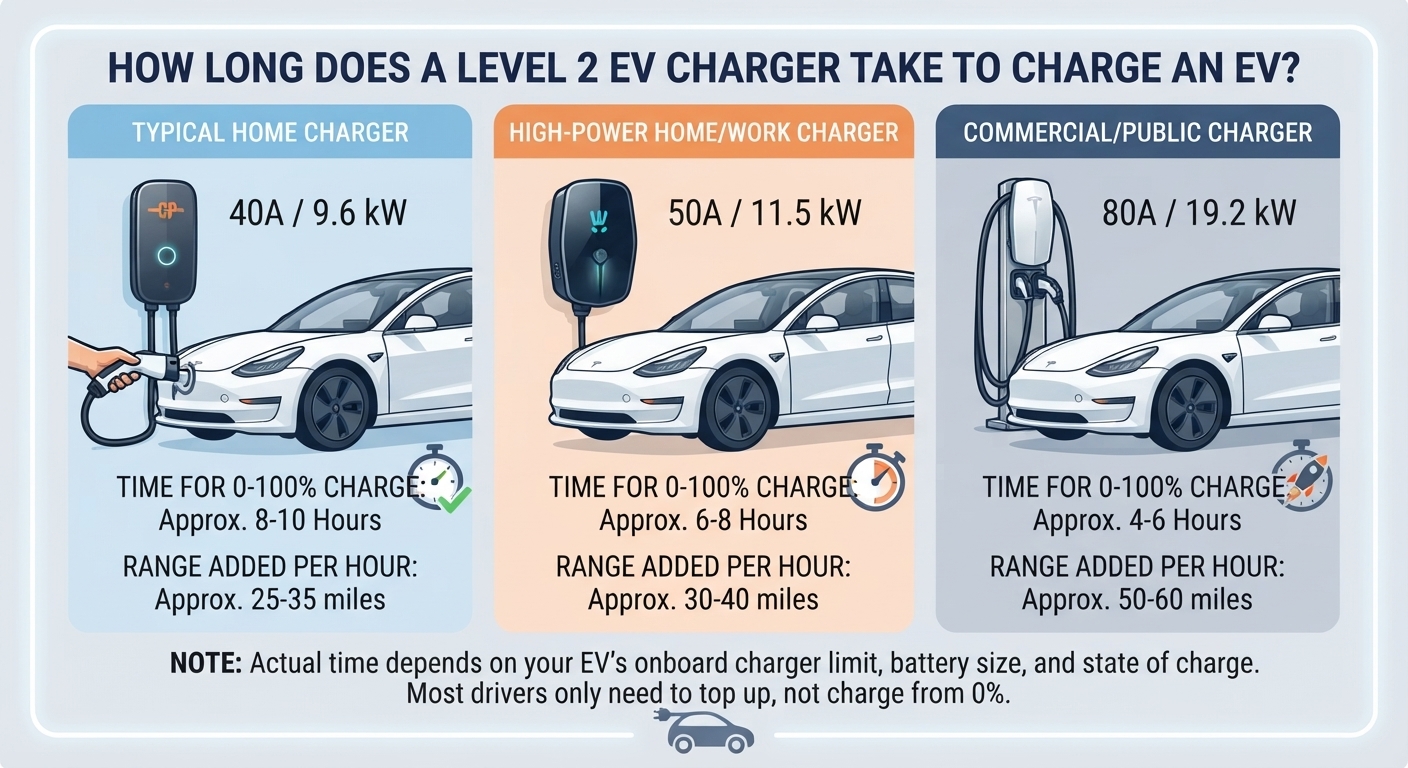
Transitioning from a standard household outlet to a dedicated home charging station is one of the most impactful upgrades an electric vehicle owner can make. If you are wondering about the time investment required to power up your daily driver, here is the direct answer: A Level 2 EV charger typically takes 4 to 10 hours to fully charge an electric vehicle from empty.
Unlike standard wall outlets that leave your car plugged in for days, a proper 240V residential setup transforms your vehicle ownership experience by delivering rapid, convenient energy replenishment overnight. However, the exact duration depends on several technical variables, including your battery pack capacity, your vehicle’s onboard charger limits, and the amperage output of your home equipment.
In this comprehensive guide, we will break down everything you need to know about charging speeds, real-world timelines, and how to optimize your charging routine.
1. Understanding Level 2 Charging Speeds and Power Delivery
To understand why charging times vary, it helps to look at how electrical power is measured. Level 2 charging operates on 240 volts (the same voltage used by heavy household appliances like electric dryers or ovens).
Depending on the specific unit installed and your home’s electrical panel capability, Level 2 chargers typically deliver between 3.3 kW to 19.2 kW of power.
-
Range Replenishment Rate: On average, a standard home Level 2 setup pumps about 20 to 35 miles of driving range into your battery per hour of charging.
-
Amperage Impact: A standard 32-amp or 40-amp charger moves energy much faster than a basic 16-amp unit, drastically reducing the time your car spends tethered to the garage wall.
To explore the differences in equipment output and how they fit residential infrastructure, take a look at our detailed breakdown of various charging types.
2. Real-World Charging Times by EV Battery Size
Every electric vehicle model features a unique battery pack capacity measured in kilowatt-hours (kWh). Because battery sizes differ dramatically between vehicle classes, the time required for a 0% to 100% fill-up varies accordingly:
-
Compact EVs & Plug-In Hybrids (PHEVs) (30 kWh – 40 kWh): Vehicles like smaller hatchbacks or plug-in hybrids have compact batteries. Using a standard Level 2 home charger, these vehicles typically go from empty to fully charged in just 3 to 5 hours.
-
Standard Passenger EVs & Crossovers (60 kWh – 75 kWh): Popular electric sedans and mid-size crossovers fall into this category. A typical Level 2 home unit will replenish these batteries from zero in roughly 6 to 8 hours, making an overnight window more than sufficient.
-
Large SUVs, Trucks, & High-Capacity Packs (100 kWh – 130 kWh+): Heavy-duty electric trucks and luxury SUVs pack massive energy reserves. Even with a powerful Level 2 charger, filling these large power banks can take 9 to 13+ hours, often requiring the full span of an overnight charge or smart scheduling.
3. Key Factors That Influence Charging Duration
Even with a high-speed Level 2 charger installed, several external and internal factors dictate how quickly energy flows into your vehicle:
A. Your Vehicle’s Onboard Charger (OBC) Limit
An electric vehicle can only accept as much alternating current (AC) power as its internal conversion system allows. If your car has a maximum onboard charger limit of 7.2 kW, it will draw that maximum amount even if you plug it into a heavy-duty 11.5 kW wall unit. Always check your car’s manual to match your hardware correctly.
B. Battery Thermal Management
Modern electric vehicles use advanced liquid-cooling and heating systems to protect battery health during charging. In extreme winter cold or intense summer heat, your vehicle’s thermal management system may divert a portion of the incoming electrical current to regulate battery temperature before rapid charging commences, temporarily extending total session times.
C. State of Charge (SoC) Curve
Electric vehicle batteries do not charge at a constant flat rate from 0% to 100%. To protect battery longevity, most modern EVs taper the charging speed significantly once the battery reaches 80% to 90% capacity. While the first 80% happens rapidly, the final top-off trickle can take a bit longer.
4. Maximizing Efficiency with Smart Home Solutions
Because a Level 2 charger completes a full energy cycle in just a few hours, it opens up massive cost-saving opportunities through your local electric utility provider:
-
Time-of-Use (TOU) Rates: Utility companies frequently offer drastically discounted electricity rates during late-night hours (e.g., midnight to 6 AM) when overall grid demand drops.
-
Automated Scheduling: By utilizing modern software controls—such as the features highlighted in our guide on smart home EV solutions—you can program your charger to automatically activate only during these ultra-cheap off-peak hours, ensuring your car is fully juiced before you wake up without paying peak grid pricing.
If you are planning your home infrastructure upgrade and want to weigh installation costs against daily convenience, explore our core recommendations and insights at smart home EV solutions.
Summary: What to Expect Day-to-Day
-
The Routine: For daily driving habits where you typically deplete 20% to 40% of your battery during a normal commute, a Level 2 home charger will easily top your vehicle back up to 100% in just 2 to 4 hours overnight.
-
The Verdict: You will rarely ever need to wait for a 0% to 100% charge unless you return home completely drained after an exceptionally long road trip, making Level 2 the ultimate standard for hassle-free electric vehicle ownership.

















Leave a Reply