
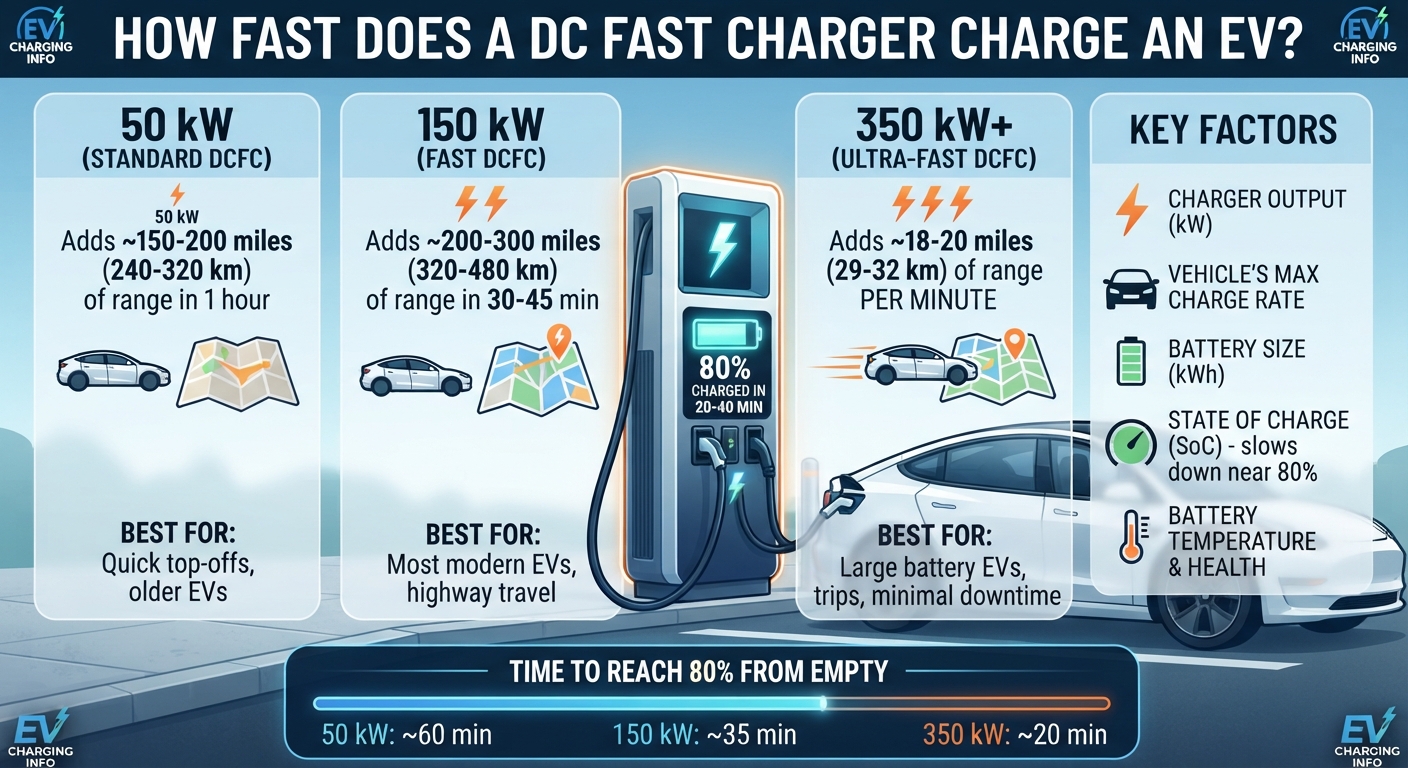
When looking for rapid energy solutions on road trips or long highway commutes, understanding high-capacity public infrastructure is essential. To answer directly: A DC fast charger can charge an electric vehicle (EV) from 10% to 80% in about 15 to 45 minutes, depending on the charger’s power and the car’s maximum intake speed.
Unlike residential AC setups that replenish power slowly overnight, Direct Current (DC) fast charging bypasses the vehicle’s onboard inverter to feed high-voltage electricity directly into the battery pack.
Here is a detailed breakdown of how DC fast charging works, what affects its speed, and why it is primarily built for traveling rather than daily home routines.
1. The 15 to 45-Minute Window: Speed in Action
DC fast chargers (often classified as Level 3 or ultra-fast stations) drastically compress refueling times compared to home units:
-
Typical Charging Sessions: Most modern EVs can pull massive amounts of current to jump from a low battery state up to 80% capacity in roughly a quarter to three-quarters of an hour.
-
Why 80%? Fast-charging stations intentionally throttle power delivery once a vehicle hits 80% capacity. This protective measure prevents overheating and preserves long-term battery health.
To explore how these high-capacity options contrast with everyday residential setups, read our overview on various charging types.
2. Key Power Outputs: From 50 kW to 350 kW+
Public charging stations vary widely in their maximum power delivery capabilities:
-
Standard DC Fast Chargers (50 kW): Common at older highway corridors or commercial sites, these typically take closer to 45 to 60 minutes for a standard top-up.
-
Ultra-Fast Stations (150 kW to 350 kW+): Modern corridors feature high-output chargers capable of adding hundreds of miles of range in under 20 minutes for vehicles equipped with 400V or 800V architectures.
If you are looking into how intelligent software manages high power and efficient energy tracking, explore our guide on smart home EV solutions.
3. Critical Bottlenecks That Impact Fast Charging Speeds
Even if a charging stall is rated for 350 kW, your actual charging speed is governed by strict limitations:
-
The Vehicle’s Peak Intake Limit: An EV can only accept as much power as its internal battery management system permits. If your car maxes out at 150 kW, plugging it into a 350 kW stall will not force it to draw faster.
-
Battery Thermal Conditions: Extreme cold or hot weather can force the car’s computer to condition or throttle power intake to protect the battery chemistry.
-
Station Sharing: Many dual-cable public stations split their total power output if two vehicles plug in simultaneously, temporarily reducing individual charging speeds.
For expert guides, safety tips, and comprehensive infrastructure breakdowns, visit us at EV Charger Advisor.
Summary: When to Use DC Fast Charging
-
Use DC Fast Chargers primarily during long-distance road trips or when you need a rapid roadside boost.
-
Rely on slower residential or workplace charging for day-to-day commuting to maximize convenience and extend battery lifespan.

















Leave a Reply