
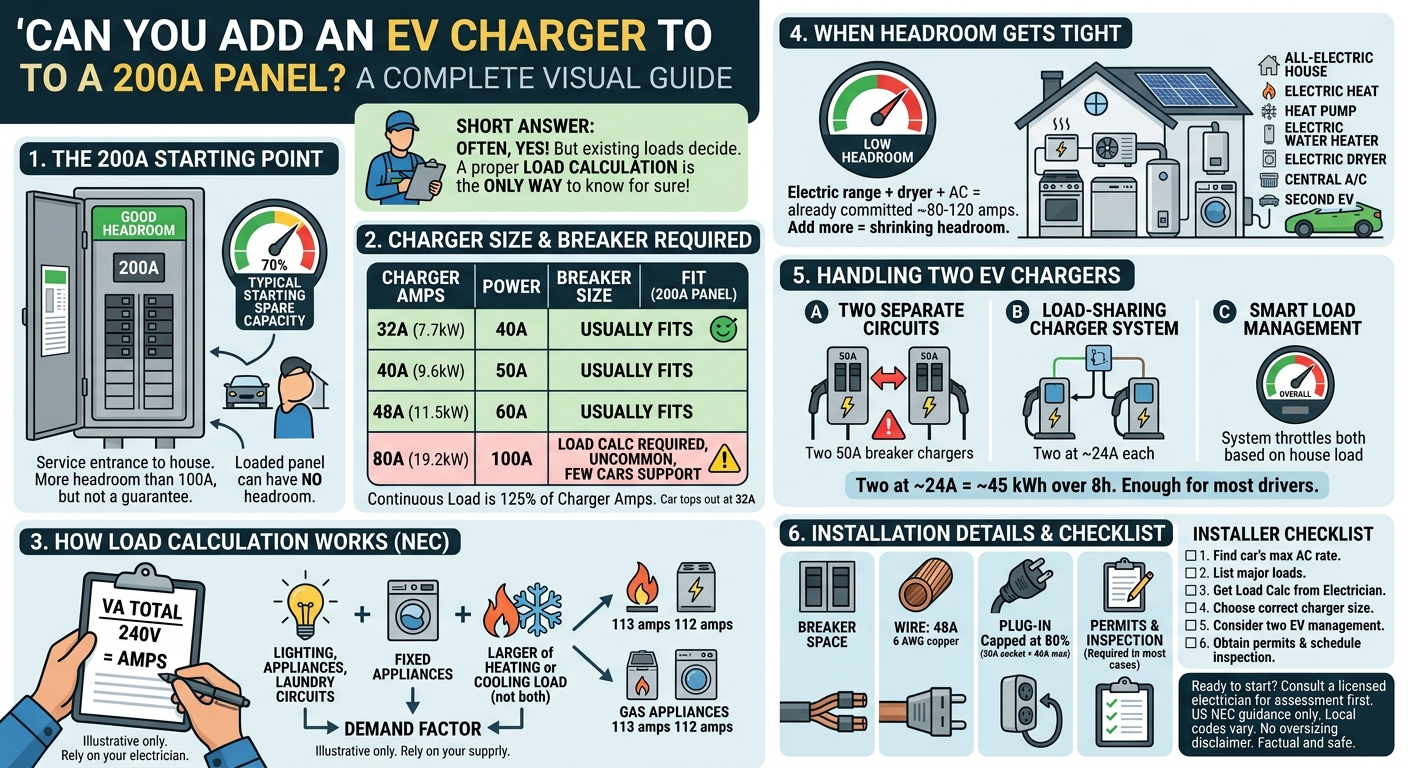
Usually, yes. Most homes with a 200-amp panel can add a Level 2 EV charger, even a 48-amp (11.5 kW) unit, without a panel upgrade. But 200 amps isn’t a guarantee. Your existing loads decide, and a proper load calculation by a licensed electrician is the only way to know for sure.
Why a 200-amp panel usually works
A 200-amp service has far more headroom than a 100-amp one. Most homes with 200-amp panels can handle a 48-amp charger (40 amps continuous) without an upgrade. One installer calculator offers a rough screen: if your existing load is below about 70% of capacity, a 48-amp charger’s 60-amp breaker still leaves you under 200 amps. That’s a quick rule of thumb, not a code method.
The catch is that a fully loaded 200-amp service can have almost no headroom. It’s your total load that matters, not the number on the panel.
What size charger fits on a 200-amp panel?
EV charging is a continuous load, so the breaker must be rated at 125% of the charger’s amperage.
| Charger amps | Power | Breaker needed | Typical fit on a 200A panel |
|---|---|---|---|
| 32A | 7.7 kW | 40A | Usually fits |
| 40A | 9.6 kW | 50A | Usually fits |
| 48A | 11.5 kW | 60A | Usually fits |
| 80A | 19.2 kW | 100A | Only after a load calculation, and few cars can use it |
Check your car’s limit before you buy. If its onboard charger tops out at 32 amps, a 48-amp charger won’t charge it any faster.
How the load calculation works
For an existing home, an electrician typically runs the NEC residential load calculation (section 220.82 or 220.83). It adds up your lighting, small-appliance and laundry circuits and fixed appliances, plus the larger of your heating or cooling load (not both). It then applies demand factors and adds the EV charger as a continuous load. Dividing the total volt-amps by 240 gives amps, which is compared with your panel rating.
Two calculator examples show how it plays out. A 200-amp home with gas appliances and a 48-amp charger comes to about 113 amps, well within 200. A similar home with a heat pump comes to about 112 amps. Another sample home, with a gas furnace, 5-ton central A/C, an electric range and an electric dryer, is described as a case where “the math decides”.
Treat these as illustrations, not guarantees. Calculators also differ on how they count the charger, so rely on your electrician.
When a 200-amp panel gets tight
A typical modern home with an electric range, electric dryer, electric water heater and central A/C is already committed to roughly 80-120 amps of load. Add electric heat, a heat pump or a second EV, and your headroom shrinks quickly.
Want to know where your panel stands? Request a load calculation from a licensed electrician https://evchargeradvisor.online/
Two EV chargers on a 200-amp panel
Two 40-amp chargers need two 50-amp breakers and represent 80 amps of continuous demand, which is likely to overlap when both cars come home in the evening. Whether your panel can support that depends on your existing load. There are three common approaches:
- Two separate circuits: The most reliable, but it needs the most capacity.
- A load-sharing charger system: Two chargers divide the available amperage, at roughly 24 amps each when both are charging.
- Smart load management: The system throttles both chargers automatically as your house load changes.
At about 24 amps each, two cars would still each gain roughly 45 kWh over 8 hours (my calculation), enough for most daily driving.
Panel and wiring details
- Breaker spaces: A 50-amp or 60-amp breaker is a 2-pole breaker and needs two adjacent spaces.
- Wire: A 48-amp charger requires a 60-amp breaker and 6 AWG copper. Wire choice also depends on cable type and run length, so your electrician decides.
- Plug-in limits: Plug-in output is capped at 80% of the receptacle rating, so 40 amps on a 50-amp outlet. A 48-amp charger generally needs to be hardwired.
- Permits: In most jurisdictions, a new 240V circuit requires an electrical permit and inspection.
If your panel is tight
You still have options short of a full upgrade:
- Install a lower-amp charger (16-24 amps).
- Add a smart load-sharing device that prioritises power between your appliances and the charger.
- Add a dedicated subpanel for EV charging.
- Upgrade your main service as a last resort.
Don’t oversize for your car
A bigger charger only helps if your car can use the extra power. If your car’s onboard charger accepts 32 amps, installing a 48-amp or 80-amp charger won’t charge it faster, and you’d be paying for capacity you can’t use.
Quick checklist
- Find your car’s maximum AC charging rate.
- List your major electric loads.
- Ask an electrician for a load calculation.
- Choose a charger size that fits the result.
- If you have two EVs, discuss load sharing.
- Get the permit and inspection.
Next step: Compare 48-amp and load-sharing home chargers https://evchargeradvisor.online/
FAQs
Can a 200-amp panel handle a Level 2 EV charger?
In most cases, yes. A load calculation confirms it.
Can a 200-amp panel handle a 48-amp EV charger?
Usually, if your existing loads leave enough headroom. A 48-amp charger needs a 60-amp breaker.
Can a 200-amp panel support two EV chargers?
It depends on your existing load. Load sharing or load management can make it work.
Do I need a panel upgrade with a 200-amp panel?
Not usually. Upgrades are mostly needed for heavily electrified homes.
Can I add an EV charger and a heat pump to a 200-amp panel?
Often yes, as calculator examples show, but your electrician should confirm.
Do I need a permit?
In most jurisdictions, yes.
What size EV charger is best for a 200-amp panel?
Most homeowners choose 32-48 amps, matched to what their car can accept.
Final thoughts
A 200-amp panel is a strong starting point for EV charging, but it isn’t a blank check. Run the load calculation first, then choose the charger that fits your car and your home.
Ready to start? Get a licensed installer quote https://evchargeradvisor.online/
General information based on US NEC guidance. Local codes vary. Always have a licensed electrician assess your panel.





Leave a Reply