
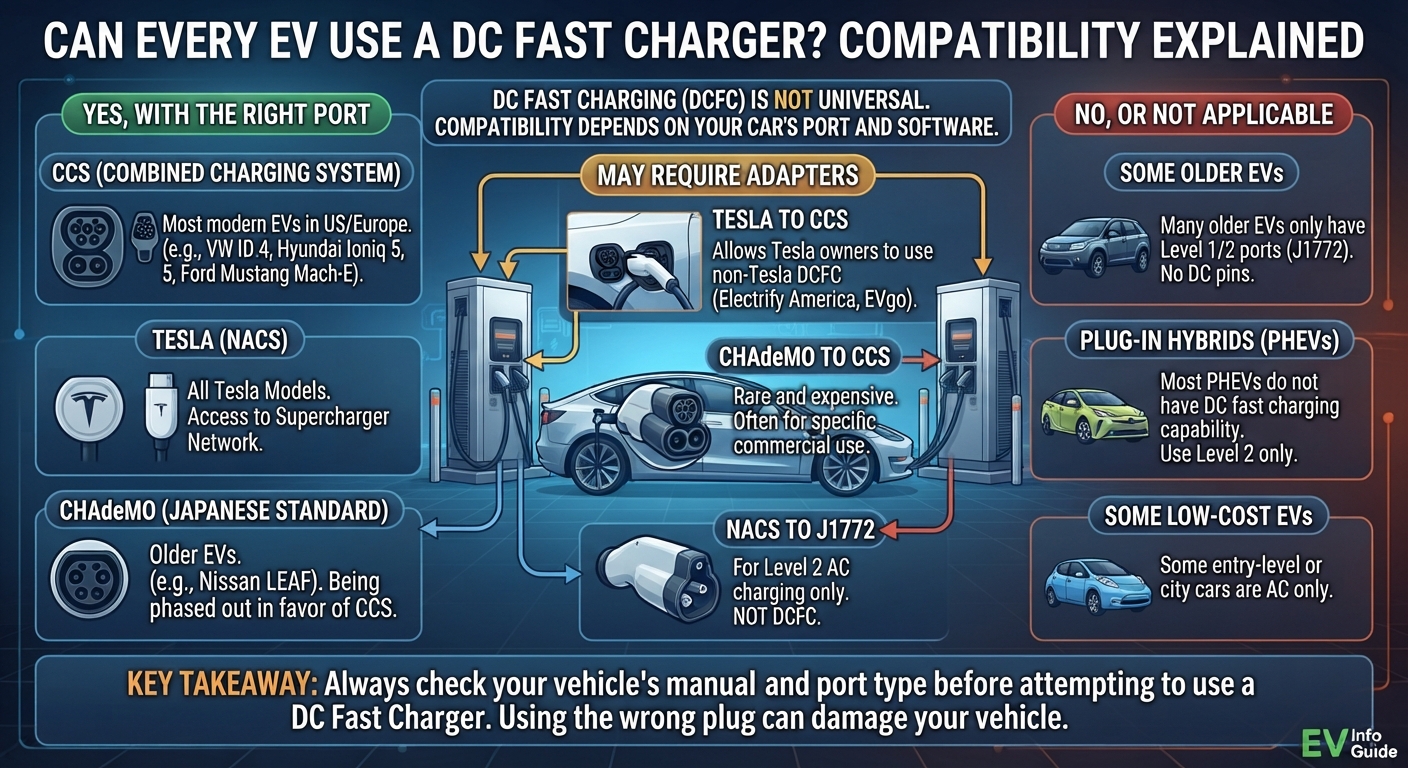
As electric vehicles (EVs) continue to dominate modern roadways, transitioning from gasoline-powered cars to battery-powered transport introduces an entirely new ecosystem of fueling infrastructure. For daily commuting and overnight recovery, standard home charging setups handle the workload effortlessly. However, when drivers embark on long-distance road trips, public direct current (DC) fast-charging stations become an absolute necessity.
A common question among prospective buyers and new EV owners is whether every electric vehicle can pull up to any high-speed public station and plug in. To answer directly: No, not every electric vehicle (EV) can use a DC fast charger. Compatibility depends on your car’s physical port, internal battery design, and whether it is equipped with direct current (DC) rapid-charging hardware.
While the vast majority of modern battery-electric vehicles (BEVs) roll off assembly lines fully equipped with rapid-charging capabilities, navigating the landscape requires a deep understanding of hardware ports, communication protocols, legacy limitations, and regional plug standards.
EV fast-charging compatibility, plug types (CCS, NACS, and CHAdeMO), thermal constraints, and how to verify your vehicle before hitting the open highway.
1. The Baseline Reality: Modern BEVs vs. Legacy and Niche Vehicles
To understand why some electric vehicles cannot utilize DC fast chargers, we must first look at how vehicle architectures have evolved over the past decade.
-
Modern Battery-Electric Vehicles (BEVs): Virtually all contemporary passenger BEVs—ranging from affordable urban hatchbacks to luxury SUVs and high-performance electric trucks—come standard with DC fast-charging ports. Manufacturers recognize that long-distance travel capability is a core consumer requirement, making rapid-charge hardware an industry-wide baseline.
-
The Exception: Older Compliance Cars and Budget Trims: In the early days of modern EV adoption, automakers rushed low-range “compliance cars” to market to meet strict regional emissions mandates. Vehicles like early generations of the Fiat 500e, the Chevrolet Spark EV, or the Smart EQ ForTwo were built strictly for short urban commutes. To cut manufacturing costs and save precious space inside tiny battery packs, automakers completely omitted DC fast-charging hardware. Trying to plug these legacy cars into a public DC station is physically impossible or functionally unsupported.
To explore how residential charging hardware differs from commercial public infrastructure, read our detailed guide on various charging types.
2. The Physical Port Divide: CCS, NACS, and CHAdeMO
Even if an electric vehicle is technically capable of accepting direct current power, compatibility hinges entirely on the physical shape of the charging plug and vehicle inlet. Over the years, the automotive industry fractured into three primary DC charging standards:
A. Combined Charging System (CCS)
For many years, CCS (specifically CCS1 in North America and CCS2 in Europe) served as the universal standard for non-Tesla electric vehicles.
-
Design: CCS ingeniously combines standard AC pins (for Level 1 and Level 2 home charging) with massive lower DC power pins into a single unified receptacle.
-
Compatibility: Any vehicle featuring a CCS port can plug into any CCS-compatible DC fast charger on public networks.
B. North American Charging Standard (NACS)
Pioneered by Tesla, the NACS plug has rapidly become the unified standard across North America, with major legacy automakers adopting the technology.
-
Design: NACS is remarkably sleek, lightweight, and handles both AC and DC charging through the exact same set of pins.
-
Compatibility: Modern Tesla vehicles use NACS natively, while newer non-Tesla EVs are transitioning to built-in NACS ports or utilizing manufacturer-approved adapters to bridge older CCS infrastructure.
C. CHAdeMO
Developed primarily by Japanese automakers, CHAdeMO is a legacy DC fast-charging standard that has seen rapid decline.
-
Design: CHAdeMO requires a separate, bulky physical port dedicated exclusively to direct current charging, meaning cars using this standard must have two separate inlets (one for AC, one for CHAdeMO).
-
Compatibility: Primarily utilized by the Nissan LEAF and early Mitsubishi Outlander PHEVs. Because major networks are phasing out CHAdeMO installations in favor of CCS and NACS, finding public stations for CHAdeMO vehicles is becoming increasingly difficult.
To understand how home energy management and smart adapters fit into your daily routine, check out our insights on smart home EV solutions.
3. Plug-in Hybrids (PHEVs) and DC Fast Charging Limitations
A major point of confusion for new alternative-fuel drivers involves Plug-in Hybrid Electric Vehicles (PHEVs). Vehicles like the Toyota RAV4 Prime, Chrysler Pacifica Hybrid, or BMW X5 xDrive45e combine a gasoline engine with a smaller electric battery pack.
-
The AC-Only Restriction: Almost all PHEVs on the market are strictly limited to AC charging (Level 1 and Level 2). They completely lack DC fast-charging hardware.
-
Why PHEVs Skip DC Fast Charging: Because PHEV battery packs are relatively small (usually between 10 kWh and 25 kWh), a standard Level 2 home charger can fully replenish the battery in just 2 to 3 hours. Adding expensive, heavy liquid-cooled DC fast-charging hardware to a hybrid vehicle would drastically increase its purchase price and weight while offering very little practical benefit.
4. Software Handshakes and Communication Protocols
Plug compatibility is only half the battle; physical connection does not guarantee energy transfer. Before a single electron flows from a DC fast charger into your EV’s battery, a complex digital “handshake” occurs:
-
ISO 15118 and Plug & Charge: Modern fast-charging networks utilize advanced digital communication protocols over the charging cable. The vehicle’s onboard computer communicates directly with the charging station’s management system, verifying billing information, security certificates, and optimal charging parameters.
-
Software Mismatches: If an older vehicle running legacy software attempts to communicate with a brand-new ultra-fast charging stall, communication errors can occur, resulting in a failed charging session. Keeping your vehicle’s firmware updated is critical for seamless public infrastructure compatibility.
For expert advice on infrastructure safety standards, pre-purchase vehicle inspections, and advisory services, visit EV Charger Advisor.
5. Thermal Management and Voltage Architecture Constraints
Even if your vehicle has the correct port and successfully establishes a digital connection, its internal battery architecture dictates whether it can fully leverage high-power DC fast charging:
-
400V vs. 800V System Architectures: Traditional EVs operate on a 400-volt electrical architecture. Newer, premium electric vehicles utilize advanced 800-volt systems (such as those built on Hyundai-Kia’s E-GMP platform or Porsche’s Taycan architecture), allowing them to accept lightning-fast speeds up to 350 kW without overheating. If you plug a standard 400V car into an ultra-powerful 350 kW station, the car will charge safely, but it will be capped by its own internal voltage limits.
-
Battery Temperature Throttling: Cold weather poses a significant compatibility hurdle. If a battery pack is freezing cold, its chemical resistance spikes. Modern EVs feature active thermal management systems that automatically warm the battery before arrival (pre-conditioning) or throttle incoming DC current to prevent permanent cell damage.
Summary: How to Ensure Your EV is DC Fast Charge Compatible
-
Check the Window Sticker or Port: Always verify that a prospective EV (especially if buying used) features a rapid-charging port (CCS, NACS, or CHAdeMO) rather than being limited to AC-only charging.
-
Avoid Assuming PHEV Capability: Remember that Plug-in Hybrids rely exclusively on AC home or destination charging and cannot plug into highway DC fast chargers.
-
Plan Ahead with Apps: Use reliable charging network maps to confirm that your specific vehicle connector type is supported along your intended travel routes.

















Leave a Reply