
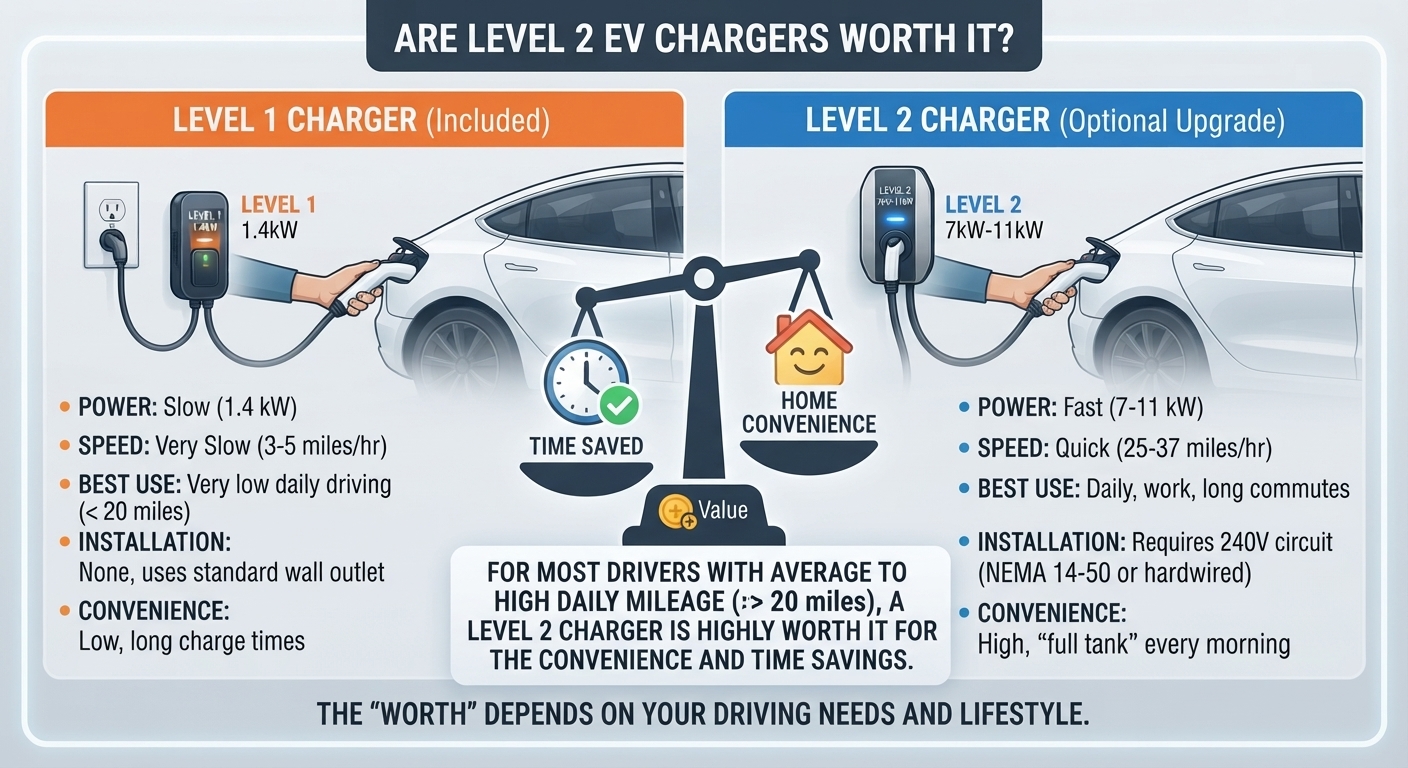
Transitioning to electric vehicle (EV) ownership brings a host of new lifestyle adjustments, with home charging infrastructure sitting at the very top of the priority list. When setting up a garage or driveway charging station, vehicle owners frequently debate whether upgrading to a 240V system is genuinely necessary. To answer directly: Level 2 EV chargers are generally worth the investment for full electric vehicle owners who drive more than 30 to 40 miles daily or need fast overnight turnaround.
While standard Level 1 chargers (which plug into ordinary 120V household outlets) can manage very short commutes, they often fall short for modern driving habits. Below is a comprehensive analysis examining costs, charging speeds, efficiency, and long-term utility savings to help you decide if a home Level 2 upgrade is right for you.
1. Understanding the Speed Advantage: Level 1 vs. Level 2
The most immediate and noticeable difference between charging setups comes down to raw power delivery and time.
-
Level 1 Charging: Relies on a standard household outlet, delivering a trickle charge of roughly 2 to 5 miles of range per hour. Recharging a depleted large-capacity battery from 0% to 100% using Level 1 can take anywhere from 12 to 20+ hours. If your daily commute eats up most of your battery, a Level 1 setup simply cannot replenish it overnight.
-
Level 2 Charging: Operates on a dedicated 240V circuit (similar to heavy appliances like an electric clothes dryer or oven). Depending on your amperage configuration—such as popular models covered in our guide on charging types—a Level 2 charger delivers 20 to 40 miles of range per hour, completely filling an empty EV battery in just 4 to 8 hours.
This rapid turnaround eliminates range anxiety, ensuring your vehicle is fully juiced and ready every single morning without altering your daily routine.
2. Financial Breakdown: Upfront Costs vs. Long-Term Savings
Evaluating whether Level 2 is “worth it” requires looking past the initial installation sticker shock and assessing long-term economics:
-
The Initial Investment: Purchasing a Level 2 unit generally costs between $400 and $800, while professional electrical installation (running a dedicated 240V circuit, breaker additions, and potential panel inspections) can range from $500 to over $2,000 depending on your home’s layout.
-
Escaping Public Charging Fees: Relying heavily on public DC fast chargers or commercial stations can quickly become expensive, often costing significantly more per kilowatt-hour than residential utility rates. Home charging keeps your baseline fuel costs drastically lower.
-
Time-of-Use (TOU) Rate Optimization: Many electric utility providers offer heavily discounted electricity rates during off-peak overnight hours. Because a Level 2 charger can completely restore your battery within a short 4-to-6-hour window, you can program your equipment to draw power exclusively during the cheapest hours.
By dodging expensive public charging and maximizing low overnight utility tariffs, a home Level 2 charger actively offsets its initial installation cost over time.
3. Energy Efficiency and Battery Preservation
Beyond raw speed and utility bill savings, a Level 2 system optimizes the technical health of your electric vehicle:
-
Lower Conversion Overhead: Charging an EV involves converting alternating current (AC) from your home into direct current (DC) for the battery pack. Because Level 1 chargers take an excessively long time to complete a cycle, the car’s onboard computers, cooling systems, and pumps stay powered on much longer, resulting in higher standby energy waste (conversion losses). Level 2 systems complete the task swiftly, maximizing transfer efficiency.
-
Smart Energy Controls: Modern residential upgrades often include software tracking. Utilizing smart home EV solutions allows you to monitor power draw, schedule sessions remotely via smartphone applications, and dynamically balance your home’s total electrical load to prevent tripping your main panel.
4. Added Home Value and Future-Proofing
Installing permanent high-voltage electrical infrastructure does more than just serve your current vehicle—it impacts your property value. As electric vehicles become the dominant standard for modern transportation, prospective homebuyers increasingly look for pre-equipped, EV-friendly properties. Having a clean, professionally installed Level 2 charging station acts as a high-value home amenity that enhances market appeal and future-proofs your real estate investment.
For further expert tips on evaluating home compatibility and infrastructure safety, explore resources directly through EV Charger Advisor.
Summary: Is a Level 2 Charger Worth It For You?
-
Skip It If: You drive less than 15–20 miles per day, exclusively own a plug-in hybrid with a small battery pack, or live in a temporary rental where modifying electrical panels is prohibited.
-
Definitely Buy It If: You own a full battery-electric vehicle (BEV), drive more than 30 to 40 miles daily, manage a multi-EV household, or want the ultimate peace of mind with fast, reliable overnight charging.

















Leave a Reply