
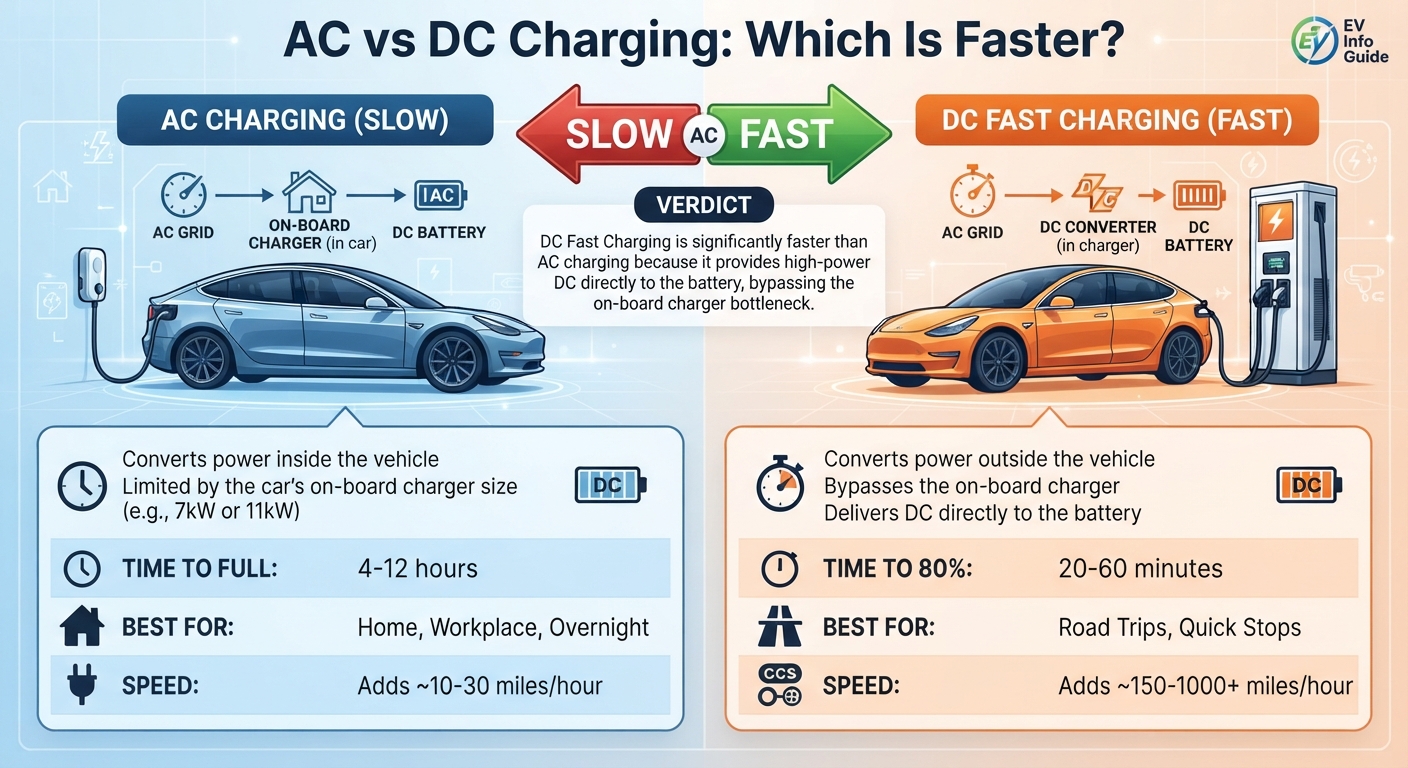
When exploring the world of electric vehicles (EVs), understanding how power flows into your battery is essential for planning long road trips and daily commutes. To answer the core question directly: DC fast charging is significantly faster than AC charging for electric vehicles (EVs).
While AC charging handles everyday home and destination needs through a slow, steady conversion process, DC fast charging bypasses the car’s internal bottlenecks to pump high-voltage direct current straight into the battery pack.
Here is a comprehensive 1000-word breakdown explaining the mechanics, speed differences, and practical applications of both charging methods.
1. Understanding the Core Difference: AC vs. DC Power
To understand why one method is drastically faster, you first need to look at how electricity is generated versus how an EV battery stores power.
-
Alternating Current (AC): Power coming from the standard utility grid is always AC. Your home wall outlets, Level 1, and Level 2 chargers all supply AC power. However, an EV battery can only store energy as Direct Current (DC). This means any AC charger relies on an internal component inside your car called the Onboard Charger (OBC) to convert AC electricity into DC electricity before it reaches the cells.
-
Direct Current (DC): DC fast chargers (often found at highway service stations) contain massive, heavy-duty converters outside the car. They convert AC grid power to DC power right at the station and send it directly into the vehicle’s battery pack, bypassing the vehicle’s onboard converter entirely.
To explore how residential equipment manages power conversion at home, read more about various charging types.
2. Speed Comparison: How Fast Are They Really?
The speed discrepancy between AC and DC charging is massive, shifting the timeline from hours to minutes:
-
AC Charging Speeds (Level 1 & Level 2):
-
Level 1 (120V): Delivers a trickle of power (approx. 1.4 kW to 1.9 kW), adding only 2 to 4 miles of range per hour.
-
Level 2 (240V): Delivers standard home speeds (approx. 7 kW to 19.2 kW), adding 20 to 40 miles of range per hour and taking 4 to 10 hours for a full charge.
-
-
DC Fast Charging Speeds (Level 3):
-
Public DC fast chargers typically start at 50 kW and can scale up to 150 kW, 250 kW, or even 350 kW+ in ultra-fast stations.
-
Instead of measuring speeds in miles per hour, DC fast charging is measured in minutes: it can frequently replenish an EV battery from 10% to 80% in just 15 to 30 minutes.
-
To evaluate how smart energy management systems interact with your vehicle during different charging cycles, check out our guide on smart home EV solutions.
3. Why Can’t We Use DC Fast Charging Everywhere?
Given that DC charging is overwhelmingly faster, a common question is why people bother installing AC chargers at home. Several critical factors prevent DC fast charging from being practical for everyday residential use:
-
Astronomical Installation and Equipment Costs: Commercial DC fast chargers require heavy industrial grid connections, massive transformers, and specialized cooling cables. Installing a single unit can cost anywhere from $50,000 to over $150,000, making them completely unfeasible for standard residential garages.
-
Battery Degradation Over Time: Pumping massive amounts of high-voltage energy into a battery generates intense heat and chemical stress. Relying exclusively on DC fast charging for daily top-ups can accelerate long-term degradation of your EV’s battery health. AC charging, by contrast, is much gentler on the cells.
-
Grid Strain: Drawing hundreds of kilowatts instantly places an immense burden on local neighborhood electrical grids, whereas a standard home Level 2 charger operates safely within residential electrical allowances.
For tailored advice on balancing home charging safety, equipment durability, and everyday budgeting, explore our core recommendations at EV Charger Advisor.
4. Choosing the Right Method for Your Lifestyle
Understanding when to use AC versus DC charging ensures you maximize battery life while maintaining travel flexibility:
-
When to use AC Charging: Use home AC charging (Level 1 or Level 2) for your daily routine. Plugging in overnight lets you wake up to a full battery every morning without stressing the grid, wearing down your battery cells, or paying peak commercial public charging rates.
-
When to use DC Charging: Save DC fast charging strictly for long-distance road trips, cross-country travel, or rare emergencies when you need a rapid juice-up on the go.
Summary: Which Is Faster?
-
DC Charging wins by a landslide on raw speed, filling your battery in minutes rather than hours.
-
AC Charging remains the undisputed king for home convenience, daily cost savings, and long-term battery preservation.

















Leave a Reply