
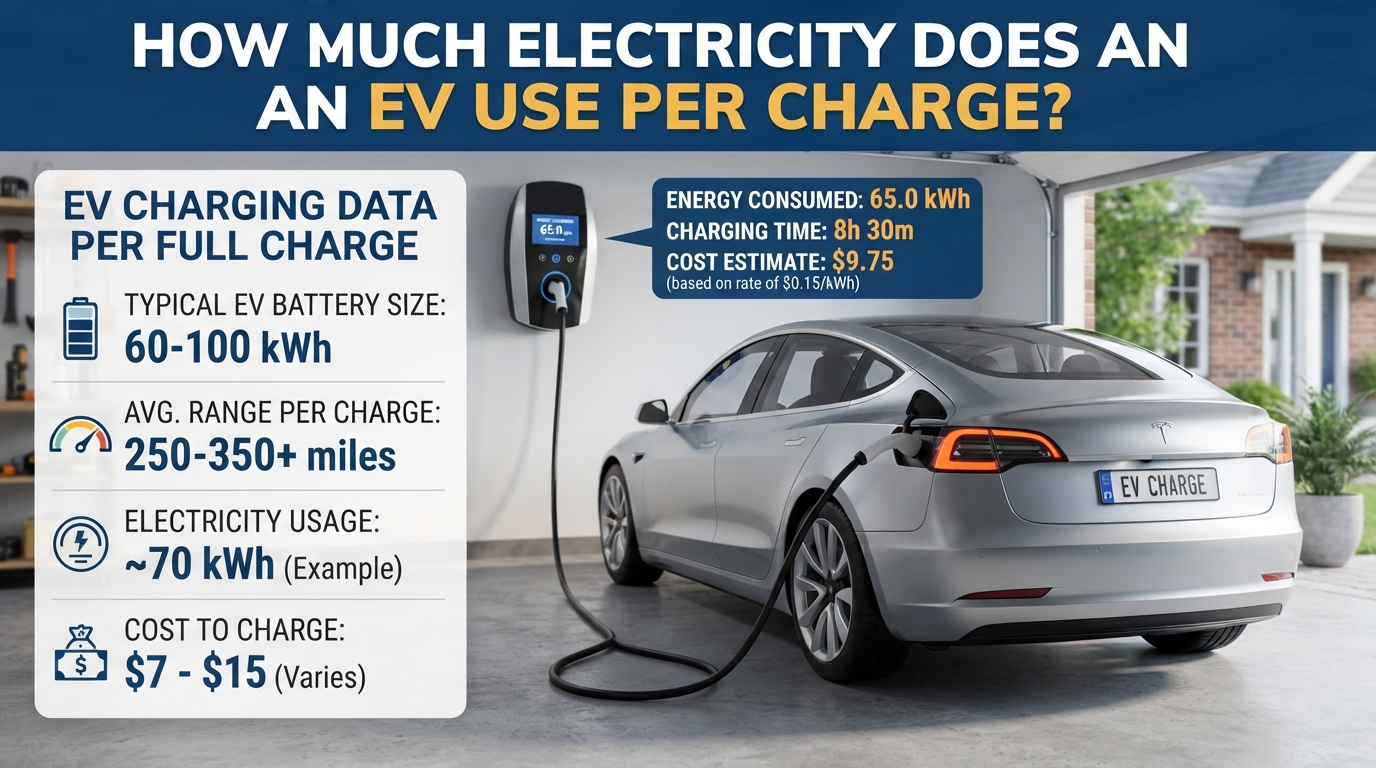
A full charge from empty uses roughly 70-140 kWh from the wall, depending on the vehicle, which equals its usable battery size plus about 10% charging losses. Most drivers never charge that far. A typical 20-80% charge uses about 40-85 kWh, and a daily top-up uses far less, often around 13 kWh.
What does “per charge” mean?
The answer changes depending on what you count:
- A full charge (0-100%): The largest number, and rare in daily life.
- A typical charge (20-80%): The range many owners stick to for battery health.
- A daily top-up: Replacing what you drove, usually 10-15 kWh for an average commuter.
How to calculate kWh per charge
kWh from the wall = battery size (kWh) × percentage added ÷ 0.9
The 0.9 allows for roughly 10% lost as heat and conversion, with some sources putting losses at up to 15%. For example, a 75 kWh Tesla Model 3 Long Range going from 20% to 80% adds 75 × 0.60 = 45 kWh to the battery, or about 50 kWh from the wall.
Use usable capacity, not total. A battery’s total capacity is slightly higher than what the car lets you use, often by roughly 6-10%.
kWh and cost per charge by model
| Vehicle | Usable battery | Full charge from wall (0-100%) | Cost at ~18¢/kWh | 20-80% from wall | Cost at ~18¢/kWh |
|---|---|---|---|---|---|
| Chevrolet Bolt EUV | 63 kWh | ~70 kWh | ~$12.60 | ~42 kWh | ~$7.60 |
| Tesla Model 3 Long Range | 75 kWh | ~83 kWh | ~$15.00 | ~50 kWh | ~$9.00 |
| Tesla Model Y Long Range | 77 kWh | ~86 kWh | ~$15.40 | ~51 kWh | ~$9.20 |
| Ford Mustang Mach-E ER | 87 kWh | ~97 kWh | ~$17.40 | ~58 kWh | ~$10.40 |
| Ford F-150 Lightning ER | 125 kWh | ~139 kWh | ~$25.00 | ~83 kWh | ~$15.00 |
Figures are my calculations from published usable capacities, assuming 10% charging losses. Trims, model years and chemistries vary, so check your own car’s spec sheet.
Why battery sizes differ so much
Larger batteries hold more kWh for the same percentage change. A 125 kWh F-150 Lightning going from 20% to 80% adds about 75 kWh, while a 63 kWh Bolt EUV adds about 38 kWh. Spec sheets can also differ on nominal vs usable capacity. A single model can range widely, such as Tesla’s Model Y, which runs from about 60 kWh usable on RWD LFP versions to about 79 kWh on Performance.
How cost changes by state
The table above uses about 18 cents per kWh, the rough national residential average. A full charge in a cheaper state at around 12-13 cents would cost about 30% less, while one in California at around 34 cents would cost nearly double.
Want to see what a home charger would cost you per charge? Compare home chargers and costs https://evchargeradvisor.online/
What a daily top-up really uses
Most owners don’t charge from empty. The average driver covers about 37 miles a day and needs roughly 13 kWh, which is about $2.30 a day at the national average rate. Over a week, that’s about 90 kWh, or about the same as one full charge of a mid-size EV.
Does charging speed change how much electricity you use?
No. A faster charger delivers the same kWh in less time. Level 1, Level 2 and DC fast charging all deliver the same energy for the same percentage. The differences are speed, and slightly different losses.
How to cut the electricity you use per charge
- Charge off-peak: On one California utility, peak pricing is about six times its overnight price, so scheduling matters.
- Charge at home: Home Level 2 charging can cost up to 50% less than public charging.
- Drive efficiently: Lower kWh per mile means fewer kWh to replace.
- Avoid unnecessary 100% charges: Keep full charges for trips.
Quick checklist
- Find your car’s usable battery size.
- Decide whether you want a full, 20-80% or top-up figure.
- Multiply by the percentage added, then divide by 0.9.
- Multiply by your electricity rate.
- Compare off-peak rates if available.
Next step: Get a licensed installer quote https://evchargeradvisor.online/
FAQs
How much electricity does an EV use per charge?
About 70-140 kWh for a full charge from empty, depending on the vehicle.
How many kWh does a Tesla use per full charge?
Roughly 83-86 kWh from the wall for a Long Range Model 3 or Model Y.
How much does it cost to fully charge an EV?
Roughly $12-$25 at the national average rate, depending on the vehicle.
How many kWh does an EV use for a 20-80% charge?
Roughly 40-85 kWh from the wall, depending on battery size.
Why do I use more kWh than my battery size?
Charging losses add roughly 10% to what you draw from the wall.
Do all EVs use the same electricity per charge?
No. Battery size and efficiency vary widely.
Does a faster charger use more electricity?
No. It delivers the same kWh in less time.
Final thoughts
Electricity per charge depends on your battery size and how far you charge. Work out your own figure, and you’ll know exactly what each charge costs.
Ready to plan your home charging? See our top home EV chargers https://evchargeradvisor.online/
General information with approximate figures. Battery sizes, efficiency and electricity prices vary. Check your own vehicle’s specs and rates.

















Leave a Reply