
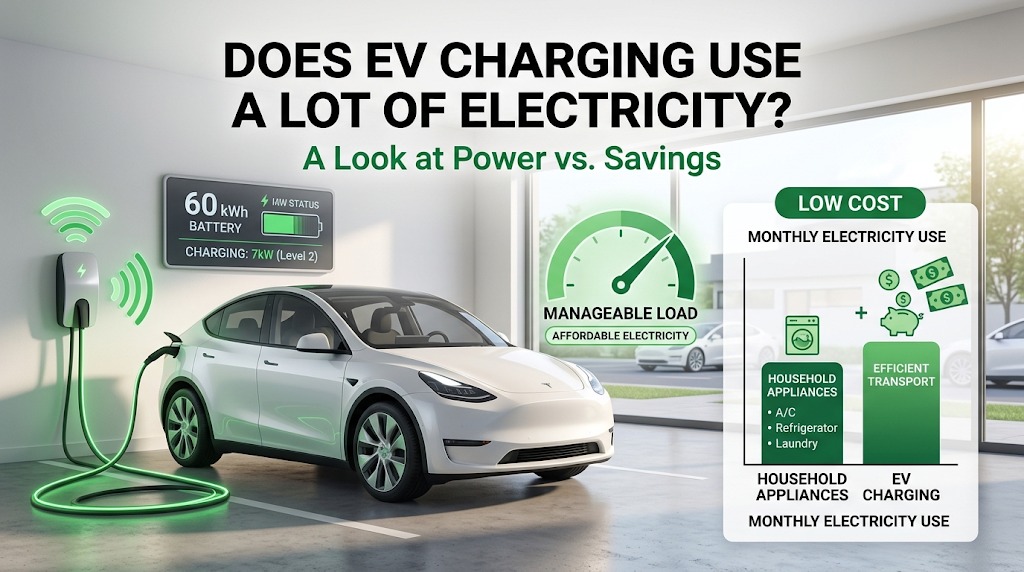
It uses a moderate amount. The average driver needs about 13 kWh a day, or roughly 4,700 kWh a year. That’s about 45% on top of an average US home’s roughly 10,500 kWh. At about 18 cents per kWh, that’s around $850 a year (my calculation), though your own cost depends heavily on your electricity rate.
The quick numbers
For an average driver and an average EV:
| Period | Electricity used | Cost at ~18¢/kWh |
|---|---|---|
| Per day | ~13 kWh | ~$2.30 |
| Per month | ~394 kWh | ~$71 |
| Per year | ~4,725 kWh | ~$850 |
Costs are my calculation. The average American drives about 37 miles a day, or around 13,500 miles a year, and the average EV uses about 0.35 kWh per mile.
How the numbers work
The formula is simple:
Miles driven × kWh per mile = kWh used
Your car’s kWh per mile varies a lot. Economical models might use about 0.25 kWh per mile, while a big electric pickup might use more than 0.60. Check your car’s EPA rating on fueleconomy.gov, listed as kWh per 100 miles.
How does it compare with your home?
The average US household uses about 10,500 kWh a year, or around 875 kWh a month. Here’s how three kinds of EV stack up for a driver covering 13,500 miles a year:
| Vehicle | kWh per mile | Yearly kWh | Added to a typical home |
|---|---|---|---|
| Efficient EV | 0.25 | ~3,400 kWh | ~32% |
| Average EV | 0.35 | ~4,700 kWh | ~45% |
| Large electric truck | 0.63 | ~8,500 kWh | ~81% |
These are my calculations, using the 10,500 kWh household average. So EV charging is noticeable, but for most drivers it’s far from doubling your home’s electricity use.
What it costs depends on where you live
The national residential average is roughly 18 cents per kWh, but rates vary enormously by state. Louisiana averaged about 12.7 cents in July 2026, while California averaged about 33.6 cents. For the average driver using 4,725 kWh a year:
| Rate | Example | Yearly charging cost |
|---|---|---|
| ~12.7¢/kWh | Low-cost state | ~$600 |
| ~18¢/kWh | National average | ~$850 |
| ~33.6¢/kWh | High-cost state | ~$1,590 |
At the national average, driving 100 miles costs roughly $6.
Charging losses
Not all the power from your wall ends up in the battery. Roughly 10-15% is lost as heat and conversion. The EPA’s kWh per 100 miles figures already include these losses, which is why they match your electric bill better than the battery size does.
Want to see what a home charger would add to your bill? Compare home chargers and costs https://evchargeradvisor.online/
How to use less and pay less
- Charge off-peak: On one California utility, peak pricing is about six times its overnight price. Many cars and chargers let you schedule charging.
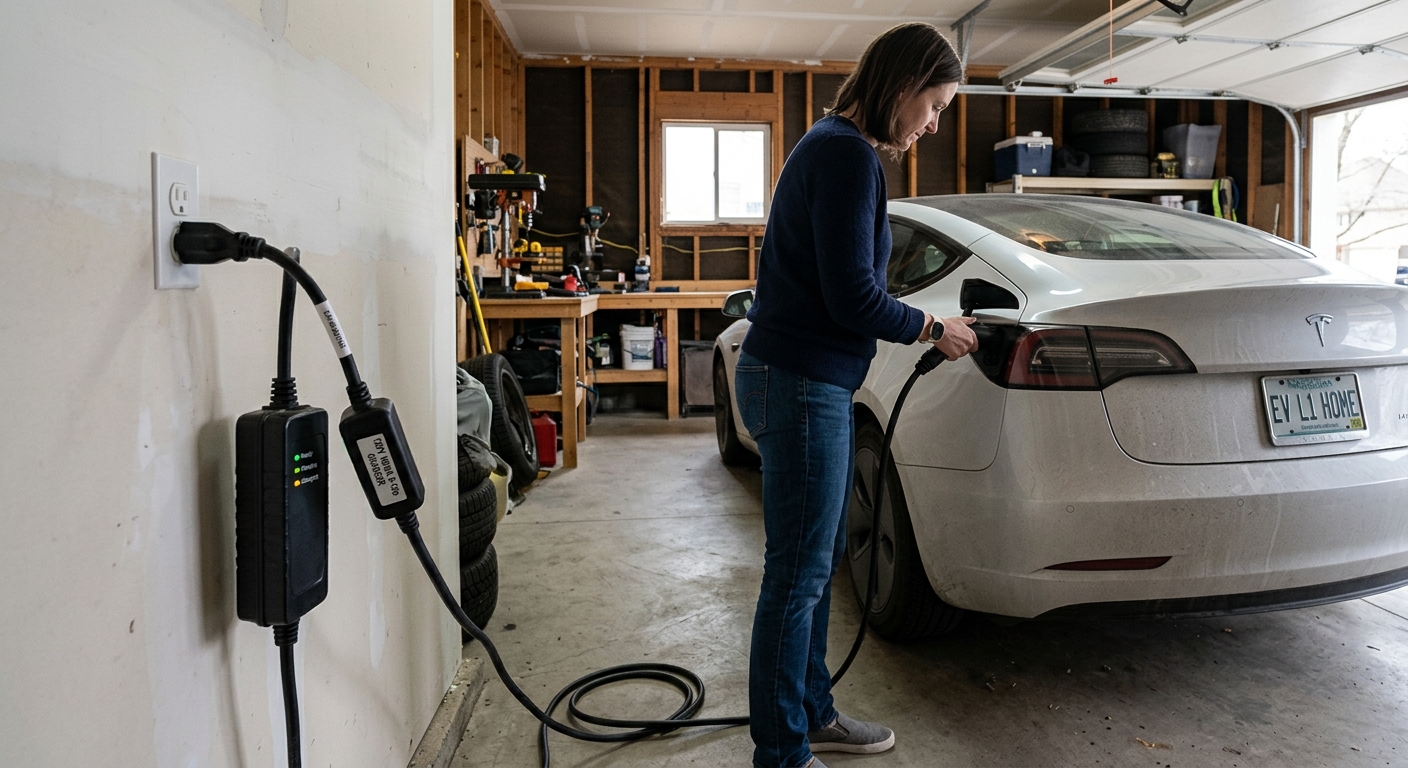
- Charge at home: Home Level 2 charging can cost up to 50% less than public charging.
- Drive efficiently: Smooth driving and sensible speeds cut your kWh per mile.
- Check your rate plan: Ask your utility whether it offers an EV or time-of-use rate.
Will it spike my electric bill?
For the average driver and the national average rate, expect to add roughly $70 a month. In a high-cost state or with a large vehicle, the increase will be bigger, so check your utility’s rate before you buy.
Energy isn’t the same as power
A 13 kWh daily need is energy used over a day. Your charger’s power rating, in kW, only decides how fast that energy flows. That’s why a modest charger can usually cover your daily driving overnight, and why your panel capacity is a separate question from your monthly bill.
Quick checklist
- Find your car’s kWh per 100 miles.
- Estimate your daily miles.
- Multiply by your electricity rate.
- Ask your utility about EV or time-of-use plans.
- Charge off-peak where possible.
Next step: Get a licensed installer quote https://evchargeradvisor.online/
FAQs
Does EV charging use a lot of electricity?
A moderate amount. The average driver uses about 13 kWh a day, roughly 45% on top of an average home’s usage.
How many kWh does an EV use per day?
About 9-23 kWh, depending on the car, with roughly 13 kWh for an average driver.
How much does it cost to charge an EV at home?
About $70 a month at the national average rate for an average driver, but it varies by state.
How many kWh to fully charge an EV?
It depends on battery size, from about 40 to over 100 kWh. A full charge isn’t needed for most daily driving.
Is charging an EV at home cheaper than public charging?
Usually, yes. Home Level 2 charging can cost up to 50% less.
Does a faster charger use more electricity?
No. A faster charger delivers the same kWh in less time.
Will charging my EV overload my home’s electricity?
Daily energy use isn’t the issue. Panel capacity is, and a load calculation will tell you.
Final thoughts
EV charging adds a real but manageable amount to your electricity use. Check your car’s kWh per mile and your own rate, and you can see your costs before you buy.
Ready to plan your home charging? See our top home EV chargers https://evchargeradvisor.online/
General information with approximate figures. Electricity prices and usage vary. Check your own rates and your car’s EPA rating.





Leave a Reply