
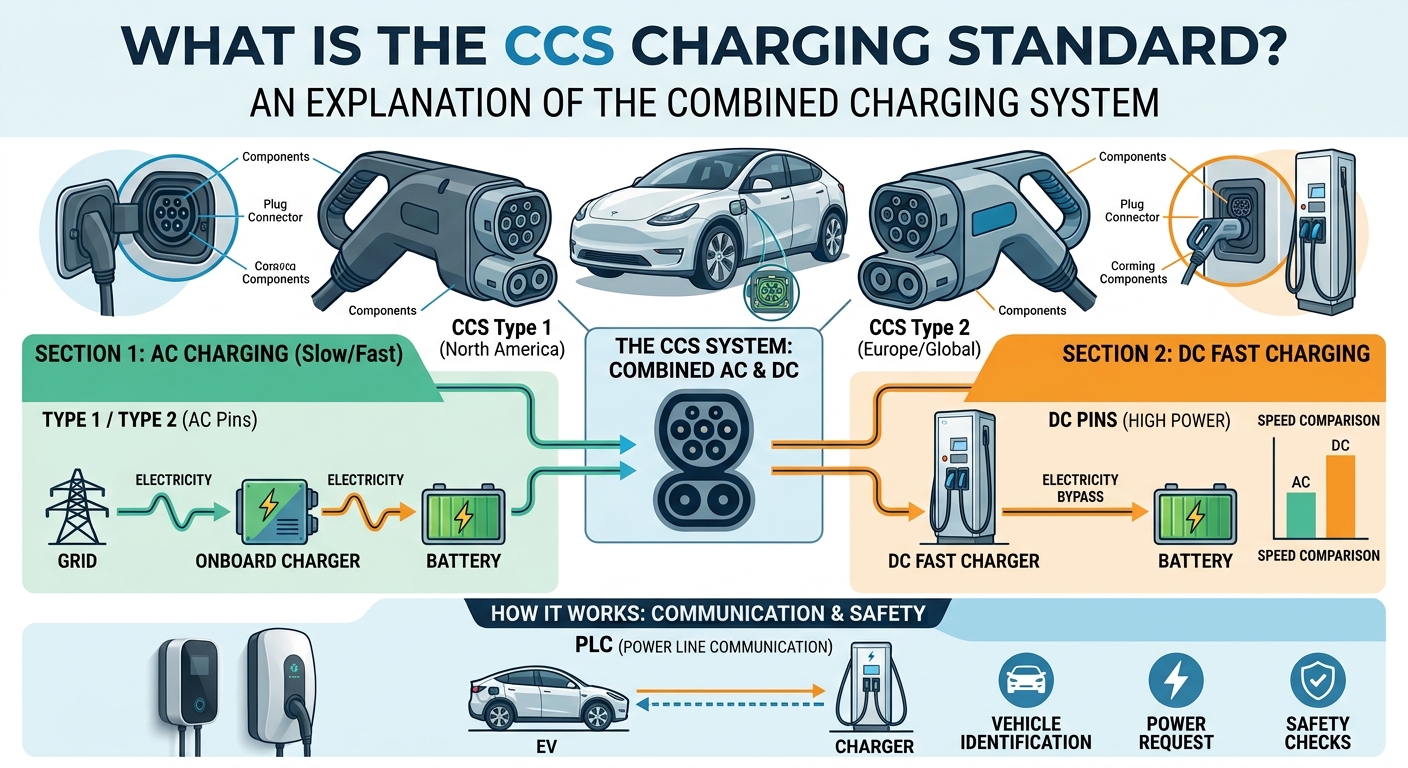
CCS stands for Combined Charging System. It’s an open EV charging standard that lets one port handle both slower AC charging and fast DC charging. There are two versions: CCS1, used mainly in North America and South Korea, and CCS2, used in Europe and many other regions. The CCS2 specification supports charging speeds up to 350 kW.
What Does “Combined” Mean in CCS?
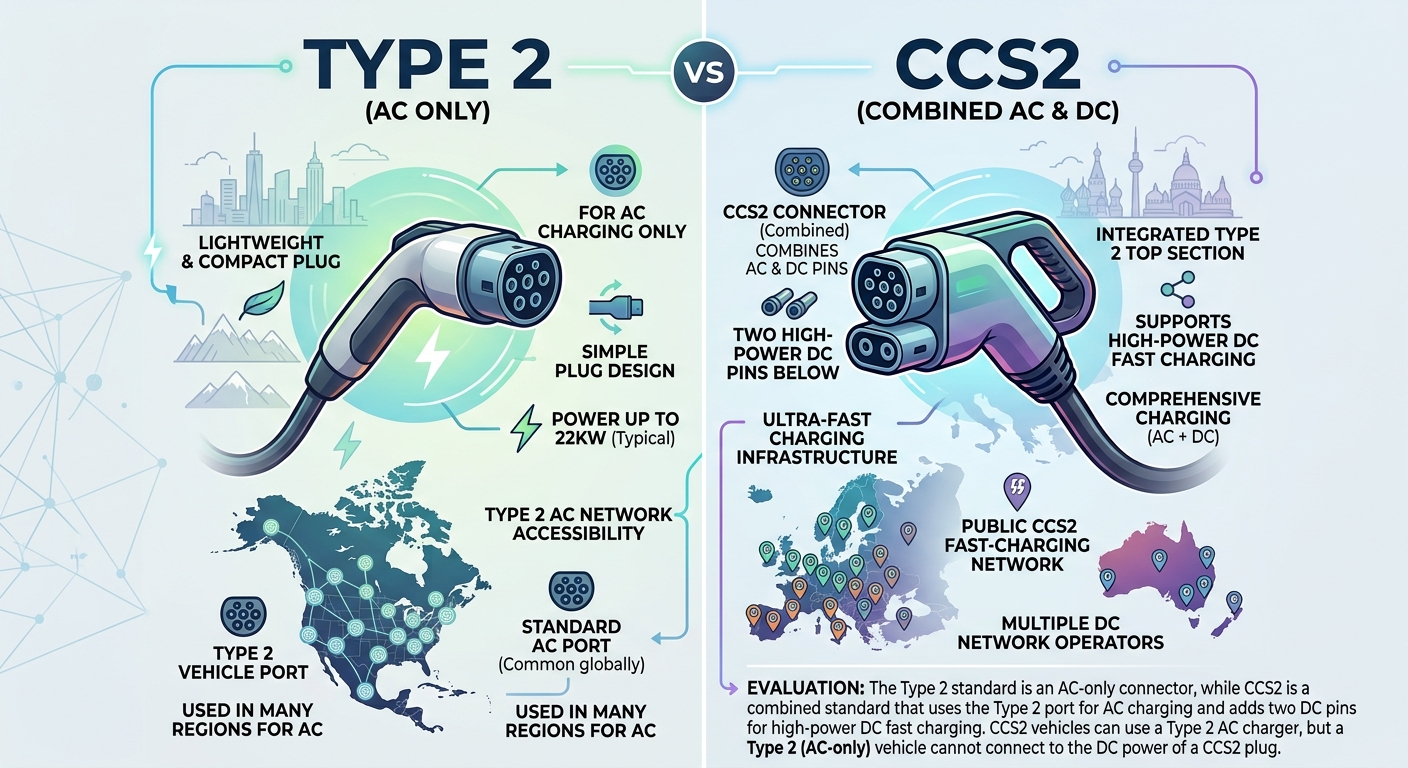
CCS takes an everyday AC plug and adds two large DC pins below it. That’s the “combined” part.
- On a CCS1 car, the top half is the standard J1772 plug used for AC charging in North America.
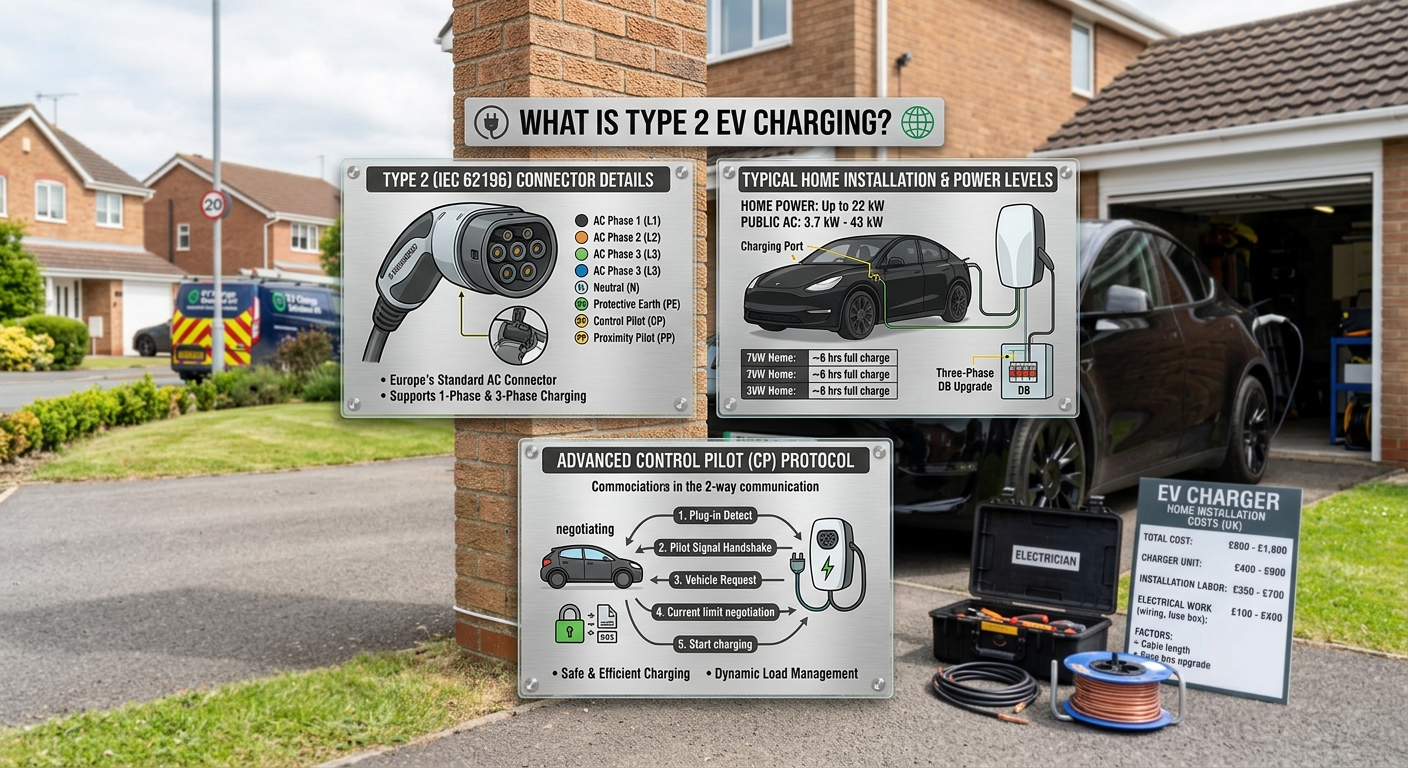
- On a CCS2 car, the top half is the Type 2 plug used in Europe.
- The two extra pins carry high-power DC electricity for fast charging.
Because of this design, the car needs only one port. You can plug in a basic AC charger or a DC fast charger without changing sockets.
CCS1 vs. CCS2: What’s the Difference?
| Feature | CCS1 | CCS2 |
|---|---|---|
| Where it’s used | North America, South Korea | Europe and many other regions |
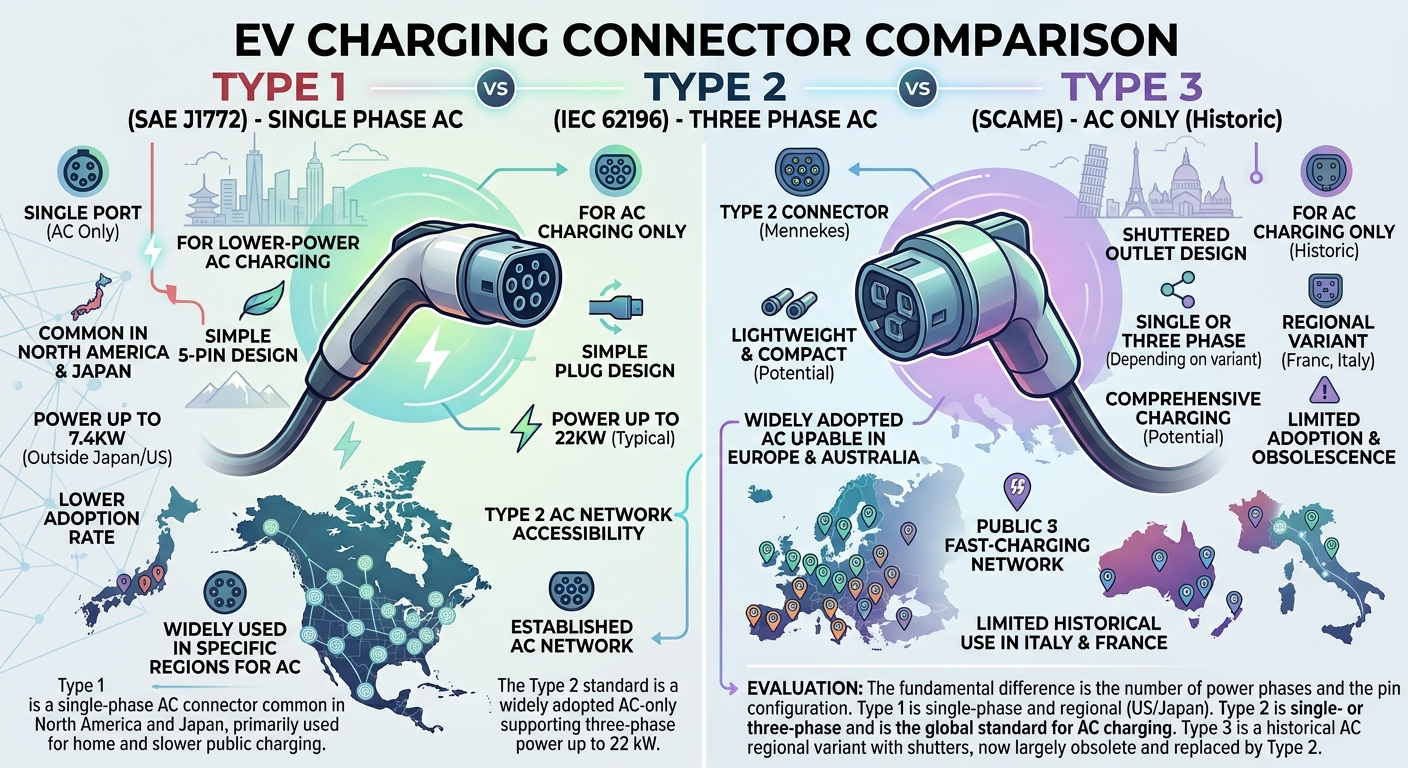
| AC base plug | J1772 (Type 1) | Type 2 |
| Home AC charging | Single-phase | Single-phase or three-phase |
CCS1 and CCS2 are not interchangeable. The plugs are different shapes, so a CCS1 car can’t plug into a CCS2 charger, and the reverse is also true. Both versions use similar communication methods, so the difference is mainly the connector shape and the regional power grid.
How Fast Is CCS Charging?
The CCS2 specification supports up to 350 kW, with a maximum of 920 volts and 500 amps. Real speeds are usually lower, because they depend on:
- Your car’s maximum charging rate. Many EVs can’t accept anywhere near 350 kW.
- The charger’s power output. Many public stations deliver far less than the maximum.
- Battery temperature and charge level. Charging slows as the battery fills.
The plug itself is rarely the limit. Your car and the charger decide the speed.
Is CCS Used for Charging at Home?
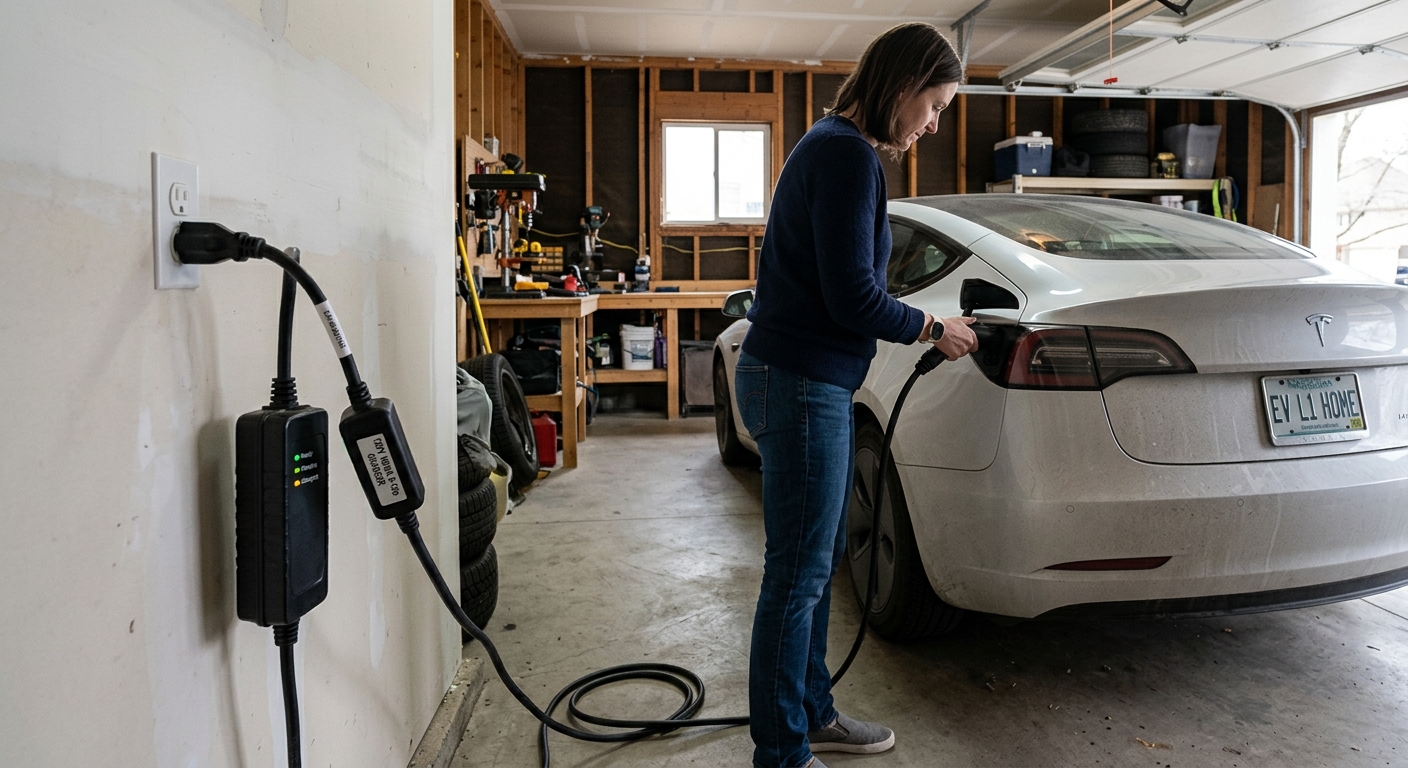
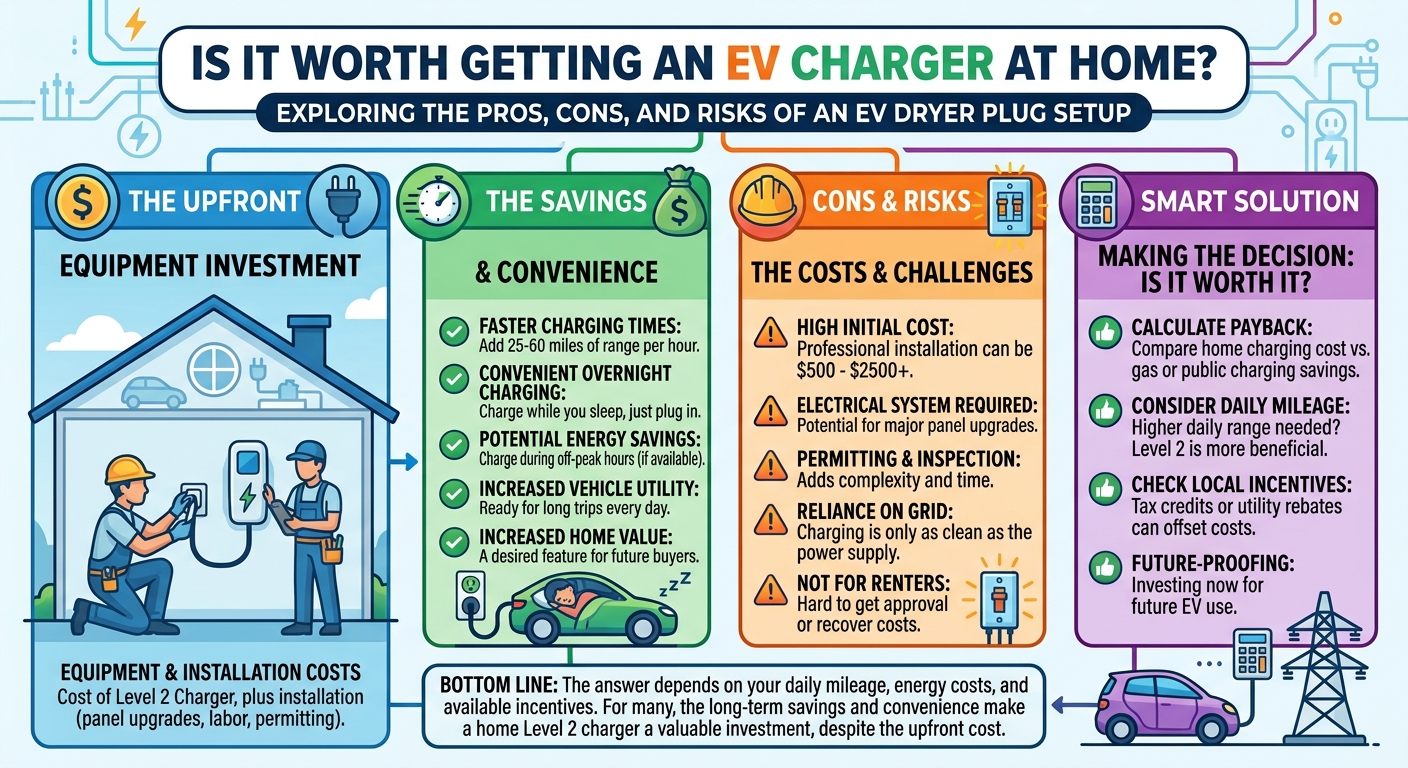
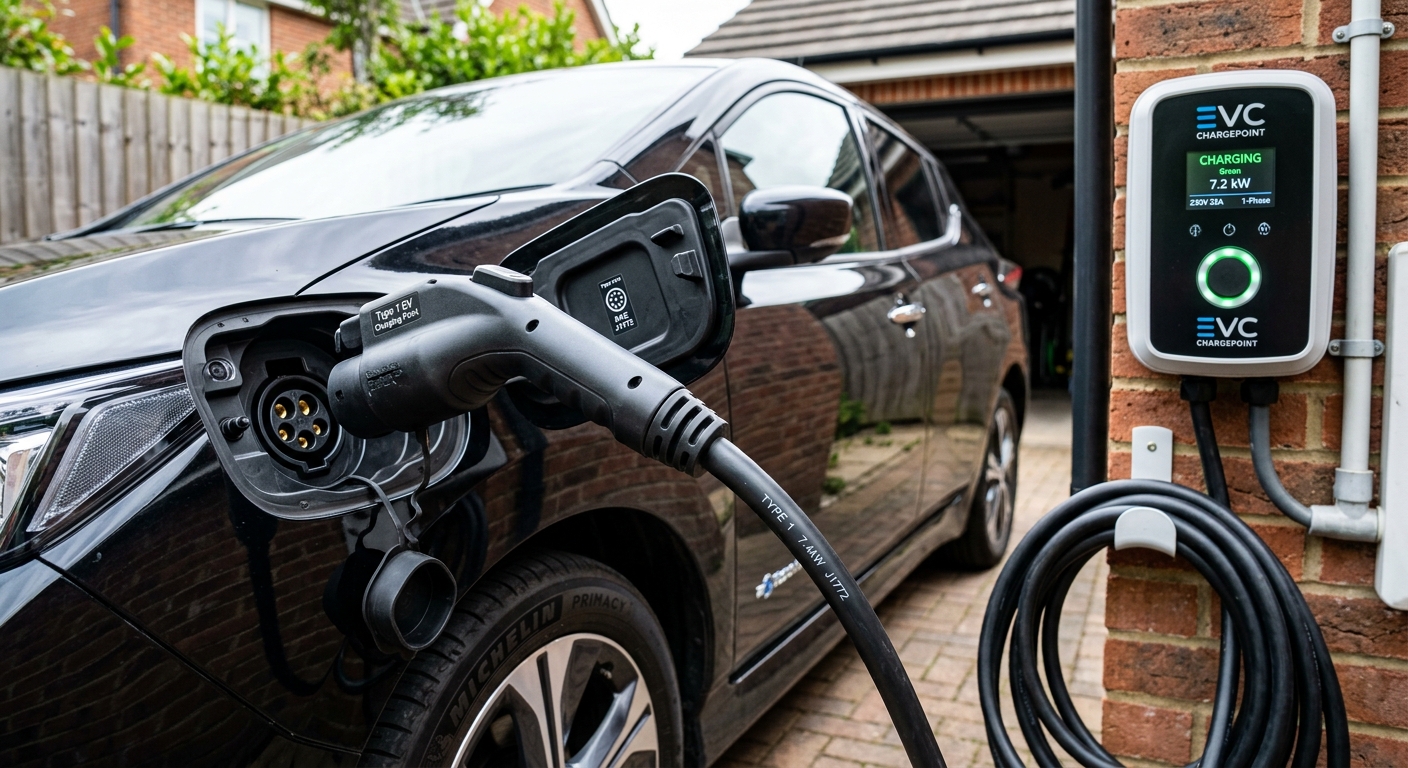
Not for DC fast charging. Home chargers deliver AC power through the top part of the plug (J1772 or Type 2). That’s what Level 2 home charging uses. The DC pins are used at public fast chargers, because high-power DC equipment is large and expensive.
If you’re setting up home charging, read about Level 2 charging. For public fast charging, see our DC fast charging guides.
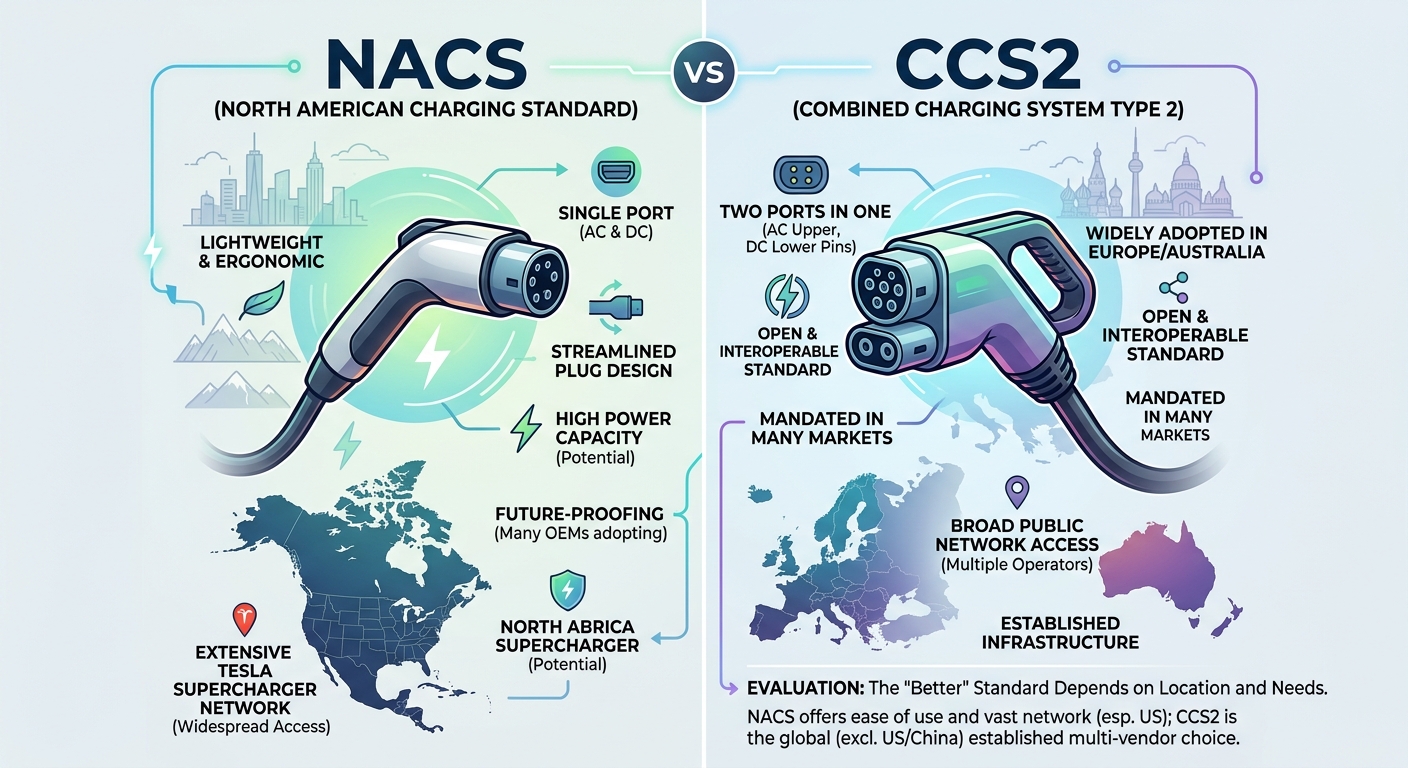
CCS vs. NACS: What Changed?
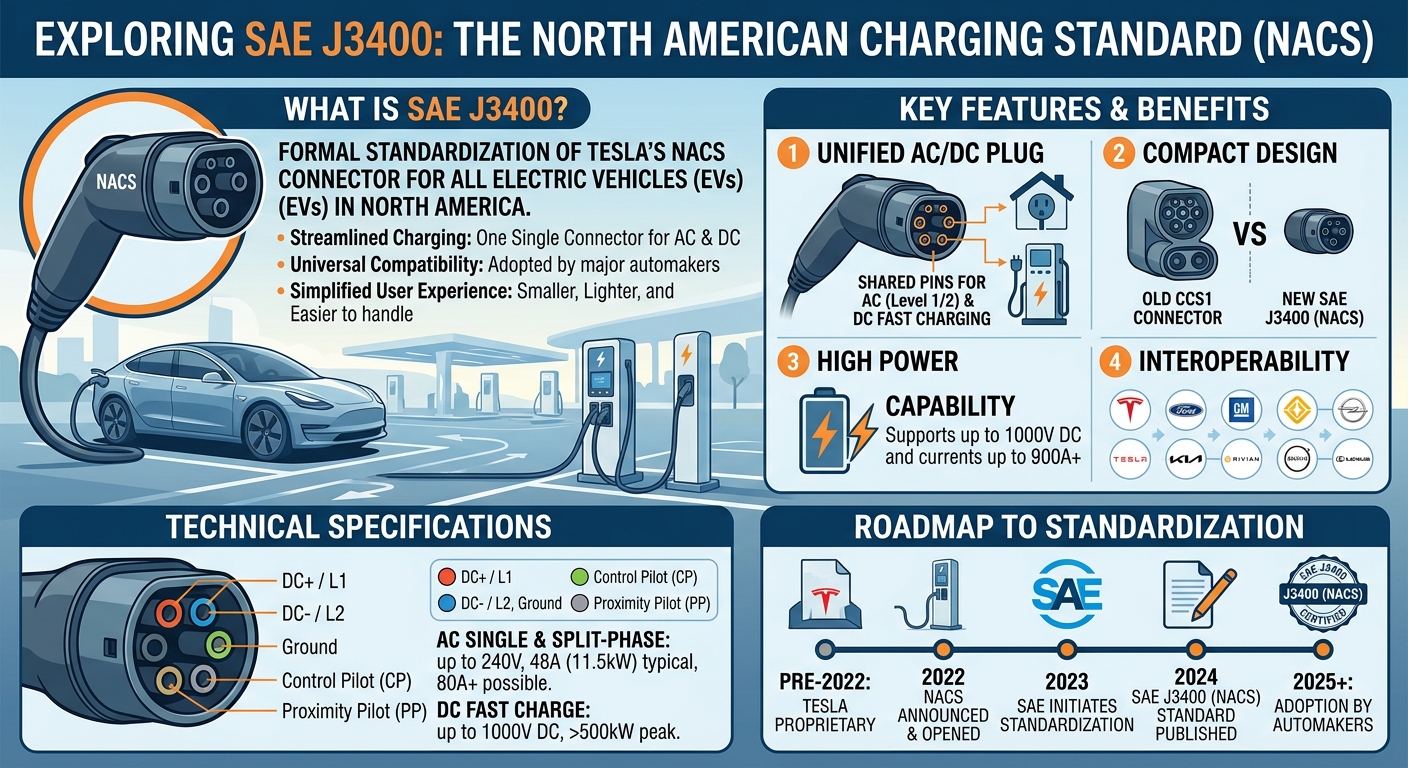
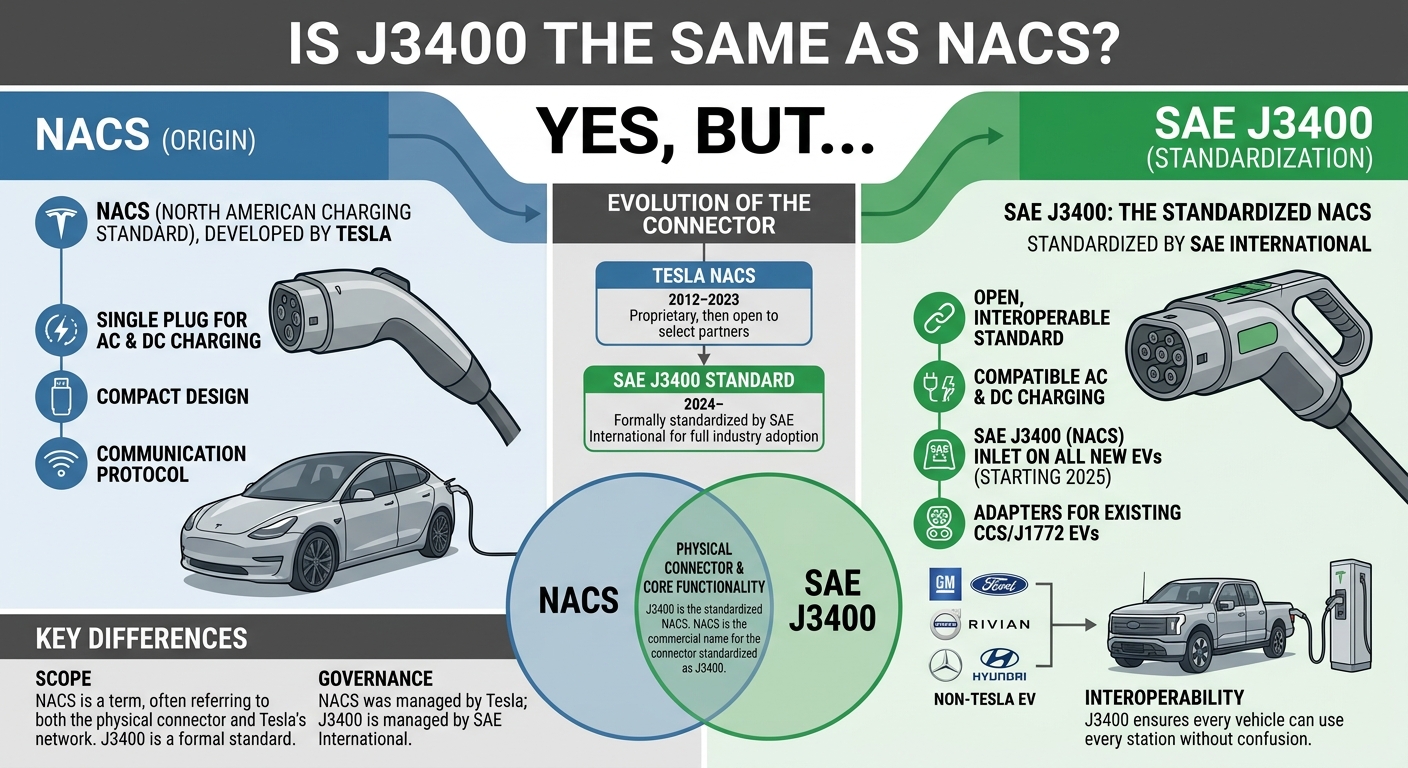
In North America, Tesla’s connector, the North American Charging Standard (NACS), is now standardized as SAE J3400. Ford, GM and Rivian announced in 2023 that they would move from CCS to NACS, and the J3400 standard was finalized in September 2024. Most major automakers selling EVs in North America have since announced NACS support.
What this means for you:
- Existing CCS1 cars aren’t obsolete. Many EVs built through about 2024 use CCS1, and CCS1 chargers are still widely installed.
- Adapters bridge the gap. Many drivers use adapters to use one type of station with the other. Check that your car’s maker supports this.
- Some new stations offer both. Many North American fast-charging stations now include both CCS1 and NACS connectors.
- Europe is different. CCS2 remains the main standard there.
Other Plug Types You May See
- J1772 / Type 2: the AC-only plugs used for Level 2 charging.
- NACS (J3400): Tesla’s compact connector for AC and DC in one plug.
- CHAdeMO: an older DC fast charging standard used on some older Nissan Leaf models.
What Should You Check Before Buying or Charging?
- Look at your car’s charge port. It will show whether it’s CCS1, CCS2, NACS or another type.
- Check the charger’s connector before you drive to a station.
- Ask about adapters if you plan to use stations that don’t match your car’s plug.
- Buying used? Confirm the port type, since standards differ by country and model year.
Frequently Asked Questions
What does CCS stand for in EV charging?
CCS stands for Combined Charging System.
Is CCS fast charging?
Yes. CCS supports DC fast charging, and the CCS2 specification allows up to 350 kW. It also works for slower AC charging.
What is the difference between CCS1 and CCS2?
CCS1 uses the J1772 plug and is common in North America. CCS2 uses the Type 2 plug and is common in Europe. They aren’t interchangeable.
Can I use CCS for home charging?
Home charging uses the AC part of the plug (J1772 or Type 2). DC fast charging via CCS is mainly for public stations.
Is CCS being replaced by NACS?
In North America, many automakers are moving to NACS (SAE J3400), but CCS1 cars and chargers are still in wide use. In Europe, CCS2 remains the standard.
Can a CCS1 car use a CCS2 charger?
No. The plugs are different shapes and aren’t compatible.
Do Teslas use CCS?
Tesla vehicles in Europe use CCS2. In North America, Teslas use NACS, and some models may use CCS stations with an adapter. Check with Tesla for your model.
What is the maximum speed of CCS?
Up to 350 kW in the CCS2 specification. The speed you actually get depends on your car and the charger.
Final Takeaway
CCS is a single-port charging standard for both AC and DC fast charging, split into CCS1 (North America) and CCS2 (Europe and elsewhere). NACS is changing the North American market, but CCS cars and stations aren’t going away overnight. Check your car’s port type before you plan a trip or buy a charger.
Have a question about your charging setup? Contact us, or explore our charging types guides and charger articles.
Disclaimer: Charging standards and adapter support vary by vehicle, region and model year. Check your car’s manual or manufacturer for compatibility.





Leave a Reply