
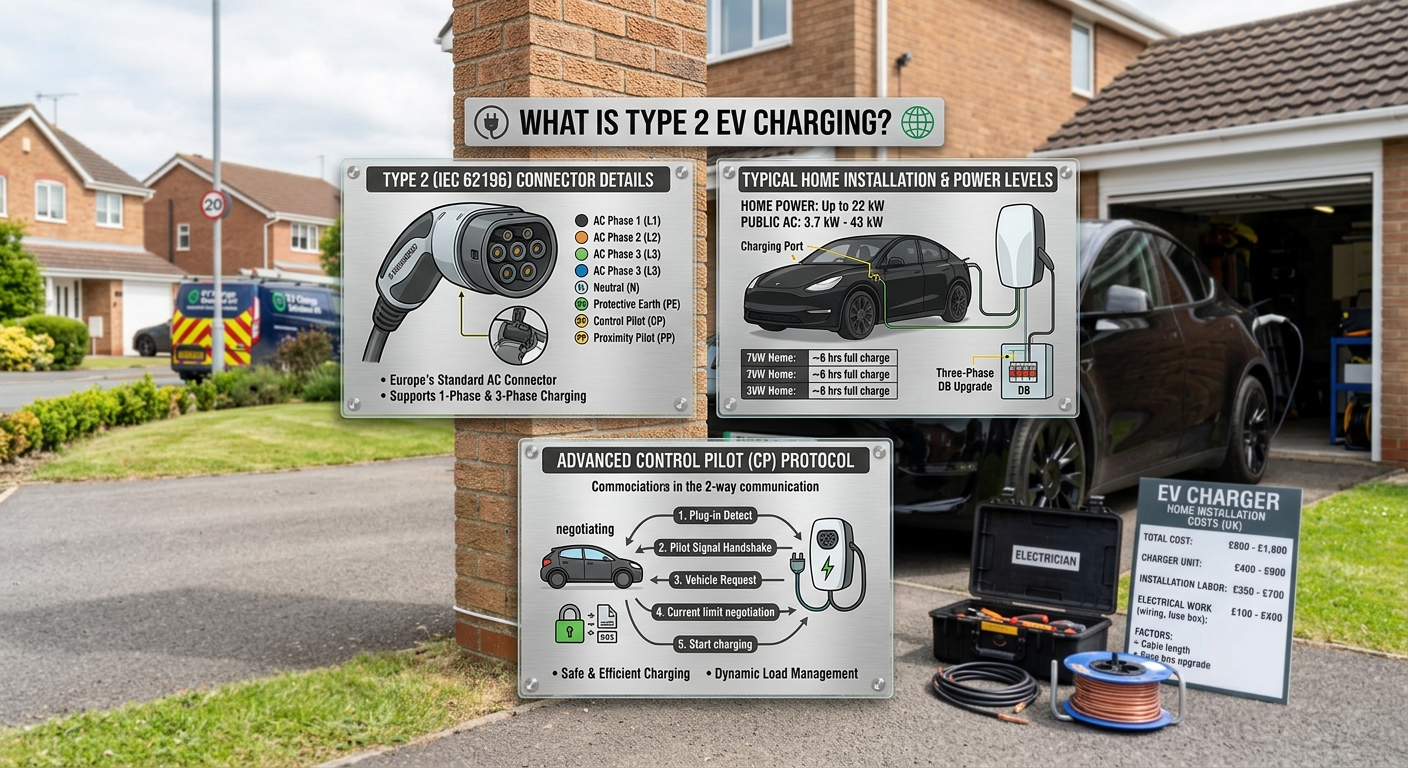
If you own or manage an electric vehicle (EV) across Europe, the United Kingdom, Australia, or many parts of Asia, you interact with Type 2 EV charging almost every time you plug in at home, work, or public destination chargers.
Formally designated as IEC 62196-2 Type 2—and widely known across the automotive industry as the Mennekes plug—the Type 2 connector is the official standard for Alternating Current (AC) charging across the European Union and many international export markets. Unlike older single-phase connectors, the Type 2 interface was engineered from the ground up to support both standard single-phase residential grids and high-power three-phase AC utility grids, enabling remarkably fast AC charging speeds without requiring bulky external DC equipment.
In this deep-dive guide, we cover everything you need to know about Type 2 EV charging: how its 7-pin geometry works, power ratings, mathematical charging time calculations, and how it pairs with CCS2 for ultra-fast DC charging.
To learn more about optimizing your home wallbox or public destination charger, check out our guide to smart charging technology. For a comprehensive overview of how AC compares to DC fast charging, explore our breakdown of global charging types or head straight to our main portal at EV Charger Advisor.
1. What Is a Type 2 (Mennekes) Connector?
Developed in 2009 by the German manufacturer Mennekes, the Type 2 plug was officially selected by the European Commission in 2013 as the mandatory standard AC charging interface for electric road vehicles across all EU member states.
Key Physical & Mechanical Characteristics
-
Shape & Form Factor: A distinct circular plug with a flattened top edge to ensure correct orientation during insertion.
-
7-Pin Layout: Contains seven conductive pin slots designed to transmit power, ground bonding, and high-frequency control handshakes between the charger and the car.
-
Built-in Mechanical Locking Latch: Features an automated solenoid lock mechanism built into the vehicle inlet. Once charging begins, the vehicle locks the plug in place, preventing unauthorized unplugging, cable theft, or accidental disconnection while under high voltage.
         Type 2 Connector Pin Mapping
      ┌─────────────────────────────────┐
      │     (CP)               (PP)     │  <-- Control & Proximity Pilots
      │                                 │
      │   (L1)       (N)       (L2)     │  <-- AC Power Line 1, Neutral, Line 2
      │                                 │
      │        (PE)         (L3)        │  <-- Protective Earth & Line 3
      └─────────────────────────────────┘
2. Technical Breakdown: Understanding the 7 Pins
Every pin inside a Type 2 connector serves a dedicated electrical or communication function to guarantee safety and performance:
| Pin Designation | Full Name | Primary Function |
| L1 | Line 1 | Transmits Phase 1 AC power current from grid to vehicle. |
| L2 | Line 2 | Transmits Phase 2 AC power current (active only in 3-phase setups). |
| L3 | Line 3 | Transmits Phase 3 AC power current (active only in 3-phase setups). |
| N | Neutral | Completes the AC circuit path back to the supply transformer. |
| PE | Protective Earth | Ground safety wire. Protects against shock hazards and equipment faults. |
| CP | Control Pilot | Communication signal line carrying Pulse Width Modulation (PWM) handshakes. |
| PP | Proximity Pilot | Detects plug insertion and communicates cable maximum current capacity. |
3. Power Outputs & Charging Speeds: Single-Phase vs. Three-Phase
The true engineering versatility of Type 2 charging lies in its ability to operate on single-phase or three-phase AC utility supplies.
Single-Phase AC Charging (Residential Default)
In standard residential homes with standard single-phase electrical panels (230V phase-to-neutral):
-
16 Amp Single-Phase: Operates at $230\text{V} \times 16\text{A} = \mathbf{3.7\text{ kW}}$ (Typical portable trickle charger or basic wallbox).
-
32 Amp Single-Phase: Operates at $230\text{V} \times 32\text{A} = \mathbf{7.4\text{ kW}}$ (Standard UK and European residential home wallbox installation).
Three-Phase AC Charging (Commercial & High-Power Residential)
In commercial locations, workplaces, or European homes equipped with three-phase 400V power distribution:
-
16 Amp Three-Phase: Operates at $\sqrt{3} \times 400\text{V} \times 16\text{A} = \mathbf{11\text{ kW}}$ (Standard capability for most modern EV onboard chargers).
-
32 Amp Three-Phase: Operates at $\sqrt{3} \times 400\text{V} \times 32\text{A} = \mathbf{22\text{ kW}}$ (High-power public AC destination chargers).
-
63 Amp Three-Phase: Operates at $\sqrt{3} \times 400\text{V} \times 63\text{A} = \mathbf{43\text{ kW}}$ (Found on select legacy public AC chargers).
4. Mathematical Deep Dive: Calculating Type 2 AC Power Delivery
To understand how Type 2 power is derived, we apply standard electrical engineering power formulas for AC systems.
Formula 1: Single-Phase Power ($P_{\text{1-phase}}$)
Where:
-
$V$ = Line voltage (typically $230\text{V}$ in Europe/UK).
-
$I$ = Current in Amperes.
Formula 2: Three-Phase Power ($P_{\text{3-phase}}$)
Where:
-
$\sqrt{3} \approx 1.732$ (Mathematical phase offset factor for a balanced three-phase system).
-
$V_{\text{L-L}}$ = Line-to-line voltage ($400\text{V}$ in standard European three-phase distribution).
-
$I$ = Current per phase in Amperes.
Step-by-Step Practical Calculation
Suppose a driver plugs a vehicle with a 60 kWh battery pack (charging from 20% to 100%) into a public 22 kW Type 2 three-phase charger.
Step 1: Calculate Energy Required ($\Delta E$)
Step 2: Verify Maximum 3-Phase Power Output
Step 3: Account for Vehicle Onboard Charger (OBC) Bottleneck
Important Technical Note: The actual charging speed is always limited by the vehicle’s internal Onboard Charger (OBC). Even if the Type 2 station delivers 22 kW, if the vehicle’s OBC is rated for only 11 kW, the maximum charge rate will be 11 kW.
Assuming the vehicle has an 11 kW OBC with a 90% AC-to-DC conversion efficiency ($\eta = 0.90$):
Step 4: Calculate Total Charging Time ($T$)
5. Type 2 vs. CCS2: What Is the Difference?
A common point of confusion among new EV drivers is the relationship between Type 2 and CCS2 (Combined Charging System 2).
-
Type 2 (AC Only): Uses the standard 7-pin upper connector for single-phase or three-phase AC charging up to 22 kW (or 43 kW).
-
CCS2 (AC & High-Power DC): Extends the standard Type 2 inlet by adding two large, high-amperage direct current (DC) power pins directly below the circular Type 2 block.
Because the upper portion of a CCS2 inlet on a vehicle is identical to a standalone Type 2 socket, you can plug a standard Type 2 cable directly into a CCS2 vehicle port for home or destination AC charging.
   Standalone Type 2 (AC)            CCS2 Combo Connector (AC + DC)
   ┌───────────────────┐             ┌───────────────────┐
   │   (L1) (N) (L2)   │             │   (L1) (N) (L2)   │
   │  (CP) (PE) (PP)   │             │  (CP) (PE) (PP)   │
   │       (L3)        │             │       (L3)        │
   └───────────────────┘             └───────────────────┘
                                     │  [ DC+ ]  [ DC- ] │  <-- Added DC Pins
                                     └───────────────────┘
6. Global Adoption and Market Presence
While North America has transitioned toward NACS (SAE J3400) and legacy CCS1, the Type 2 interface remains the indisputable monarch of AC charging across the rest of the world:
-
European Union & UK: Mandatory standard for all public AC chargers and European production EVs.
-
Australia & New Zealand: Official national standard for AC public infrastructure and consumer EVs.
-
South America & Southeast Asia: Broadly adopted across modern public infrastructure import networks.
-
North America (Niche Use): Rarely used on passenger vehicles, though adapters exist for international import testing and commercial transit hubs.
7. Summary
Type 2 EV charging stands out as one of the most flexible, future-proof AC charging standards in the electric mobility sector. By natively supporting both single-phase 230V residential connections and three-phase 400V commercial power distribution, the Type 2 Mennekes design delivers safe, reliable, and high-efficiency charging anywhere from private garages to public parking hubs.

















Leave a Reply