
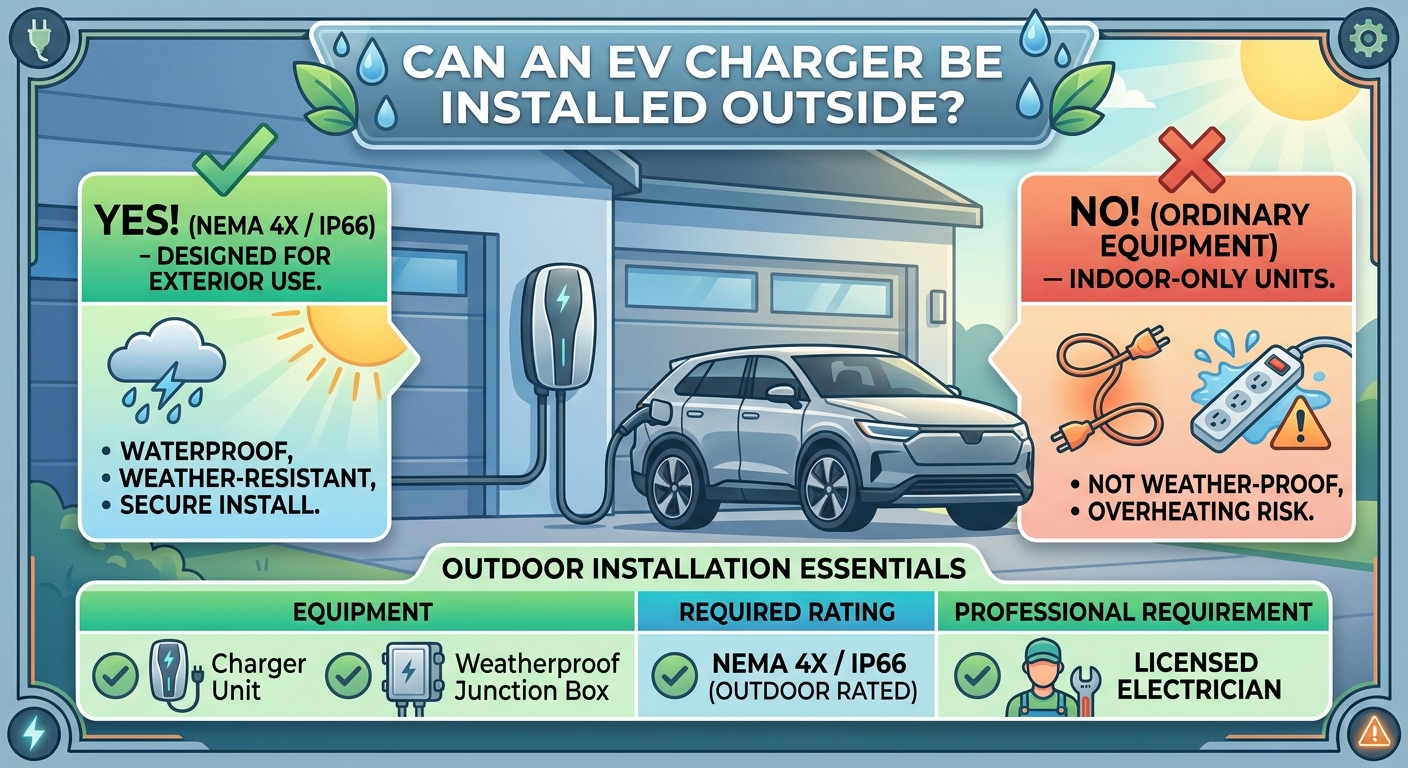
Most Level 2 EV chargers are designed for outdoor use, as long as they carry an outdoor rating (NEMA 3R or 4) and are installed with weatherproof conduit, grounding and GFCI protection. Always confirm the rating before you buy, because an unrated charger shouldn’t go outside, even under a carport.
Quick answer by situation
| Situation | Outdoor install OK? |
|---|---|
| Hardwired Level 2 charger, NEMA 3R or 4 rated | Yes |
| Plug-in Level 2 charger on a weather-resistant outlet | Yes, with a suitable cover |
| Charger with no listed NEMA/IP rating | No |
| Exposed wiring without conduit | No |
What rating does an outdoor charger need?
The enclosure rating tells you what weather the charger can handle:
| NEMA rating | Protects against | Best for |
|---|---|---|
| 3R | Rain, sleet and snow, with drainage | The minimum for outdoor use, and mild or sheltered locations |
| 4 | Everything in 3R, plus windblown dust and hose-directed water | Most exposed outdoor installs |
| 4X | Everything in 4, plus corrosion resistance | Coastal areas |
For most outdoor installations, NEMA 4 is the better choice, and it’s worth the upgrade for exposed positions. In coastal locations, pair a NEMA 4X unit with stainless steel conduit to resist salt air.
An enclosure rating isn’t a temperature rating
These are separate specifications. A NEMA rating describes protection against water and dust, not how cold the unit can operate. Check the manufacturer’s operating temperature range, because some units work down to -20°F while others only to 14°F. If you live somewhere with hard winters, also check how flexible the cable stays in the cold.
Code requirements you can’t skip
- A dedicated 240-volt circuit: Your outdoor charger needs its own circuit.
- GFCI protection: Required by code for outdoor EV charging equipment, and it’s what protects you from shock.
- Weatherproof hardware: All conduit fittings, connectors and junction boxes outdoors need a weatherproof or raintight rating.
- A permit: Most jurisdictions require one for a new 240V circuit.
Want an installer to check your site? Get a quote from a licensed installer https://evchargeradvisor.online/
Wiring and conduit outdoors
Any wiring exposed to the weather must run in protective conduit. Electricians typically use EMT or rigid metal conduit for permanent runs, with liquid-tight flexible conduit for short transitions near the charger.
If the run goes underground, for example to a driveway or detached garage, the electrician will use direct-burial wire or buried conduit. Burial depth depends on the conduit type and local code. A 2-inch conduit leaves room to pull additional circuits later.
Where to mount your outdoor charger
- Height: Manufacturer guidance varies. One brand recommends 24-48 inches off the ground and warns against mounting below 24 inches to avoid water damage. Another installer guide suggests 48-54 inches for a natural working height. Follow your charger’s instructions.
- Cable reach: For most outdoor installs, a cable of at least 20 feet gives you flexibility.
- Shelter: An eave or carport helps, especially in a mild climate with a 3R unit.
- Snow and plough spray: Height and position matter in winter.
- Security: Consider a locking charger or cord lock if your driveway is accessible.
Plug-in vs hardwired outdoors
A hardwired charger connects straight to the circuit, so there’s no outlet to weatherproof. A plug-in charger needs a weather-resistant NEMA 14-50 receptacle with a cover that closes and locks while the plug is in use. In both cases, the charger itself must still be outdoor-rated.
Detached garages and driveways
Running power across your yard means trenching and buried conduit or direct-burial cable. It’s well within a licensed electrician’s normal scope, but it raises the job’s complexity, so ask for a site visit before you buy a charger.
Quick checklist
- Choose a NEMA 3R or 4 rated charger, with 4X for coastal areas.
- Check the operating temperature range for your climate.
- Plan a dedicated 240V circuit with GFCI protection.
- Run all exposed wiring in conduit.
- Choose a mounting spot with good cable reach, shelter and security.
- Get the permit and inspection.
Next step: Compare outdoor-rated Level 2 chargers https://evchargeradvisor.online/
FAQs
Can an EV charger be installed outside?
Yes, if it’s rated for outdoor use (NEMA 3R or 4) and installed correctly.
What NEMA rating do I need for an outdoor EV charger?
NEMA 3R is the minimum. NEMA 4 is better for exposed locations, and 4X for coastal areas.
Can I install a charger outdoors under a carport?
Yes, but use an outdoor-rated unit. A carport doesn’t make an unrated charger suitable.
Do outdoor EV chargers need GFCI protection?
Yes, code requires it for outdoor EV charging equipment.
Can EV chargers work in cold weather?
Yes, but check the operating temperature range, because it varies between models.
Do I need conduit for an outdoor EV charger?
Yes. Exposed wiring should run in conduit rated for the location.
Do I need a permit for an outdoor EV charger?
In most jurisdictions, yes.
Final thoughts
Outdoor installation is routine for modern chargers. Pick the right rating for your climate, protect the wiring properly, and have a licensed electrician handle the circuit and permit.
Ready to start? Get a licensed installer quote https://evchargeradvisor.online/
General information based on US NEC guidance. Local codes vary. Always have a licensed electrician assess your installation.

















Leave a Reply