
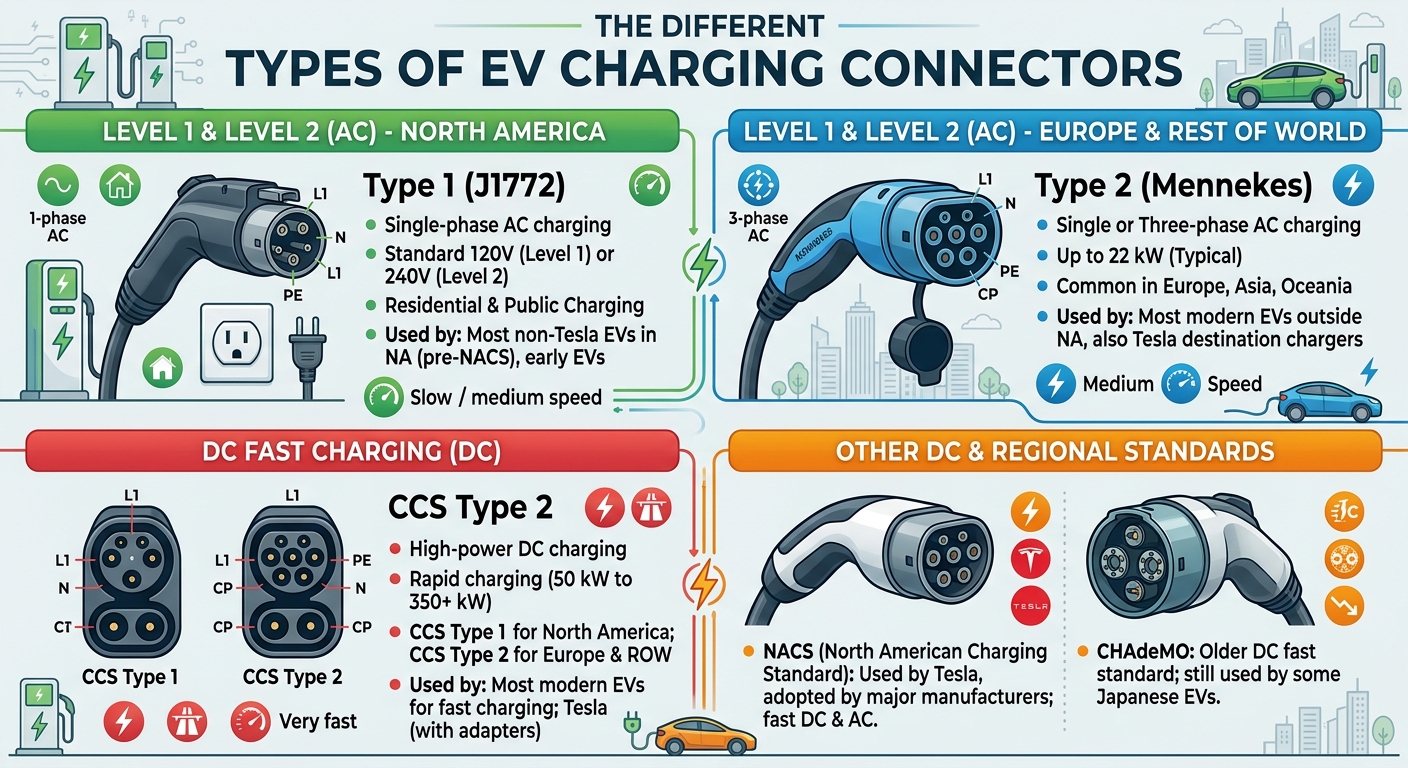
As electric vehicles (EVs) go mainstream across North America, Europe, Asia, and beyond, one of the most practical questions drivers, fleet engineers, and property managers face is: why are there so many different EV charging connectors, and how do they work?
Just as mobile phones historically went through a phase of competing charger ports (30-pin, Micro-USB, Lightning, and USB-C), electric vehicles utilize different charging plugs based on their region of sale, whether they are using Alternating Current (AC) or Direct Current (DC), and the underlying capabilities of the local power grid.
In this comprehensive guide, we unpack the technical differences between every major EV connector standard in use today, explain how AC and DC charging mechanics work, and outline how adapters bridges the gap across modern charging networks.
To learn more about optimizing charger delivery rates and intelligent grid integration, visit our dedicated section on smart charging. You can also dive into our broader breakdown of charging types or head straight to our homepage at EV Charger Advisor for deep dives into hardware reviews and installation planning.
1. Fundamentals First: AC vs. DC Charging Electronics
To understand EV connector geometry, you must first understand where electrical conversion happens.
AC Charging (Home/Destination):
[Grid AC Power] ──> [AC Charger / Cable] ──> [EV In-Port] ──> [Onboard Converter (OBC)] ──> [DC to Battery Pack]

DC Fast Charging (Highway Corridors):
[Grid AC Power] ──> [High-Power Offboard Converter Station] ──> [DC Direct to Battery Pack]
Alternating Current (AC) Charging
All utility grids supply power in Alternating Current (AC). However, EV lithium-ion batteries can only store energy as Direct Current (DC). When you plug into an AC wallbox or Level 2 destination charger:
-
Grid AC power flows through the charging cable directly into the vehicle’s charge port.
-
The vehicle’s internal Onboard Charger (OBC) converts that AC electricity into DC energy.
-
The converted DC power is routed to the battery pack.
Because the onboard charger is constrained by weight, space, and heat limitations, AC charging is inherently slower (typically ranging from 3.7 kW up to 22 kW).
Direct Current (DC) Fast Charging
DC fast charging circumvents the vehicle’s onboard converter altogether. The massive offboard charging station converts high-voltage AC electricity from the grid into DC power directly inside the station enclosure.
-
That DC electricity is pumped straight into the battery pack via heavy-duty liquid-cooled cables.
-
Because the station handles the conversion workload, power outputs range from 50 kW up to 350+ kW.
2. AC Charging Connectors: Level 1 and Level 2 Standards
AC charging connectors handle daily home charging, workplace top-ups, and public destination parking.
A. Type 1 / SAE J1772 (North America & Japan)
-
Current Type: Single-phase AC
-
Max AC Power Output: Up to 19.2 kW (at 240V, 80A)
-
Pin Layout: 5-pin circular connector (Line 1, Line 2/Neutral, Protective Earth ground, Control Pilot, Proximity Pilot)
-
Overview: Developed by the Society of Automotive Engineers (SAE), J1772 was the standard AC connector for non-Tesla EVs in North America for over a decade. It features a physical manual latch mechanism that prevents accidental disconnection while charging.
B. Type 2 / Mennekes (Europe, UK, Australia, Middle East)
-
Current Type: Single-phase and Three-phase AC
-
Max AC Power Output: Up to 7.4 kW (Single-phase) or 22 kW to 43 kW (Three-phase)
-
Pin Layout: 7-pin circular design with a flattened top edge
-
Overview: European electrical infrastructure widely delivers three-phase utility power to residential and commercial properties. The Type 2 standard, originally designed by Mennekes, utilizes additional pin conductors for Phase 2 and Phase 3 power, delivering triple the AC charging speeds of single-phase systems.
3. DC Fast Charging & Combo Connectors
To enable high-speed charging along highway corridors, automotive engineering groups created unified DC fast charging standards.
A. NACS / SAE J3400 (North American Charging Standard)
-
Current Type: Unified AC (Single-phase) and High-Voltage DC
-
Max Power Output: Up to 11.5 kW AC / 250 kW to 500+ kW DC
-
Pin Layout: Ultra-compact single port using shared pins for both AC and DC current transmission
-
Overview: Originally developed as Tesla’s proprietary connector, it was opened as the open standard NACS (SAE J3400). Because of its compact ergonomic handle and native integration with the Tesla Supercharger network, virtually all major automakers operating in North America (including Ford, GM, Rivian, Hyundai, Kia, BMW, and Toyota) have transitioned to NACS ports on their production vehicles.
B. CCS1 (Combined Charging System 1 – North America)
-
Current Type: AC and high-power DC fast charging
-
Max Power Output: Up to 360 kW DC
-
Pin Layout: Combines a standard J1772 AC inlet with two large, high-amperage direct current pins positioned underneath.
-
Overview: CCS1 was the primary DC fast-charging standard for legacy non-Tesla vehicles in North America. While legacy vehicles still use CCS1 natively, automakers are providing certified CCS1-to-NACS adapters to transition legacy fleets over to NACS hardware.
C. CCS2 (Combined Charging System 2 – Europe & Global Export Markets)
-
Current Type: Single/Three-phase AC and DC fast charging
-
Max Power Output: Up to 350–400 kW DC
-
Pin Layout: Combines a Type 2 AC connector with two large DC power pins below.
-
Overview: Required by European regulatory standards, CCS2 is the dominant fast-charging standard across Europe, the UK, South America, Africa, Australia, and parts of Asia.
D. CHAdeMO (Japan & Legacy Global Models)
-
Current Type: Dedicated DC fast charging
-
Max Power Output: 50 kW to 100 kW (up to 400 kW in rare liquid-cooled setups)
-
Pin Layout: Large, round 10-pin standalone connector
-
Overview: Developed in Japan by the CHAdeMO Association, this early fast-charging standard supported bidirectional vehicle-to-grid (V2G) power transfer. Outside of Japan, CHAdeMO is declining as legacy vehicles like the early Nissan Leaf phase out in favor of CCS2 and NACS.
E. GB/T 20234 (China)
-
Current Type: Dual separate ports for AC and DC
-
Max Power Output: Up to 7.4 kW AC / 237.5 kW to 250 kW DC (up to 900 kW under new ChaoJi specs)
-
Pin Layout: China requires two distinct vehicle inlets: a 7-pin AC port and a distinct 9-pin DC fast-charging port.
-
Overview: Mandated across mainland China, the GB/T architecture powers the largest EV fleet in the world. China is currently co-developing the next-generation ultra-fast ChaoJi standard to push DC outputs past 900 kW for passenger cars and heavy commercial trucks.
4. Technical Summary Matrix of Global Connector Types
| Connector Name | Primary Current | Primary Region | Max AC Power | Max DC Power | Dual-Duty Port? |
| SAE J1772 (Type 1) | AC | North America, Japan | 19.2 kW | N/A | No (AC only) |
| Type 2 (Mennekes) | AC | Europe, UK, Australia | 22–43 kW | N/A | No (AC only) |
| NACS (SAE J3400) | AC & DC | North America | 11.5 kW | 250–500 kW+ | Yes (Unified pins) |
| CCS1 | AC & DC | North America, S. Korea | 19.2 kW | 360 kW | Yes (Combo design) |
| CCS2 | AC & DC | Europe, Global Exports | 22–43 kW | 400 kW | Yes (Combo design) |
| CHAdeMO | DC | Japan (Legacy worldwide) | N/A | 50–100 kW+ | No (DC only) |
| GB/T | AC & DC (Separate) | China | 7.4 kW | 250–900 kW | No (Separate inlets) |
5. Mathematical Calculation: Determining Charging Speeds & Time
To calculate how fast any connector type will charge an electric vehicle battery, use the following fundamental physics formula:
Where:
-
$\text{SoC}$ = State of Charge expressed as a decimal (e.g., $80\% = 0.80$, $10\% = 0.10$).
-
$\text{Effective Charging Power (kW)} = \text{Voltage (V)} \times \text{Current (A)} / 1000$.
-
$\eta$ = System Efficiency factor (typically ~0.90 to 0.95 due to heat loss during conversion).
Step-by-Step Example Calculation
Imagine charging an 80 kWh EV battery pack from 10% to 80% using two different setups:
Case A: European Three-Phase Type 2 AC Charger (22 kW)
-
Calculate required energy deliverable to battery:
$$\Delta E = 80\,\text{kWh} \times (0.80 – 0.10) = 56\,\text{kWh}$$ -
Assuming $92\%$ onboard charger conversion efficiency ($\eta = 0.92$):
$$\text{Time} = \frac{56\,\text{kWh}}{22\,\text{kW} \times 0.92} \approx \frac{56}{20.24} \approx 2.76\,\text{hours} \quad (2\,\text{hrs}\,45\,\text{mins})$$
Case B: High-Power NACS or CCS2 DC Fast Charger (150 kW Average Rate)
-
Since DC bypasses onboard AC conversion efficiency losses (station handles conversion):
$$\text{Time} = \frac{56\,\text{kWh}}{150\,\text{kW} \times 0.95} \approx \frac{56}{142.5} \approx 0.393\,\text{hours} \quad (\approx 23.5\,\text{minutes})$$
This demonstrates why choosing the correct connector type and power delivery method transforms an overnight charge into a quick roadside stop.
6. Navigating the Adapter Ecosystem
Because multiple connector types coexist worldwide, adapters play a critical role in charging flexibility:
-
NACS to J1772 Adapters: Allow non-Tesla EVs with legacy J1772 ports to plug into Tesla Destination Chargers and Level 2 AC wallboxes.
-
J1772 to NACS Adapters: Allow NACS-equipped vehicles to use standard Level 2 J1772 AC charging hardware.
-
NACS to CCS1 Fast-Charging Adapters: Heavy-duty, temperature-monitored adapters that allow legacy CCS1 vehicles to fast-charge at certified NACS Supercharger locations.
7. Conclusion
Understanding EV connector types comes down to three core factors: your geographic location, the type of power supplied (AC vs. DC), and your vehicle’s physical port geometry. While Europe relies on CCS2 and China operates under GB/T, North America has firmly consolidated around NACS (SAE J3400) alongside legacy CCS1 support.
As charging hardware becomes smarter and universal adapters become standard equipment, EV drivers can seamlessly navigate public and private charging networks with confidence.

















Leave a Reply