
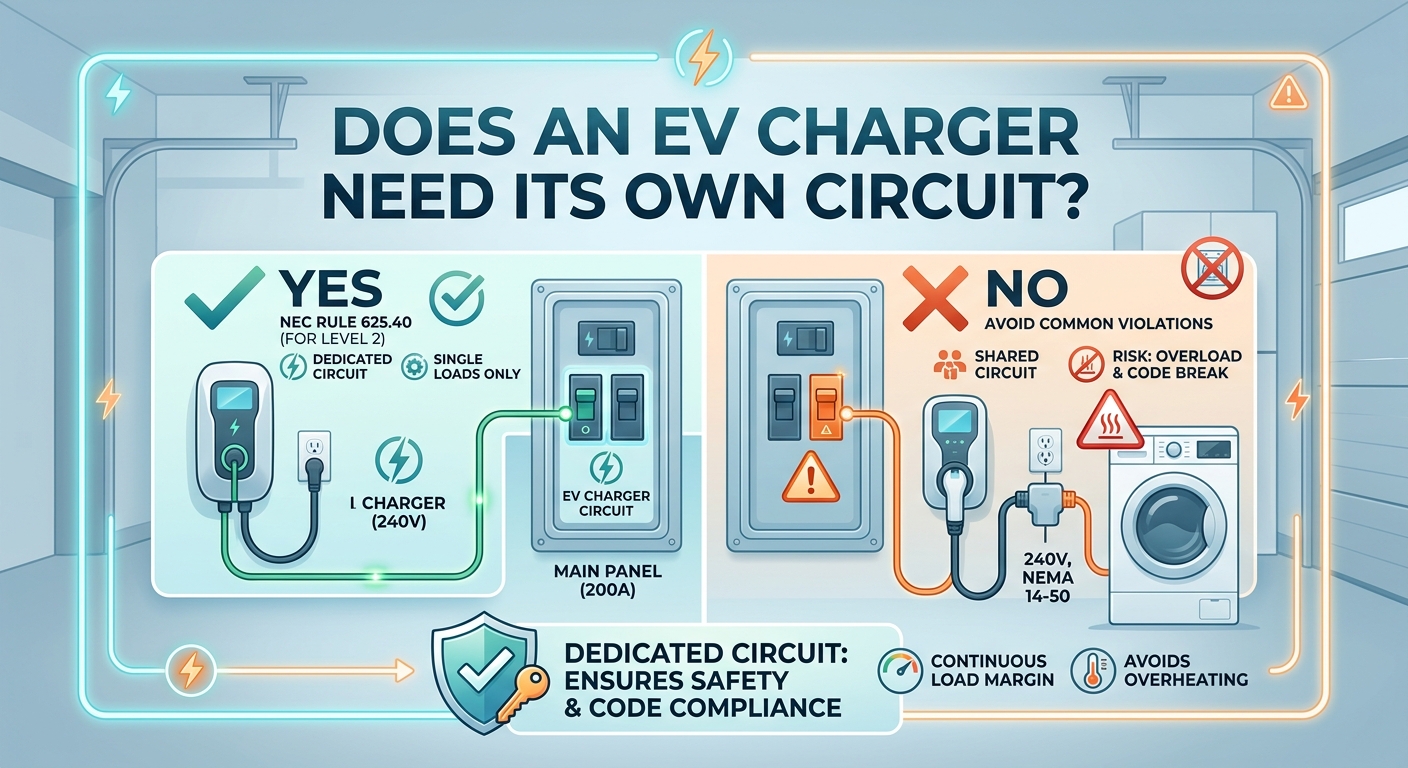
For Level 2 charging, yes. The National Electrical Code (NEC) requires each EV charger to be supplied by its own individual branch circuit, with no other outlets on it. Level 1 charging is more forgiving because it plugs into a standard 120V outlet, but a dedicated circuit is still the safest setup.
Quick answer by situation
| Situation | Dedicated circuit needed? |
|---|---|
| Level 2 (240V) charger | Yes, one individual branch circuit per charger |
| Level 1 (120V) charger | Not strictly required, but strongly recommended |
| Sharing your dryer outlet | No, this breaks the code |
| Two EV chargers | Two dedicated circuits, or a listed load-sharing system |
What the code says
NEC section 625.40 requires each EV charging outlet to be supplied by an individual branch circuit, and that circuit can’t have any other loads on it. The circuit and breaker are also sized at 125% of the charger’s output, because EV charging is a continuous load. A 40-amp charger needs a 50-amp circuit, and a 48-amp charger needs a 60-amp circuit.
Outlets for EV chargers rated 50 amps or less at 125-250 volts also fall under the code’s GFCI protection rules, so confirm the details with your electrician.
What “dedicated” actually means
A dedicated circuit has one job: it powers the charger. That means:
- Its own breaker in the panel
- Its own wiring from the panel to the charger location
- No other outlets, lights or appliances on the same circuit
- Sizing at 125% of the charger’s output
The good news is that installing one is usually less work than people expect. A charger installation typically adds just one new circuit from your panel to the charging spot.
Why sharing a circuit is a problem
EV charging draws a high current for hours at a time. Appliances like ranges, dryers and HVAC units draw too much power to share a standard circuit with other fixtures, and EV chargers are no different. If something else draws power on the same circuit while your car charges, you risk tripped breakers or overloaded wiring.
That’s why the NEC has specific, conservative rules for continuous loads.
Not sure whether your home can support a new circuit? Get a quote from a licensed installer https://evchargeradvisor.online/
Do Level 1 chargers need a dedicated circuit?
Level 1 chargers are plug-and-play. They work with any standard 120V outlet and add roughly 3-5 miles of range per hour. The code’s dedicated-circuit rule is aimed at Level 2 equipment, but you should still know what else shares that breaker and keep other loads low while the car charges.
If you charge nightly, a properly installed outlet on its own circuit is the safest option. Avoid extension cords and power strips.
The dryer-outlet shortcut
Many owners are tempted to unplug the dryer and plug in their EV. Electricians advise against it:
- Dryer outlets aren’t designed for the continuous high-power draw of EV charging.
- A dryer circuit is often wired to a 30-amp breaker. Hooking a charger into it is one of the most common garage retrofit violations.
- Running the dryer and the charger at the same time could trip the breaker.
A better solution is a new dedicated EV circuit, or a load management device that prevents simultaneous use.
What if you have two EVs?
Two vehicles can be handled in two ways:
- Two dedicated circuits: The most reliable option, but it needs the most panel capacity.
- A load-sharing system: Two chargers divide the available amperage on one circuit. Since the 2023 NEC, listed energy management systems can allow shared capacity, so confirm this with your electrician and local inspector.
Check your panel capacity first
A new circuit adds load to your service. Before you commit, an electrician should run a load calculation. Whether you have a 100-amp or 200-amp panel, the same question applies: is there room for the new circuit?
Permits and professional installation
Installing a Level 2 charger generally requires a dedicated 240V circuit, a licensed electrician and a permit. Most jurisdictions also require inspection once the work is finished.
What the installation involves
- A new 2-pole breaker in your panel
- Wire sized for the charger, from the panel to the charger location
- A NEMA 14-50 outlet or a hardwired connection
- Correct sizing at 125% of the charger’s output
- A permit and final inspection
Quick checklist
- Choose a charger no larger than your car can accept.
- Ask an electrician to confirm your panel capacity.
- Plan one dedicated circuit per charger.
- Don’t share your dryer outlet.
- Get the permit and inspection.
Next step: Compare Level 2 home chargers https://evchargeradvisor.online/
FAQs
Does an EV charger need its own circuit?
Level 2 chargers do, under NEC 625.40.
Do Level 1 chargers need a dedicated circuit?
Not strictly, but it’s the safest option. Know what else shares the breaker.
Can I plug my EV charger into my dryer outlet?
It isn’t recommended and can violate code, since a dryer circuit is a shared appliance circuit.
Can two EV chargers share one circuit?
Only with a listed load-sharing system. Otherwise, each needs its own circuit.
How many circuits do I need for two EVs?
Two dedicated circuits, or one shared circuit with a listed load management system.
Do I need a permit for a new EV charger circuit?
In most jurisdictions, yes.
Can I use an existing outlet?
Only if the circuit is otherwise unused, correctly sized and passes inspection. Your electrician decides.
Final thoughts
The rule is simple: one charger, one circuit. Sharing might look like a shortcut, but it’s one of the most common code violations in home charger installs. A proper dedicated circuit protects your wiring, your car and your home.
Ready to start? Get a licensed installer quote https://evchargeradvisor.online/
General information based on US NEC guidance. Local codes vary. Always have a licensed electrician assess your installation.

















Leave a Reply