
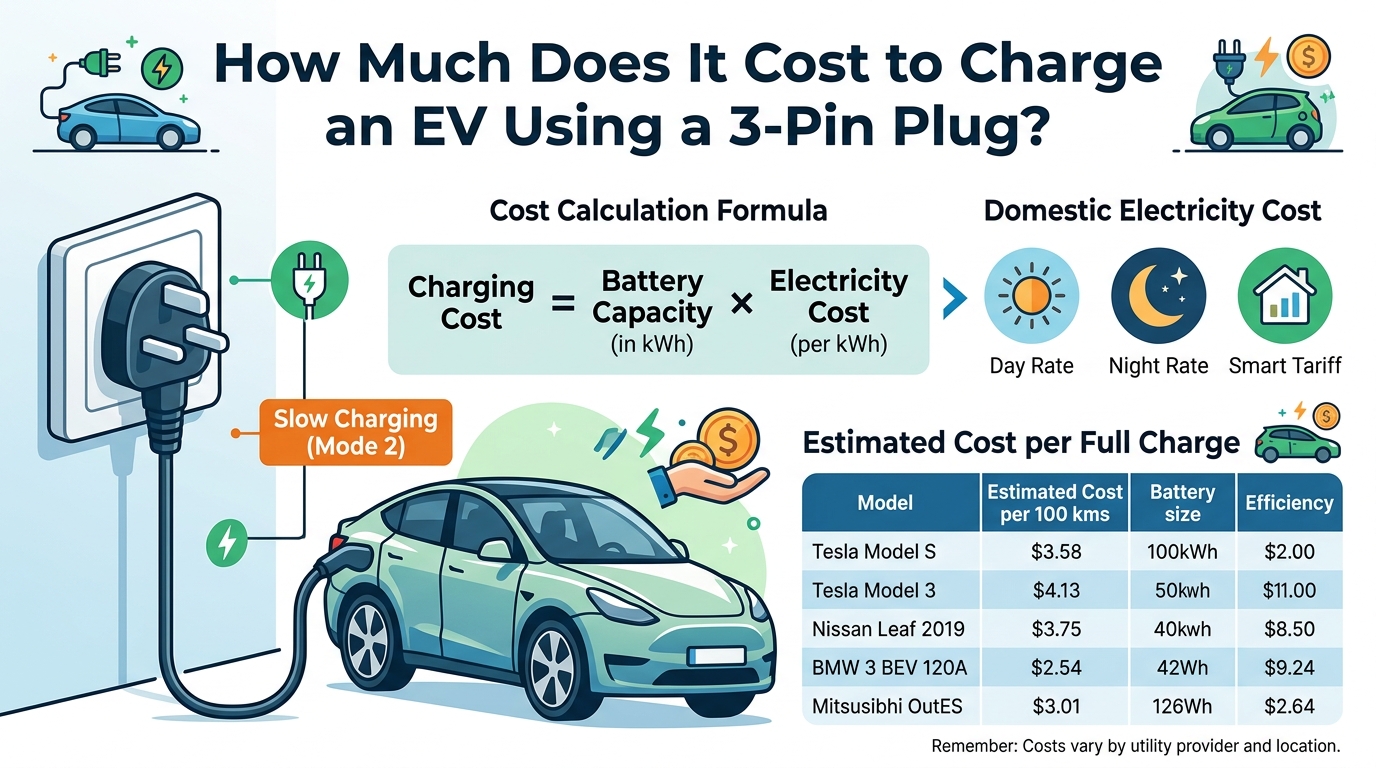
Transitioning to an electric vehicle (EV) opens up entirely new ways to refuel your car without ever visiting a public gas station. For many new owners, one of the most accessible and cost-effective ways to get started is by utilizing standard household infrastructure. To answer directly: Charging an electric vehicle (EV) using a standard domestic 3-pin plug (often called Level 1 or “granny” charging) costs between £2.80 and £19.30 in the UK, or $4.80 to $16.84 in the US for a single session, depending entirely on your energy tariff and battery size.
Often referred to as trickle charging or emergency charging, plugging your EV into a standard wall outlet requires no expensive hardware installation, making it an appealing option for apartment dwellers, rural travelers, or weekend drivers. However, because standard electrical outlets deliver low amperage, the session duration is exceptionally long, and conversion losses can impact your overall utility bill.
Here is an extensive, comprehensive guide examining the financial reality of 3-pin charging, step-by-step mathematical breakdowns for both UK and US markets, thermal efficiency losses, and a realistic assessment of when granny charging makes financial sense.
1. What Is a 3-Pin Plug Charger (Level 1 “Granny” Charging)?
Before calculating costs, it is essential to understand what a 3-pin plug charger actually is and how it delivers power to your electric vehicle:
-
The Hardware: A Level 1 EVSE (Electric Vehicle Supply Equipment) cord typically comes included with many electric vehicles. One end plugs into a standard household wall socket (Type G in the UK, Type B/NEMA 5-15 in North America), while the other plugs into your car’s charging port.
-
Power Output Limits: Standard household sockets are heavily restricted by circuit breakers to prevent overheating. In the UK, a standard 3-pin socket operates at 230 volts and delivers roughly 2.3 kW (10 amps) of continuous power. In North America, a standard 120-volt outlet delivers roughly 1.4 kW to 1.9 kW (12 to 16 amps).
-
Charging Speeds: At roughly 2.3 kW in the UK, a 3-pin plug adds about 8 to 10 kilometers (5 to 6 miles) of range per hour. In the US at 1.4 kW, it crawls at just 3 to 4 miles of range per hour, meaning a full 0% to 100% recharge can take anywhere from 20 to 40 hours depending on the battery size.
To understand how high-speed residential alternatives differ from trickle charging, read our guide on various charging types.
2. Detailed Cost Breakdown: UK Market (Pounds & Pence)
In the United Kingdom, standard domestic electricity is governed by regional price caps and dynamic Time-of-Use (TOU) tariffs. Let’s calculate the cost of a typical 3-pin charging session using current average rates (approx. 26.3p per kWh):
-
Small City EV (e.g., 40 kWh battery like a Nissan LEAF):
-
Filling from 20% to 80% requires adding 24 kWh to the battery.
-
Factoring in an 85% to 88% efficiency loss for slow 3-pin charging (due to longer runtimes keeping onboard computers and coolant pumps awake), the wall meter records roughly 27.5 kWh.
-
At 26.3p per kWh, the session costs approximately £7.23. If charged overnight on a cheap EV green tariff (e.g., 7.5p per kWh), the cost drops to an astonishing £2.06.
-
-
Large Family SUV (e.g., 80 kWh battery like a Tesla Model Y or Ford Mustang Mach-E):
-
Filling from 20% to 80% requires adding 48 kWh.
-
Factoring in conversion losses, the meter registers roughly 55 kWh.
-
At standard cap rates (26.3p), the session totals £14.47. On an off-peak overnight tariff, it plunges to just £4.13.
-
To see how home energy management systems and smart scheduling can automatically capture these low off-peak rates, check out our insights on smart home EV solutions.
3. Detailed Cost Breakdown: US Market (Dollars & Cents)
Across North America, residential electricity rates vary wildly by state—ranging from under 14 cents per kWh in the Pacific Northwest to over 30 cents per kWh in California or the Northeast. Let’s run the numbers using a national average residential rate of roughly 18.5 cents per kWh:
-
Compact Plug-In Hybrid or Small BEV (e.g., 50 kWh battery):
-
A 20% to 80% top-up requires 30 kWh.
-
With an 85% efficiency rating for 120V trickle charging, the wall draws approximately 35.3 kWh.
-
At the national average of $0.185 per kWh, the session costs $6.53.
-
-
Long-Range Full Electric SUV or Truck (e.g., 100 kWh battery):
-
A 20% to 80% top-up requires 60 kWh of stored energy.
-
Adjusting for efficiency losses, the house pulls roughly 70.5 kWh from the meter.
-
At standard residential rates ($0.185), the total cost comes to $13.04. In high-rate states like California ($0.35/kWh), that same session climbs to $24.68.
-
For comprehensive advice on electrical safety, circuit ratings, and residential load calculations, visit us at EV Charger Advisor.
4. The Hidden Efficiency Tax of 3-Pin Charging
One major financial factor that many EV owners overlook when using a 3-pin domestic plug is charging efficiency loss:
-
The Overheard Penalty: Every time you charge an electric vehicle, energy is lost as heat through cables, internal resistance, and the onboard inverter. Furthermore, the car’s internal computers, battery management systems, and cooling pumps must stay awake during the entire charging process.
-
Why 3-Pin Is Less Efficient: Because a 3-pin plug takes 30+ hours to complete a charge instead of 4 to 6 hours on a dedicated Level 2 wallbox, those electronic control systems remain powered on for six times longer. This parasitic power draw can reduce overall charging efficiency from 90% down to 80% or 85%, meaning you pay for more kilowatt-hours than actually end up inside your battery.
5. Pros, Cons, and Practical Safety Considerations
While 3-pin charging is cheap to set up because you don’t need to buy a dedicated wall charger, it comes with specific operational warnings:
-
Wiring Stress: Standard domestic UK and European sockets are designed to handle high loads for short bursts (like kettles or hair dryers), not continuous 10-amp draws for 24 straight hours. Older home wiring can overheat, posing a fire risk if extension cords or degraded wall sockets are used.
-
Best Use Case: 3-pin charging is ideal for low-mileage drivers who travel fewer than 20 miles a day and can easily recover that energy overnight, or for temporary use while visiting family. For regular daily commuters, upgrading to a dedicated Level 2 home charger is much safer and significantly more efficient.
Summary: What to Expect from a 3-Pin Session
-
Expect a cost between £2.80 and £14.50 in the UK or $4.80 and $16.50 in the US for a partial daily recharge, heavily dependent on your local utility rate.
-
Always prioritize overnight off-peak tariffs to minimize the financial impact of slower charging speeds.

















Leave a Reply