
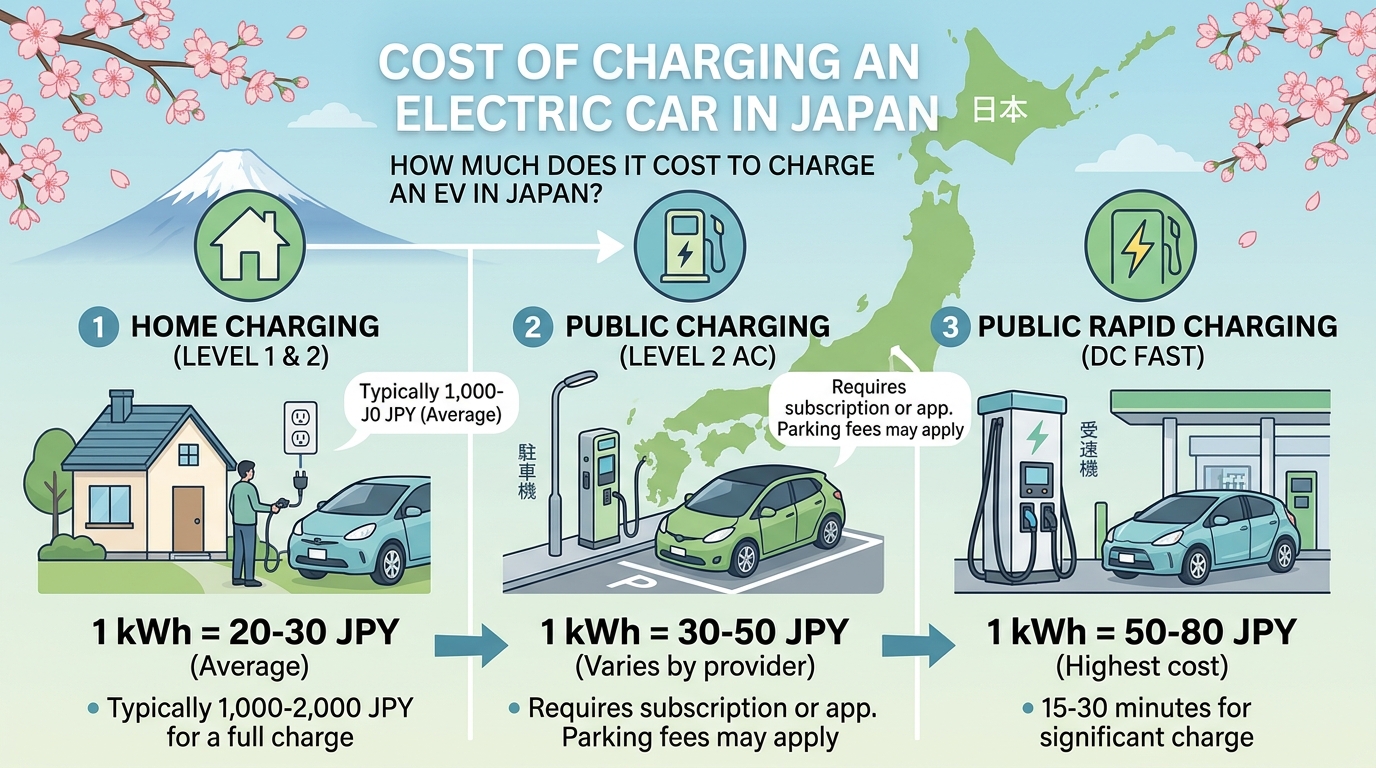
Charging an EV at home in Japan costs about ¥4.5 to ¥5 per kilometre, or roughly ¥465 per 100 km, at the national guideline rate of about ¥31 per kWh. Public fast charging usually costs more, from roughly ¥1,000 to over ¥2,000 per 100 km depending on the network and plan. Petrol, at about ¥170 per litre, costs around ¥1,130 per 100 km in a car that does 15 km/L.
Prices are in Japanese yen and reflect late 2026. Electricity rates, charging plans and fuel prices change often, so check your own bill and network before you budget.
The Simple Formula for EV Charging Cost in Japan
Cost per km = (your EV’s kWh per 100 km ÷ 100) × your electricity rate per kWh
Many EVs use roughly 12 to 18 kWh per 100 km. This guide uses 15 kWh per 100 km as an example. At ¥31 per kWh, that’s 15 × 31 = ¥465 per 100 km. Allow roughly 10% extra for charging losses, which brings it to about ¥510 per 100 km.
How Much Does Home Charging Cost in Japan?
The national guideline rate for household electricity is about ¥31 per kWh (tax included). The real rate varies by region and by plan, from roughly ¥26 to ¥41 per kWh. Here’s what that means for a full charge:
| Battery size | Cost for a full charge at ¥31/kWh |
|---|---|
| 20 kWh | About ¥620 |
| 40 kWh | About ¥1,240 |
| 60 kWh | About ¥1,860 |
| 75 kWh | About ¥2,325 |
These figures are before charging losses, and most drivers don’t charge from empty.
Monthly Cost of Charging at Home
For 1,000 km of driving a month (150 kWh at 15 kWh per 100 km):
| Electricity rate | Monthly cost |
|---|---|
| Lower-cost area (about ¥26/kWh) | About ¥3,900 |
| National guideline (about ¥31/kWh) | About ¥4,650 |
| Higher-cost area (about ¥41/kWh) | About ¥6,150 |
Many power companies also offer cheaper night-time plans. If you charge overnight, ask your supplier whether a time-of-use plan could lower your rate.
How Much Does Public Charging Cost in Japan?
Public charging in Japan is billed in two main ways, depending on the network.
1. Time-based billing. You pay for minutes plugged in, not energy delivered. On e-Mobility Power, a visitor price example is about ¥2,310 for 30 minutes on a fast charger over 50 kW, and about ¥1,650 for 30 minutes on a 25 kW unit. Your real cost per kWh depends on how fast your car actually charges. Members of a plan usually pay less than visitors.
2. kWh-based billing. You pay for the energy you receive. Some examples from 2026:
- ENEOS Charge Plus (high-power chargers): about ¥99/kWh for members and ¥154/kWh for visitors, from April 2026 to March 2027.
- PowerX: from about ¥65/kWh for regular use, or from about ¥45/kWh on a plan with a monthly fee.
Many networks also require a membership card or app, and the card may carry an issue fee. For example, a recent comparison listed ¥1,980 for an e-Mobility Power card, but fees can change.
Cost per 100 km: Home vs. Public vs. Petrol
Assuming 15 kWh per 100 km for the EV and 15 km/L for the petrol car:
| How you fuel | Rate | Approximate cost per 100 km |
|---|---|---|
| Home charging | ¥31/kWh | About ¥465 |
| PowerX (plan price) | About ¥45/kWh | About ¥675 |
| PowerX (regular) | About ¥65/kWh | About ¥975 |
| ENEOS Charge Plus (member) | ¥99/kWh | About ¥1,485 |
| ENEOS Charge Plus (visitor) | ¥154/kWh | About ¥2,310 |
| Petrol car at ¥170/L | 15 km/L | About ¥1,130 |
The takeaway: home charging is by far the cheapest, and some public fast charging can cost more than petrol. Fast charging suits trips and emergencies, not daily use.
What Affects Your EV Charging Cost?
- Your electricity plan and region. The rate per kWh is the biggest factor.
- Time of day. Night-time plans can lower costs.
- Your car’s efficiency. Small kei EVs use far less energy per km than large SUVs.
- Where you charge. Home, destination chargers and fast chargers all price differently.
- Charging speed. On time-based networks, a slower-charging car costs more per kWh.
- Charging losses. Roughly 10% of energy is lost as heat.
What About Apartments?
Many people in Japan live in apartment buildings where installing a charger is hard. If you can’t charge at home, public networks and subscription services are the main options, and costs per kWh are higher. Check whether your building, employer or a nearby facility offers charging before you buy an EV.
What If You’re Visiting or Renting an EV?
If you rent an EV in Japan, ask the rental company whether charging is included, which network card you’ll need and what the fees are. Charging cards and apps differ between networks, so it helps to know your route in advance.
How to Lower Your EV Charging Costs in Japan
- Charge at home whenever you can.
- Compare electricity plans, especially night-time and EV-friendly rates.
- Choose the right public network and plan for how often you use fast charging.
- Avoid unnecessary fast charging. It’s usually the most expensive option.
- Drive efficiently. Smooth driving uses less energy.
- Check subsidies. National and local programs for EVs and chargers exist but change often, so check the official sources.
Frequently Asked Questions
How much does it cost to charge an EV in Japan?
At home, about ¥465 per 100 km at the national guideline rate. Public fast charging is usually higher.
How much does a full charge cost in Japan?
About ¥1,240 for a 40 kWh battery and ¥1,860 for a 60 kWh battery at ¥31/kWh.
Is it cheaper to charge an EV than to buy petrol in Japan?
At home, yes, usually less than half the cost per km. Some public fast charging can cost as much as or more than petrol.
How much does public fast charging cost in Japan?
It depends on the network. Time-based examples run about ¥1,650 to ¥2,310 for 30 minutes for visitors, and kWh-based examples run about ¥45 to ¥154 per kWh.
Do I need a membership to use public chargers in Japan?
Many networks require a card or app. Some allow visitor use at higher prices.
What is the electricity rate in Japan for homes?
The national guideline is about ¥31/kWh, with regional rates from roughly ¥26 to ¥41/kWh.
Is night-time charging cheaper in Japan?
It can be, if you have a time-of-use plan. Check with your electricity supplier.
How much does petrol cost in Japan?
Around ¥170 per litre for regular gasoline in October 2026, held down by government subsidies.
Final Takeaway
In Japan, charging an EV at home costs about ¥4.5 to ¥5 per km, far below petrol. Public fast charging varies widely, and some plans can cost as much as or more than petrol. Use your own electricity rate and your car’s efficiency to calculate your cost, and charge at home whenever you can.
Have a question about your charging setup? Contact us, or browse our Level 2 charging articles and DC fast charging guides.
Disclaimer: Prices are estimates and change often. Check your electricity plan, charging network and current fuel prices for accurate figures.





Leave a Reply