
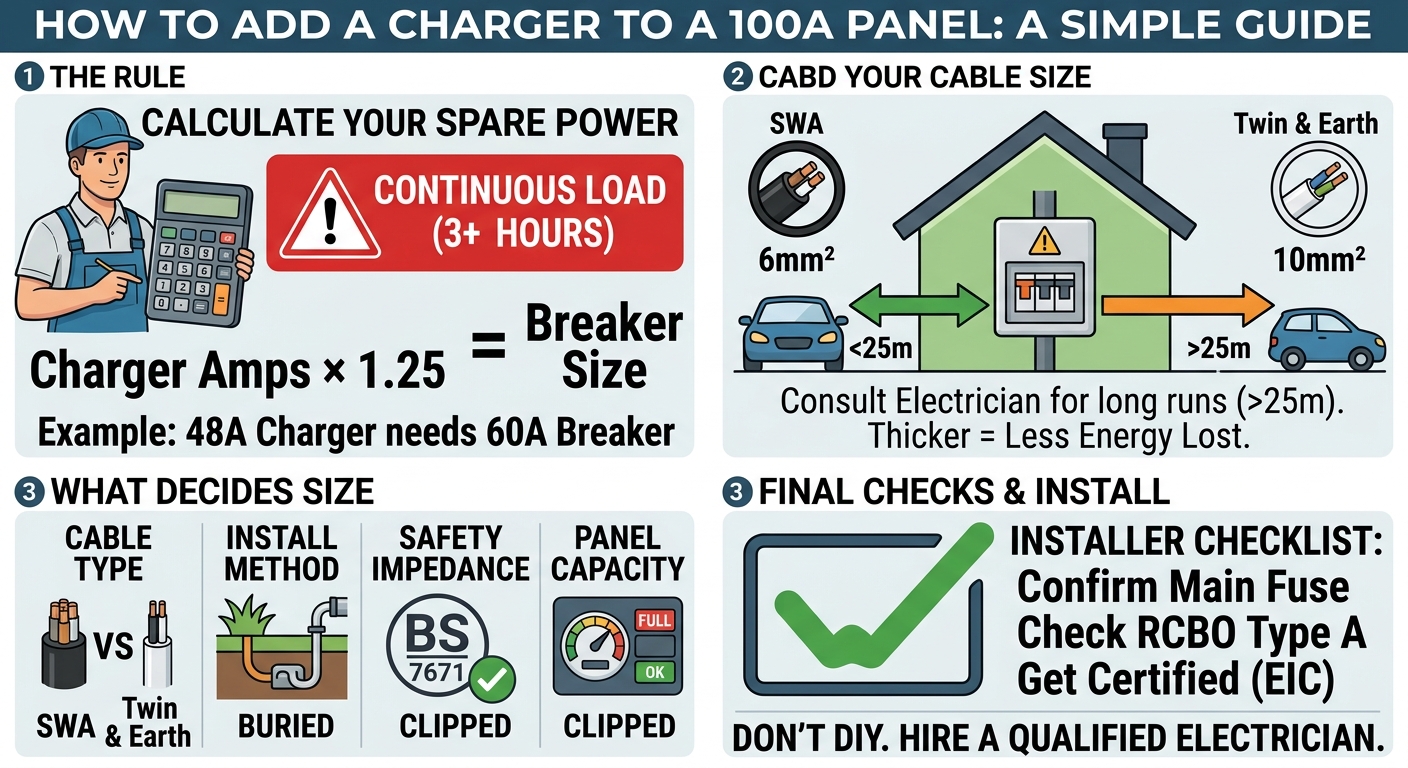
Often, yes. A 100-amp panel can usually run a Level 2 charger, typically at 24-32 amps rather than the full 40-48 amps. Whether it works for your home depends on a load calculation, and a panel upgrade isn’t automatically required. This guide covers what your panel can realistically handle and what to do if it’s tight.
Why 100 amps can be enough
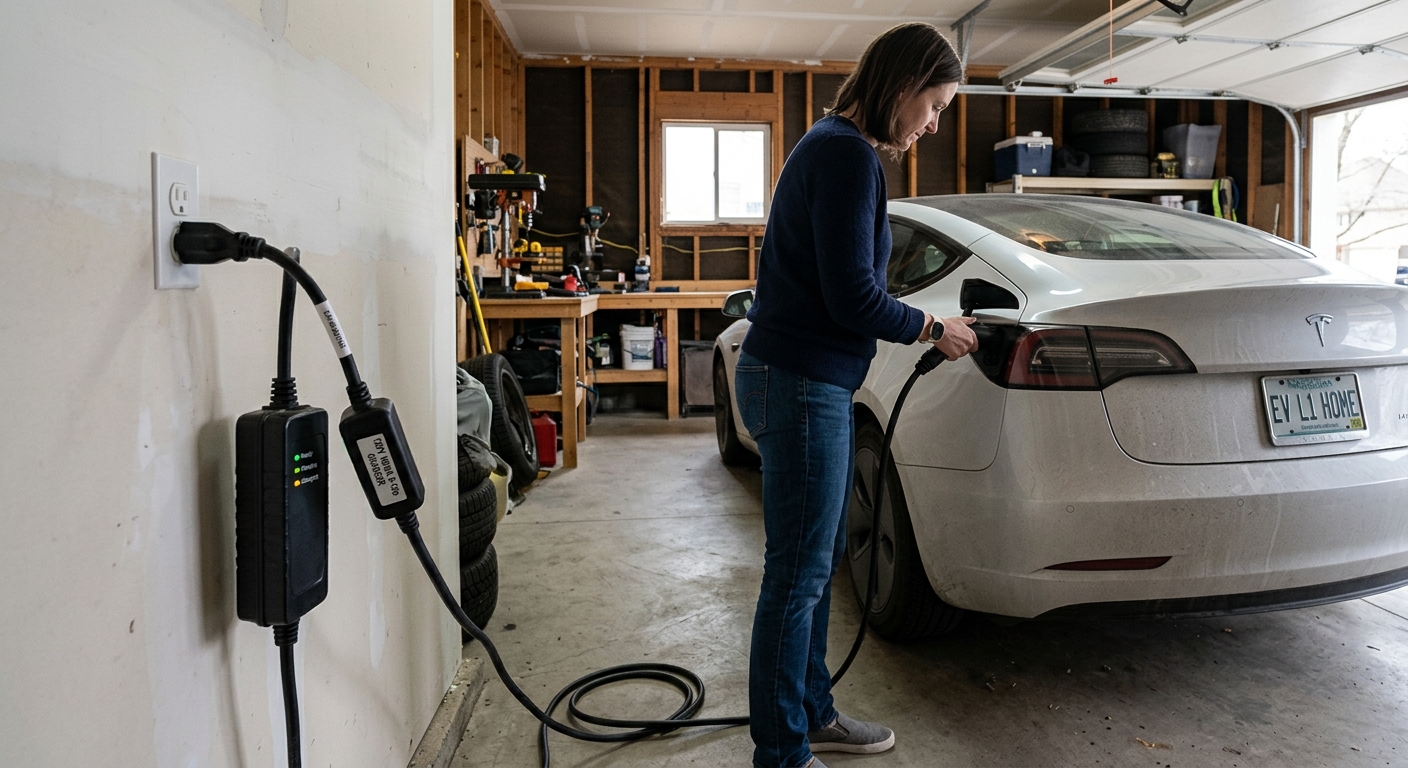
EV charging runs for hours at a stretch, so the National Electrical Code (NEC) treats it as a continuous load. The breaker must be rated at 125% of the charger’s amperage, which means the charger can use only 80% of the breaker’s rating.
A 100-amp panel isn’t automatically disqualified, but it doesn’t have unlimited room. What matters is how much of those 100 amps your home already uses. A home with gas heating and cooking has far more spare capacity than an all-electric home of the same size.
What size charger fits on a 100-amp panel?
| Charger amps | Power | Breaker needed | Typical fit on a 100A panel |
|---|---|---|---|
| 24A | 5.8 kW | 30A | Often fits |
| 32A | 7.7 kW | 40A | Often fits if the load calculation passes |
| 40A | 9.6 kW | 50A | Often needs load management or an upgrade |
| 48A | 11.5 kW | 60A | Often needs load management or an upgrade |
Many homes with 100-amp service can take a 24-32 amp charger with a simple circuit addition. Higher-output units are where problems start, because a 48-amp charger adds about 11.5 kW of continuous load on top of everything else in the house.
The load calculation decides
The only reliable answer comes from a load calculation under the NEC. For an existing home, electricians normally use section 220.83. The 2026 NEC reorganised the load calculation rules into Article 120, but the purpose is unchanged: prove your service can carry the new load safely.
The calculation adds up your general lighting, small-appliance and laundry circuits, fixed appliance loads, and the larger of your heating or cooling load. It then applies the code’s demand factors, adds the charger as a continuous load, and compares the total to your 100-amp rating. A licensed electrician can usually run it quickly, and it’s the number to ask for before you accept any panel upgrade quote.
Which appliances make it tight?
Your existing appliances matter more than the panel’s rating. The big ones are electric heat or a heat pump, an electric water heater, an electric dryer, an electric range and central air conditioning.
A 100-amp panel with a gas furnace, gas water heater and gas dryer may have enough capacity for a 24-32 amp charger. A panel with electric heat, an electric water heater and an electric dryer is almost certainly at capacity, and will need a load management device or an upgrade.
Want to know where your panel stands? Request a load calculation from a licensed electrician https://evchargeradvisor.online/
Options if your panel is tight
- Choose a smaller charger. A 24-32 amp unit may fit without other changes. An adjustable-amperage charger can be set lower now and raised later.
- Add load management. An EV energy management system (EVEMS) monitors your home’s total load and briefly reduces or pauses the charger when usage nears a set limit, such as 80 amps on a 100-amp panel. The NEC permits this under section 625.42, and the load calculation can count the managed load rather than the full charger rating.
- Install a smart panel or circuit-sharing device. These do a similar job by monitoring the whole-home load.
- Upgrade your service. Sometimes the only option for a heavily electrified home.
Costs vary widely by area, but one installer guide estimates a load management device at $200-$500, versus $2,000-$4,500 for a panel upgrade.
Will a smaller charger be too slow?
Probably not. A 24-amp charger delivers about 5.8 kW, which is roughly 46 kWh over an 8-hour night, or around 160 miles of range at 3.5 miles per kWh. A 32-amp charger delivers about 61 kWh, or roughly 215 miles (my calculations).
Compare that with the average driver, who needs only about 13 kWh a day. For most households, a smaller charger on a 100-amp panel is more than enough.
Permits and inspection
In most jurisdictions, a new 240V circuit for an EV charger requires an electrical permit and inspection. Your installer should handle both.
Quick checklist
- Confirm your panel’s main breaker rating.
- List your major electric loads.
- Ask an electrician for a load calculation.
- Choose a charger size that fits the result, or add load management.
- Get the permit and inspection.
Next step: Compare 32-amp and load-managed home chargers https://evchargeradvisor.online/
FAQs
Can a 100-amp panel handle a Level 2 EV charger?
Often yes, usually at a reduced setting of 24-32 amps. A load calculation confirms it.
What size EV charger can I install on a 100-amp panel?
Typically 24-32 amps. 40-48 amp chargers usually need load management or an upgrade.
Do I need a panel upgrade for an EV charger?
Not necessarily. A smaller charger, load management or a smart panel can avoid it.
Which appliances matter most?
Electric heat, electric water heaters and electric dryers.
Do I need a permit?
In most jurisdictions, yes.
Final thoughts
A 100-amp panel isn’t a dead end for EV charging. Get a proper load calculation first, and you may avoid an expensive upgrade.
Ready to start? Get a licensed installer quote https://evchargeradvisor.online/
General information based on US NEC guidance. Local codes vary. Always have a licensed electrician assess your panel.





Leave a Reply