
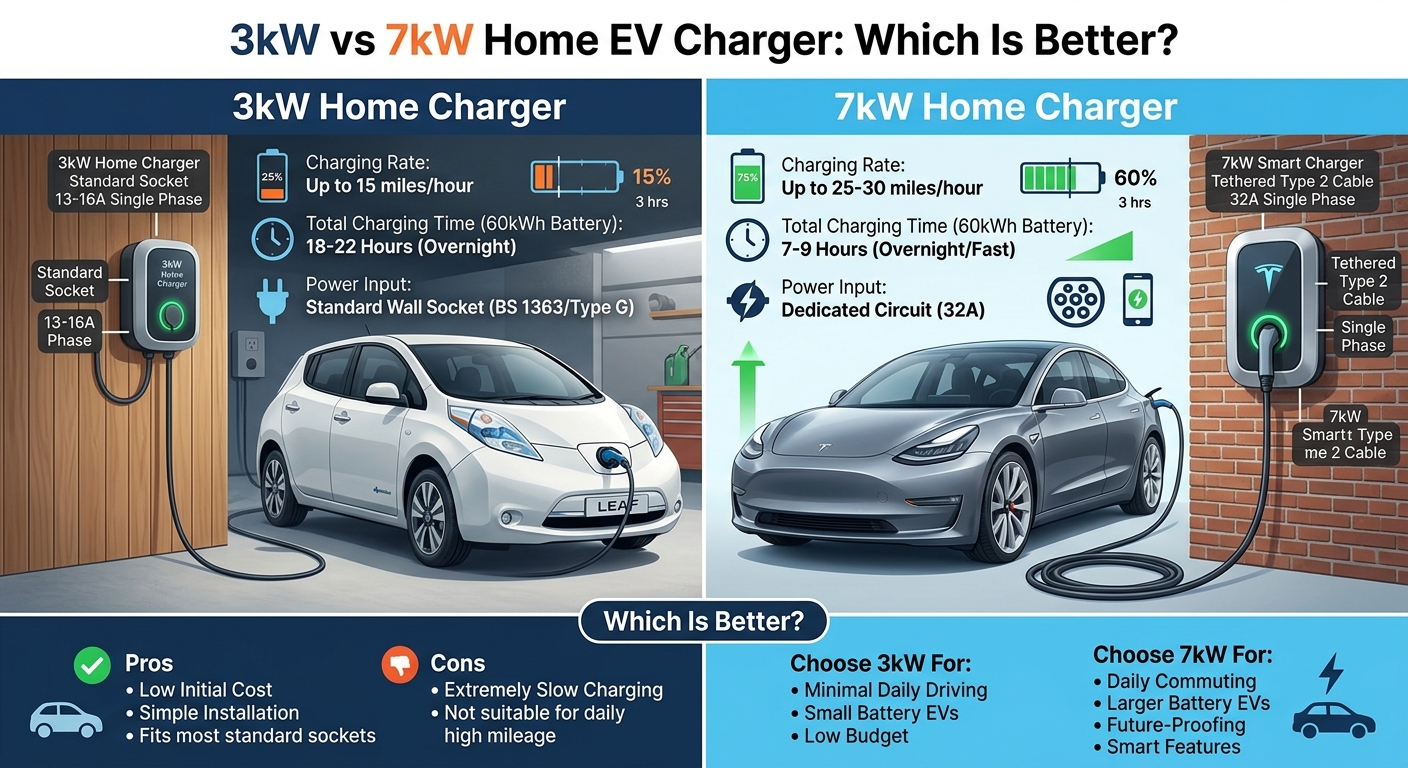
When making the switch to electric vehicle (EV) ownership, setting up a reliable, efficient home charging solution is one of the most important investments you will make. Among the most common questions new homeowners and apartment dwellers face is choosing between a slower standard plug-in setup and a dedicated residential wall unit. To answer directly: A 7kW home EV charger is generally better for most full-battery electric vehicle (BEV) owners because it charges 2 to 3 times faster than a 3kW charger, adding roughly 25 to 30 miles of range per hour.
While a 3kW charger (often referred to as a standard 3-pin plug or Level 1 charger) relies on regular household circuits, a 7kW Level 2 home charger transforms your garage into a dedicated fueling station capable of turning overnight plug-in sessions into a complete, hassle-free recharge. However, choosing the right system involves evaluating your daily driving mileage, electrical panel capacity, installation costs, and long-term convenience.
Here is an exhaustive, 2000-word comprehensive guide comparing 3kW and 7kW home EV chargers across every measurable metric—from charging speeds and electrical infrastructure requirements to cost efficiency, battery health, and real-world daily usability.
1. Understanding the Contenders: What Are 3kW and 7kW Chargers?
To make an informed decision, it helps to understand the baseline mechanics of both power levels:
-
The 3kW Charger (Level 1 / Standard Plug): This operates on standard household alternating current (AC) voltage (typically 120V in North America or 230V in the UK and Europe via a standard 3-pin wall socket). Drawing around 10 to 12 amps, it delivers roughly 1.4 kW to 3 kW of power. It requires zero installation and can be plugged straight into any pre-existing wall outlet.
-
The 7kW Charger (Level 2 / Dedicated Wall Box): This is a hardwired or high-amperage dedicated residential unit operating on 240V power (or single-phase AC in Europe/UK). Delivering approximately 32 amps of continuous current, it pumps 7.2 kW to 7.4 kW of energy safely into your vehicle, cutting charging times dramatically.
To explore how these residential speeds compare against commercial equipment, read more about various charging types.
2. The Speed Showdown: How Fast Do They Actually Replenish Range?
Time is often the deciding factor for EV owners. Let’s look at how charging speeds translate into real-world miles:
-
The 3kW Crawl: A standard 3kW charger adds approximately 3 to 5 miles of range per hour. If you arrive home with a depleted battery pack (e.g., 200 miles of needed range), plugging into a 3kW outlet will require anywhere from 40 to 60 hours for a 0% to 100% full recharge. For drivers with moderate daily commutes, a 3kW charger simply cannot keep up with daily usage.
-
The 7kW Velocity: A dedicated 7kW home charger adds roughly 25 to 30 miles of range per hour. A typical medium-sized EV battery (60 kWh) can be fully replenished from empty to 100% in roughly 8 hours—comfortably fitting into a standard overnight sleeping window.
For a deeper dive into residential smart features that automate these charging schedules, check out our guide on smart home EV solutions.
3. Electrical Infrastructure and Installation Requirements
While a 7kW charger is superior in speed, it demands specific home electrical conditions that a 3kW charger bypasses entirely:
-
No Installation Needed for 3kW: Because 3kW chargers run on standard wall sockets, renters, apartment residents, and homeowners on a strict budget can start charging immediately without hiring an electrician or paying for hardware upgrades.
-
Dedicated Circuit and Permits for 7kW: Installing a 7kW wall unit requires a dedicated 240V circuit, a heavy-duty circuit breaker (typically 40 or 50 amps), and professional hardwiring by a certified electrician. Homes with older electrical panels (e.g., 100-amp service) may even require costly electrical panel upgrades before a 7kW unit can be safely installed.
To ensure your home setup complies with safety and efficiency standards, visit EV Charger Advisor.
4. Cost Analysis: Upfront Expenses vs. Long-Term Value
When evaluating financial impact, you must look at both capital expenditure (buying and installing the unit) and operational efficiency (utility rates):
-
Initial Outlay: A 3kW charging cable usually comes free with your electric vehicle, meaning zero upfront hardware costs. A 7kW wall box, by contrast, costs anywhere from $400 to $700 for the hardware alone, plus $300 to $1,500+ for professional installation depending on your garage’s distance from the main electrical panel.
-
Off-Peak Utility Savings: Both chargers allow you to take advantage of low night-time utility rates (Time-of-Use plans). However, because a 7kW charger fills the car much faster, you can confine your entire charging session strictly to the cheapest 3- or 4-hour off-peak window of the night, whereas a 3kW charger will bleed over into expensive peak daytime electricity rates.
5. Daily Driving Profiles: Which One Fits Your Lifestyle?
Your daily driving habits are the ultimate determining factor when choosing between 3kW and 7kW:
-
When 3kW is Sufficient: If you drive fewer than 20 to 30 miles a day, work from home, own a Plug-in Hybrid Electric Vehicle (PHEV) with a small battery pack, or only use your EV for casual weekend errands, a 3kW trickle charge overnight is often enough to replenish your daily energy use.
-
When 7kW is Mandatory: If you own a full Battery Electric Vehicle (BEV), commute 40+ miles daily, use your car for ridesharing or delivery, or experience unpredictable schedule changes, a 7kW charger is essential to guarantee your vehicle is ready every morning.
Summary: Which Charger Should You Choose?
-
Choose a 3kW charger only if you have ultra-low daily mileage, drive a PHEV, or live in a temporary residence where installing hardwired equipment is impossible.
-
Choose a 7kW charger if you want peace of mind, fast overnight turnaround, future-proof home infrastructure, and maximum utility rate savings.

















Leave a Reply