
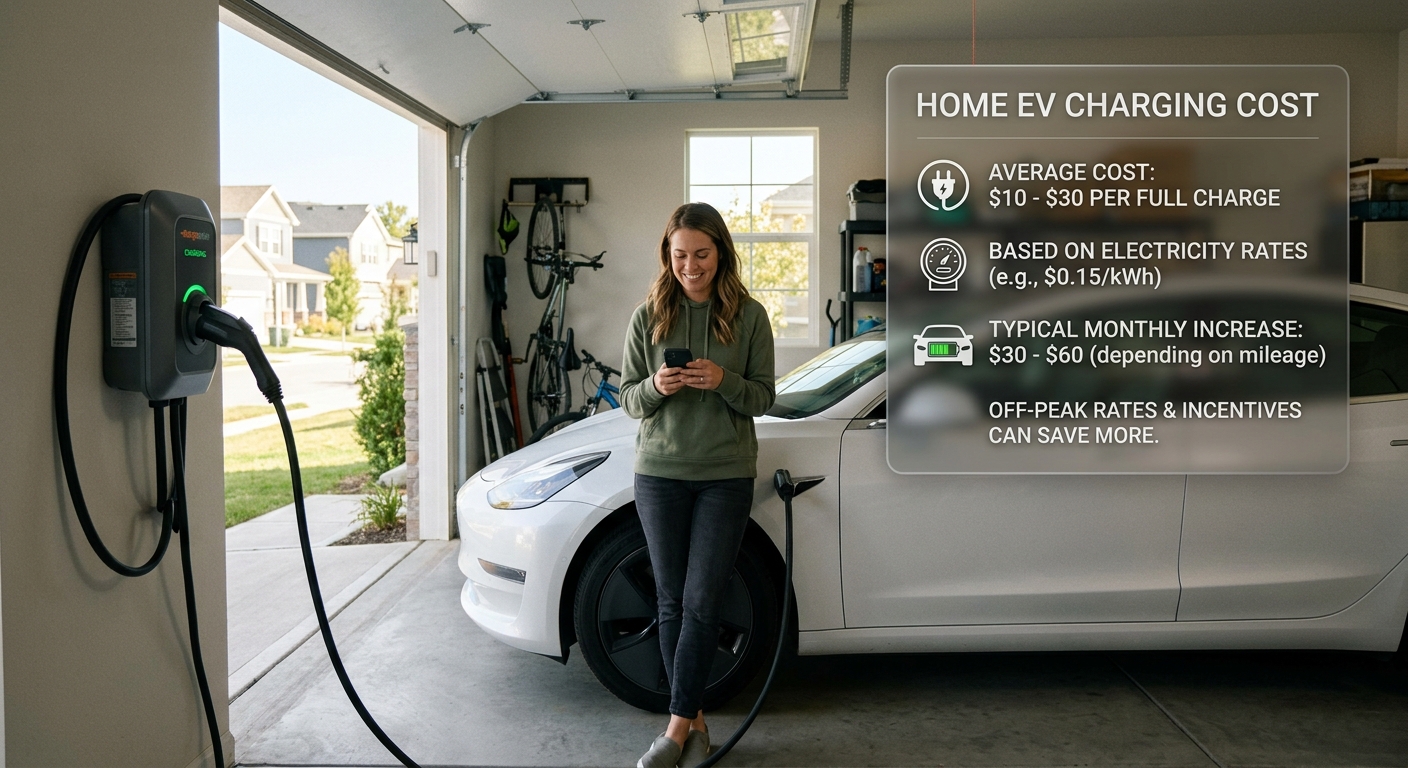
For prospective electric vehicle (EV) buyers and new owners, one of the most compelling financial advantages of transitioning away from internal combustion engines is the convenience and economy of refueling right in your own garage. To answer directly: On average, it costs $9.00 to $15.00 to fully charge an electric car at home in the United States.
When translated into standard metrics, residential electricity averages roughly 18 cents per kilowatt-hour ($0.18/kWh), meaning most drivers pay between 5 and 6 cents per mile driven—less than half the operational cost of fueling a traditional gasoline-powered automobile. However, your exact monthly electric bill will vary depending on your vehicle’s battery capacity, local utility rates, and charging efficiency.
Here is an extensive, comprehensive guide breaking down everything you need to know about calculating home EV charging expenses, regional price differences, Time-of-Use (TOU) rate savings, and how residential charging compares to public networks.
1. The Financial Breakdown: How Home Charging Costs Are Calculated
Understanding how residential power translates into vehicle range is straightforward once you know the basic math behind battery capacity and utility pricing:
-
The Core Formula: To determine the cost of a full charging session, multiply your vehicle’s battery capacity (measured in kilowatt-hours) by your local residential electricity rate per kWh. For example, a mid-size electric crossover with a 75 kWh battery pack charged at the national average rate of $0.18 per kWh will cost roughly $13.50 to replenish from 0% to 100%.
-
Partial Charging vs. Empty State: In real-world daily driving, owners rarely plug in from a completely depleted 0% battery. Because most drivers top off their vehicles daily when the battery sits between 20% and 80%, a typical daily overnight charging session costs significantly less—often between $3.00 and $7.00.
To evaluate what equipment you need to safely handle these power draws at home, explore our guide on various charging types.
2. State-by-State Differences and Regional Rate Variations
Electricity prices are far from uniform across the United States. Your geographic location plays the most significant role in determining your exact home charging expenses:
-
Low-Cost States (The Pacific Northwest and South): States with abundant hydroelectric or low-cost energy sources—such as Washington, Oklahoma, and Louisiana—often feature residential electricity rates dropping as low as $0.11 to $0.14 per kWh. At these rates, a full charge for a standard EV can drop below $9.00.
-
High-Cost States (The Northeast and West Coast): High-demand regions like California, Hawaii, New England, and parts of the Northeast feature residential electricity rates that can surge between $0.30 and $0.45+ per kWh. In these regions, a full charge can easily climb above $25.00, though it remains competitive compared to local gas prices.
To explore how smart home automation can help schedule your charging sessions during optimal utility windows, check out our insights on smart home EV solutions.
3. Leveraging Time-of-Use (TOU) Rates for Maximum Savings
One of the best-kept secrets for slashing your home EV charging budget is enrolling in a Time-of-Use (TOU) electricity plan with your local utility provider:
-
Off-Peak Hours: Electric companies often drop their rates drastically during late-night and early-morning hours (typically between 11:00 PM and 6:00 AM) when overall grid demand plummets.
-
Automated Scheduling: By programming your EV or smart home charger to initiate fueling only during these off-peak windows, you can often cut your per-kWh electricity cost by 30% to 50%, reducing annual charging expenses to just a few hundred dollars.
For expert advice on electrical safety, home infrastructure planning, and utility rebate programs, visit us at EV Charger Advisor.
4. Home Charging vs. Public Charging: A Stark Contrast
While public charging is essential for long-distance road trips, relying on it for daily driving can erode your fuel savings:
-
Public Level 2 Charging: Typically costs between $0.20 and $0.30 per kWh, or charges flat parking-lot fees, making daily public top-ups noticeably more expensive than home rates.
-
DC Fast Charging (DCFC): Public rapid highway chargers often price electricity between $0.40 and $0.60 per kWh due to high commercial demand charges and infrastructure costs. Relying exclusively on DC fast charging can double or triple your annual fuel expenses compared to home charging.
Summary: What to Keep in Mind
-
Expect a predictable monthly increase of $30 to $70 on your electric bill for typical daily commuting, far lower than traditional gas expenses.
-
Always check if your local utility offers special EV electric rate discounts or rebates for installing residential Level 2 hardware.

















Leave a Reply