
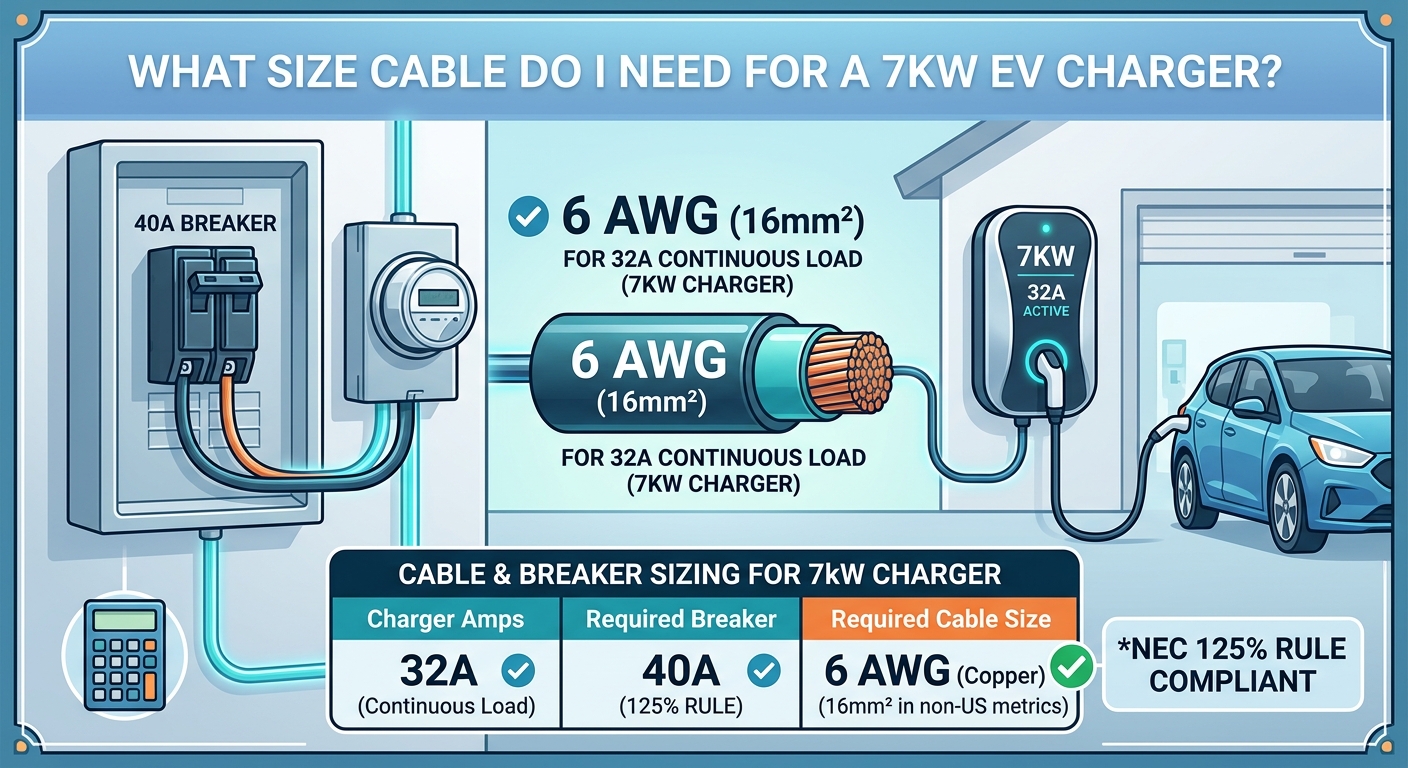
Most 7kW home EV chargers (32A, 230V single-phase) use 6mm² cable. For longer runs, 10mm² is typically needed to keep voltage drop in check, and guides put that threshold somewhere between about 15 and 25 metres. A qualified electrician should confirm the final size for your installation.
Why a 7kW charger means a 32A circuit
Divide 7,000 watts by 230 volts and you get a design current of about 30.4 amps, which rounds up to a 32A circuit. A 7.4kW charger is in the same 32A class, so the cable advice is the same.
Cable size by distance
| Distance from consumer unit to charger | Typical cable | Note |
|---|---|---|
| Short run (up to roughly 15-25 m) | 6mm² (twin-and-earth or SWA) | The standard choice for most homes |
| Longer run (roughly 25-50 m) | 10mm² | Keeps voltage drop within limits |
| Very long run (50 m+) | 10mm² or larger | Needs a full voltage-drop calculation |
Guides vary on where the 6mm² limit sits, so treat these as starting points. Your electrician’s voltage-drop calculation decides.
Why not 4mm² or smaller?
A 4mm² cable can carry more than 32A in some conditions, but EV charging is a continuous load that can run for 3-8 hours. 6mm² gives you thermal margin and better voltage-drop performance. Don’t use 2.5mm² or 4mm² for a 7kW charger.
What decides your cable size?
- Cable length and voltage drop: The longer the run, the more voltage is lost along it, so thicker cable may be needed.
- Installation method: Clipped direct, in trunking, buried or in conduit all carry current differently.
- Cable type: Twin-and-earth is common indoors, while armoured (SWA) is used outside.
- Earth fault loop impedance: Cable sizing under BS 7671 balances current capacity, voltage drop and this safety check.
Do you need armoured (SWA) cable?
For outdoor runs, electricians often use steel wire armoured (SWA) cable, which protects against physical damage and weather. The same 6mm² or 10mm² sizing rules apply, depending on the run length and conditions.
Protection, consumer unit and certification
The charger needs its own dedicated circuit, normally protected by a Type A RCBO. Your installer should also check:
- Your main fuse (ideally 100A) can handle the added load.
- Your consumer unit has space, as an external secondary unit is sometimes needed.
- An Electrical Installation Certificate (EIC) is issued after installation.
Want an accurate answer for your property? Get a quote from a qualified installer https://evchargeradvisor.online/
Don’t forget the charging cable
The cable from the charger to your car is separate. If your charger is untethered, you’ll need a Type 2 charging cable rated for 32A single-phase. Check the rating before you buy.
In the US
A 7.7 kW (32A) charger is treated as a continuous load, so it needs a 40-amp circuit with 8 AWG copper under NEC rules. See our breaker size guide for the full chart.
Quick checklist
- Confirm your charger is 7kW / 32A.
- Measure the run from the consumer unit to the charger.
- Use 6mm² as the starting point, and 10mm² for longer runs.
- Choose SWA for outdoor routes.
- Have a qualified electrician calculate voltage drop, install and certify.
Next step: Compare 7kW home chargers https://evchargeradvisor.online/
FAQs
What size cable do I need for a 7kW EV charger?
Typically 6mm², or 10mm² for longer runs.
What cable size is needed for a 7.4kW charger?
The same as for 7kW. Both are 32A chargers.
Can I use 4mm² or 2.5mm² cable for a 7kW charger?
No. Use 6mm² or 10mm², depending on the installation.
What size armoured cable do I need for a 7kW charger?
Typically 6mm² or 10mm² SWA, depending on length and conditions.
How far can a 6mm² cable run?
Guides suggest roughly 15-25 metres before moving up to 10mm². The exact limit depends on voltage drop.
Do I need a dedicated circuit for a 7kW charger?
Yes, normally protected by a Type A RCBO.
Can I install the cable myself?
No. A qualified electrician should install and certify the circuit.
Final thoughts
For most homes, 6mm² cable does the job, and 10mm² covers longer runs. The details are where a qualified installer earns their fee, so get the route assessed before you buy.
Ready to choose? See our top 7kW home chargers https://evchargeradvisor.online/
General information only. Cable sizing depends on your installation. Always use a qualified electrician.

















Leave a Reply