
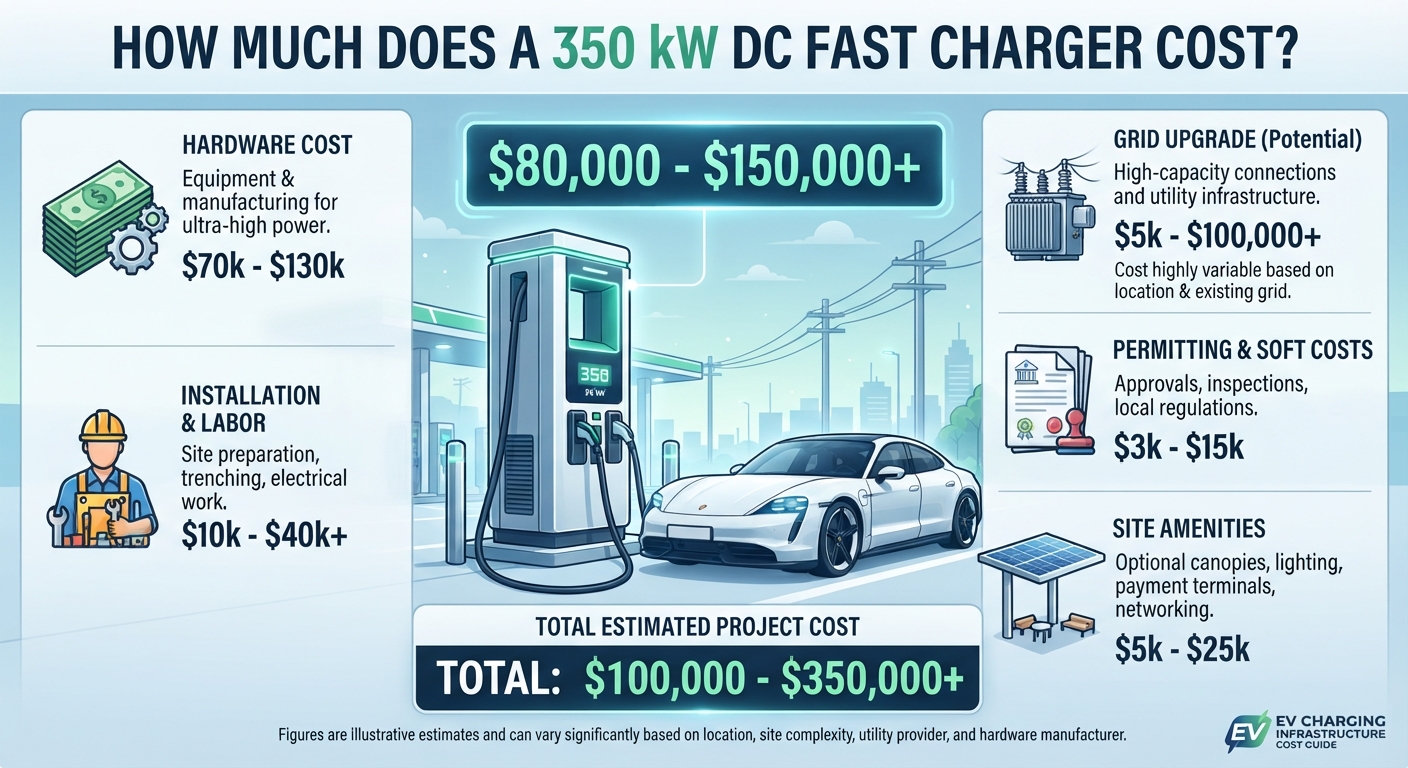
When business owners, property developers, and fleet managers explore the high-end tier of public EV infrastructure, understanding the true capital commitment is vital. To answer directly: A 350 kW DC fast charger hardware unit costs between $100,000 and $180,000+. However, when looking at the total deployment cost per port, commercial hardware and public space implementations typically vary from $35,000 to $140,000 depending on volume ordering, configuration, and structural specs.
Deploying ultra-fast highway charging corridors involves much more than simply purchasing a heavy-duty cabinet. It requires navigating complex utility grids, high-voltage step-down transformers, extensive civil construction, and advanced software network integrations.
Here is an extensive, comprehensive guide exploring every financial variable, component breakdown, and long-term economic factor behind 350 kW ultra-fast DC charging stations.
1. The Core Hardware: Understanding the $100,000+ Price Tag
At the apex of public charging technology, the physical equipment is a major capital investment:
-
Advanced Liquid-Cooled Cabling: Pushing 350 kilowatts of continuous electricity into a vehicle generates immense thermal energy. To prevent cables and handles from melting or overheating, complex liquid-cooling loops are built directly into the hardware, significantly driving up manufacturing costs.
-
Scalable Power Cabinets: Many ultra-fast sites separate the heavy power conversion electronics from the user-facing pedestals, utilizing centralized power banks that dynamically distribute energy across multiple stalls.
To understand how high-power commercial equipment differs from residential hardware, read more about various charging types.
2. Balance of System: Installation, Transformers, and Grid Upgrades
The hardware unit itself is often only a fraction of the total budget. Installing an ultra-fast charging site requires heavy civil and electrical engineering:
-
Grid Connection & Transformers: Drawing hundreds of kilowatts requires commercial utility tie-ins, heavy step-down transformers, and sometimes local substation upgrades that can cost tens of thousands of dollars.
-
Trenching and Civil Construction: Pouring reinforced concrete pads, running thick underground conduits across paved lots, and installing protective bollards add significant labor and material expenses.
To explore how advanced energy distribution, load balancing, and site optimization are managed, check out our guide on smart home EV solutions.
3. Ongoing Operational Expenses (OpEx) and Maintenance
Beyond the initial capital expenditure (CapEx), station operators must budget for recurring operational costs to keep stalls functional and profitable:
-
Commercial Demand Charges: Electric utilities often levy heavy fees based on peak power spikes, making energy storage and smart management software essential for controlling monthly bills.
-
Maintenance and Networking Contracts: High-voltage liquid-cooled systems require routine coolant checks, firmware updates, and payment processing subscriptions to maintain high uptime.
For comprehensive insights on EV infrastructure planning, safety standards, and advisory services, visit us at EV Charger Advisor.
Summary: What to Keep in Mind
-
Expect significant initial capital outlays for 350 kW ultra-fast chargers, with total multi-port station deployments running well into six figures.
-
Comprehensive site assessments and early utility coordination are vital to controlling expensive electrical upgrade surprises.

















Leave a Reply