
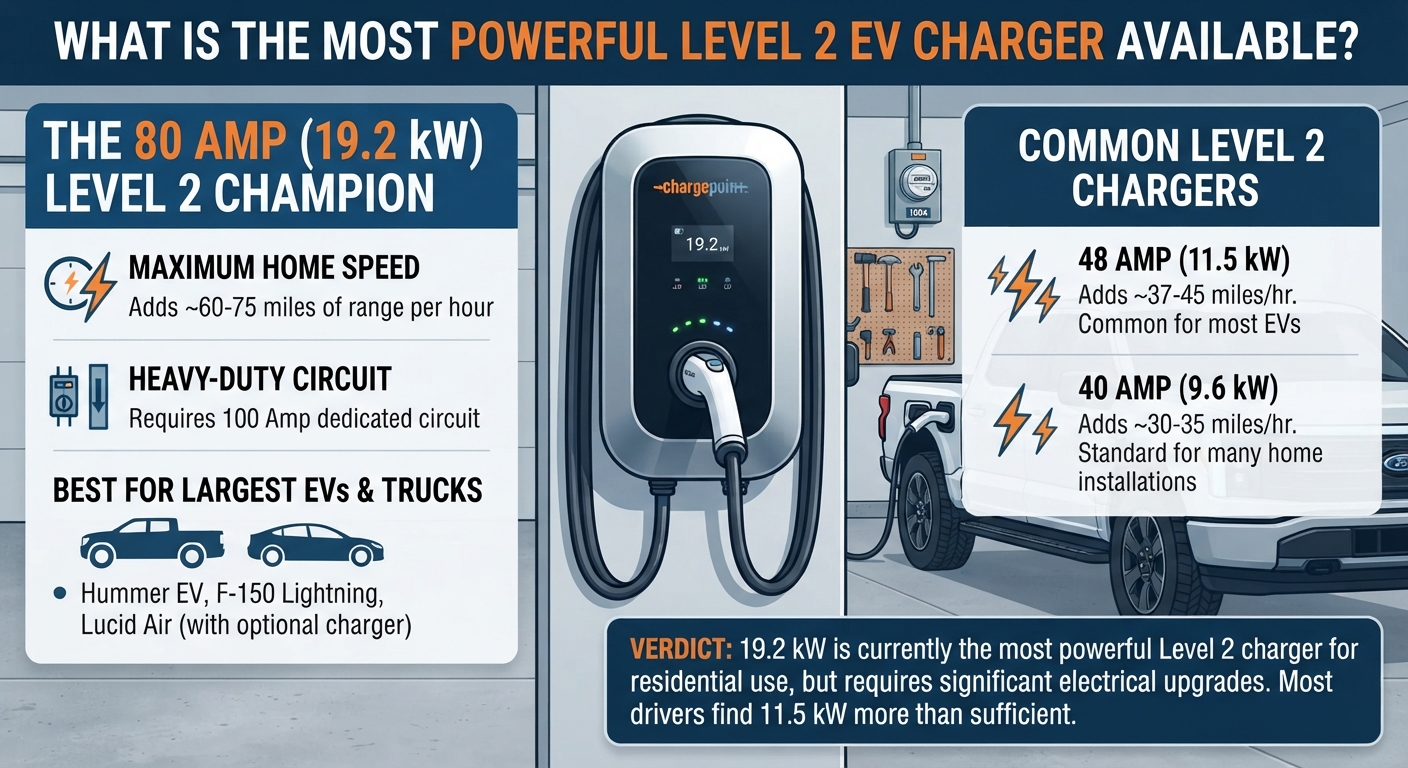
When looking for the absolute fastest home charging performance for a modern electric vehicle, power output is the primary consideration. To answer directly: The most powerful residential Level 2 EV chargers available deliver 80 amps of continuous current (providing 19.2 kW of power output) and require a heavy-duty 100-amp circuit breaker.
While standard residential setups typically utilize 32-amp or 40-amp chargers, high-end 80-amp systems represent the peak performance tier for residential alternating current (AC) power delivery. Understanding how these heavy-duty units function, what infrastructure they demand, and whether your vehicle can actually utilize them will help you make an informed investment.
Here is a comprehensive look at the most powerful Level 2 charging technology on the market.
1. Understanding 80-Amp (19.2 kW) Power Delivery
Residential electrical grids operate on 240V split-phase power in North America. When a high-capacity charger delivers a continuous 80 amps across that voltage line, it yields a maximum output of 19.2 kilowatts (kW):
-
Blazing Fast Range Recovery: Top-tier units (such as heavy-duty residential hardware from brands like Autel or Primecom) can inject up to 70 to 75 miles of driving range into a compatible electric vehicle for every single hour it remains plugged in.
-
Rapid Overnight Turnaround: Even massive EV battery packs—such as those found in electric pickup trucks, heavy-duty commercial style personal vehicles, or long-range SUVs—can be completely replenished from near-empty to 100% in just a few hours.
To see how these maximum-output setups compare to standard hardware, check out our overview of different charging types.
2. Heavy-Duty Infrastructure and Electrical Requirements
Running a continuous 80-amp load safely inside a residential environment requires serious electrical planning:
-
The 100-Amp Breaker Rule: National Electrical Code (NEC) guidelines mandate a continuous load safety factor of 125%. Therefore, to safely run an 80-amp continuous draw, your electrician must install a dedicated 100-amp circuit breaker paired with thick, industrial-grade copper wiring and robust conduit.
-
Main Panel Capacity Check: Many residential homes feature 100A or 200A main service panels. Drawing 100 amps solely for an EV charger means a professional load calculation is mandatory to ensure your home’s total electrical service won’t trip or overload when household appliances run concurrently.
For smart ways to manage heavy residential electrical loads, explore our resources on smart home EV solutions.
3. Does Your EV Support 19.2 kW Charging?
One of the most common misconceptions is that plugging any EV into an 80-amp charger will automatically force maximum charging speeds. In reality, charging speed is strictly limited by your vehicle’s internal hardware:
-
The Onboard Charger (OBC) Bottleneck: When Level 2 charging, your car uses an internal AC-to-DC converter. If your specific EV model has an onboard charger capped at 11.5 kW or 7.7 kW, connecting it to a 19.2 kW powerhouse will simply result in the car accepting its maximum rated limit.
-
Compatibility List: Only select high-end electric trucks, large luxury SUVs, or vehicles equipped with dual onboard chargers can fully saturate an 80-amp circuit.
To evaluate whether upgrading your home grid is worth the investment for your specific daily driving patterns, learn more about our recommendations at EV Charger Advisor.
Summary: Should You Install the Most Powerful Charger?
-
Choose an 80-amp (19.2 kW) system if you own a heavy-duty electric vehicle or truck with a massive battery, possess a 200A+ home service panel ready for the load, and require absolute maximum charging speed.
-
Choose a standard 32A to 40A unit if your everyday commute is modest, saving you thousands of dollars in heavy electrical wiring and installation fees.

















Leave a Reply