
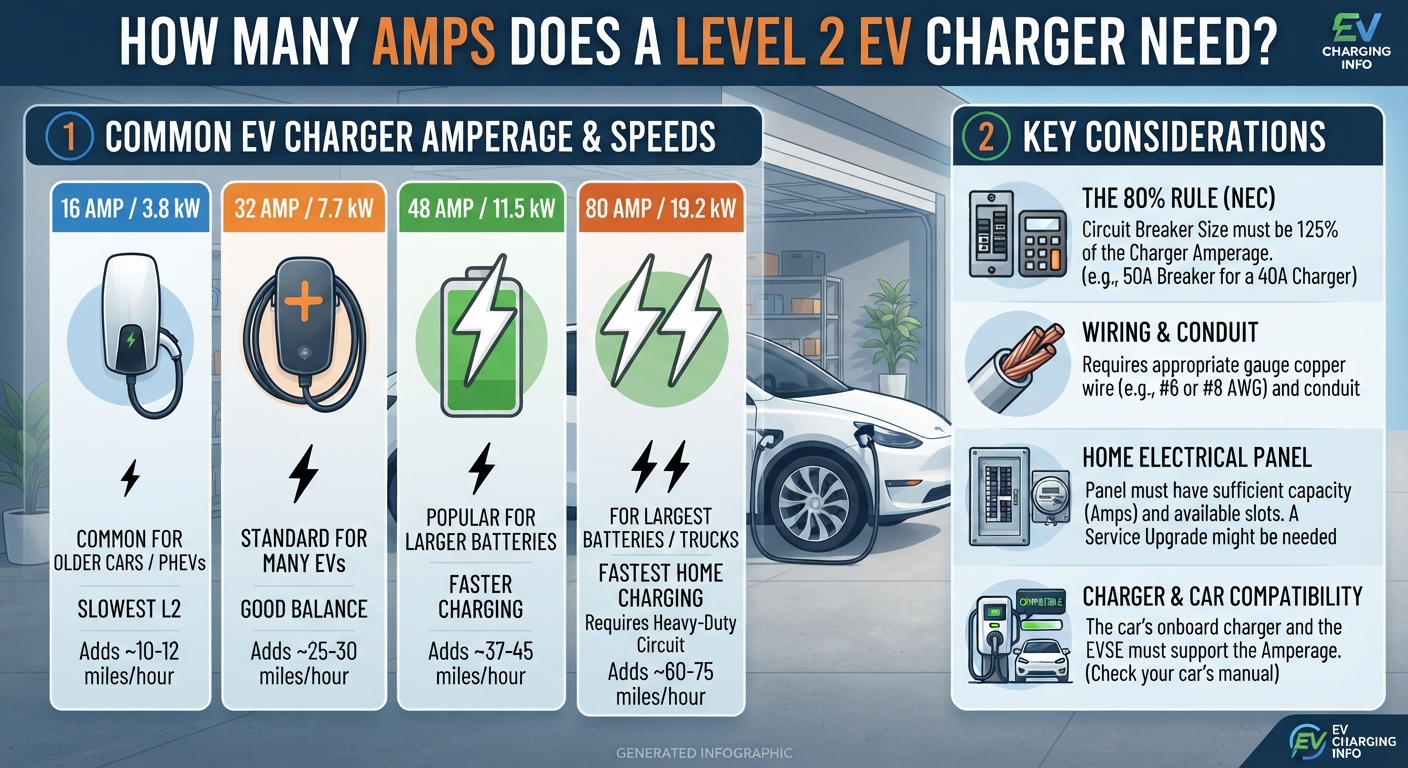
When installing a home charging station for your electric vehicle, choosing the right electrical specifications is essential for safety, speed, and long-term reliability. To give you a direct and comprehensive answer: Most home Level 2 electric vehicle (EV) chargers need 40 or 48 amps of electrical current running on a 240-volt circuit. While Level 2 chargers generally range from 16 to 80 amps, 40A and 48A options provide the best balance of charging speed, installation cost, and safety for daily driving.
Navigating residential electrical requirements can feel overwhelming if you are unfamiliar with terms like amperage, voltage, and continuous loads. This guide breaks down everything you need to know about sizing your home charging system properly.
1. Understanding the Spectrum: From 16 Amps to 80 Amps
Level 2 residential charging equipment spans a wide range of power outputs, but each tier serves a distinct purpose depending on your vehicle and driving habits:
-
Lower Amperage (16A to 24A): These units deliver about 3.8 kW to 5.8 kW of power. They are typically used for smaller plug-in hybrids (PHEVs) or homes with strict electrical panel capacity limits. While cheaper to install, they take significantly longer to replenish a full battery.
-
The Sweet Spot (40A to 48A): Operating on 9.6 kW to 11.5 kW power outputs, these configurations represent the gold standard for modern EV owners. They add roughly 30 to 37 miles of range per hour, easily filling even large battery packs overnight.
-
Heavy-Duty Units (60A to 80A): Delivering up to 19.2 kW, these high-end chargers are designed for massive battery electric trucks or commercial-grade applications. However, they require heavy copper wiring (often 2 AWG) and dual-pole 60-amp or 100-amp breakers, which most residential panels cannot support without costly overhauls.
To learn more about how equipment classifications differ, check out our guide on various charging types.
2. Why 40 Amps and 48 Amps Are the Industry Standard
Choosing a 40-amp or 48-amp charger is rarely an arbitrary choice; it is driven by the National Electrical Code (NEC) “80% rule” and typical home electrical limitations:
-
The Continuous Load Rule: Under electrical safety codes, EV chargers are considered “continuous loads” (drawing maximum current for 3 hours or more). This means a circuit must be rated for 125% of the charger’s continuous draw.
-
The Breaker Match: A 40-amp charger requires a dedicated 50-amp circuit breaker and heavy-duty wiring, while a 48-amp hardwired charger requires a dedicated 60-amp breaker. These components fit comfortably within standard 200-amp home electrical panels without triggering the need for a full service upgrade.
If you are looking to integrate intelligent power monitoring and automated scheduling into these circuits, explore our insights on smart home EV solutions.
3. Key Factors to Check Before Selecting Your Amperage
Before purchasing or installing a Level 2 unit, evaluate these three critical parameters:
-
Your EV’s Onboard Charger (OBC) Limit: Your car acts as the ultimate bottleneck. If your electric vehicle’s internal charger maxes out at 7.7 kW (32 amps), plugging it into a 48-amp or 80-amp charger will not make it charge any faster. Always check your vehicle owner’s manual first.
-
Hardwired vs. Plug-In Options: Units drawing 40 amps or less can often use heavy-duty 240V outlets (like a NEMA 14-50 plug). However, units operating at a full 48 amps must be hardwired directly into the electrical panel to prevent plug degradation and melting under sustained heat.
-
Main Electrical Panel Capacity: A licensed electrician must evaluate whether your home has 100A, 150A, or 200A service, and how much spare capacity is left after accounting for heavy appliances like HVAC systems, electric water heaters, and ovens.
For comprehensive safety guidelines, cost projections, and expert recommendations on managing your home energy setup, visit us at EV Charger Advisor.
Summary: What Amperage Should You Get?
-
Choose a 40-amp charger (plug-in or hardwired on a 50A breaker) if you want a flexible setup that delivers rapid overnight charging for standard passenger EVs.
-
Choose a 48-amp hardwired charger (on a 60A breaker) if your vehicle explicitly supports higher AC charging inputs and you want maximum future-proofing.

















Leave a Reply