
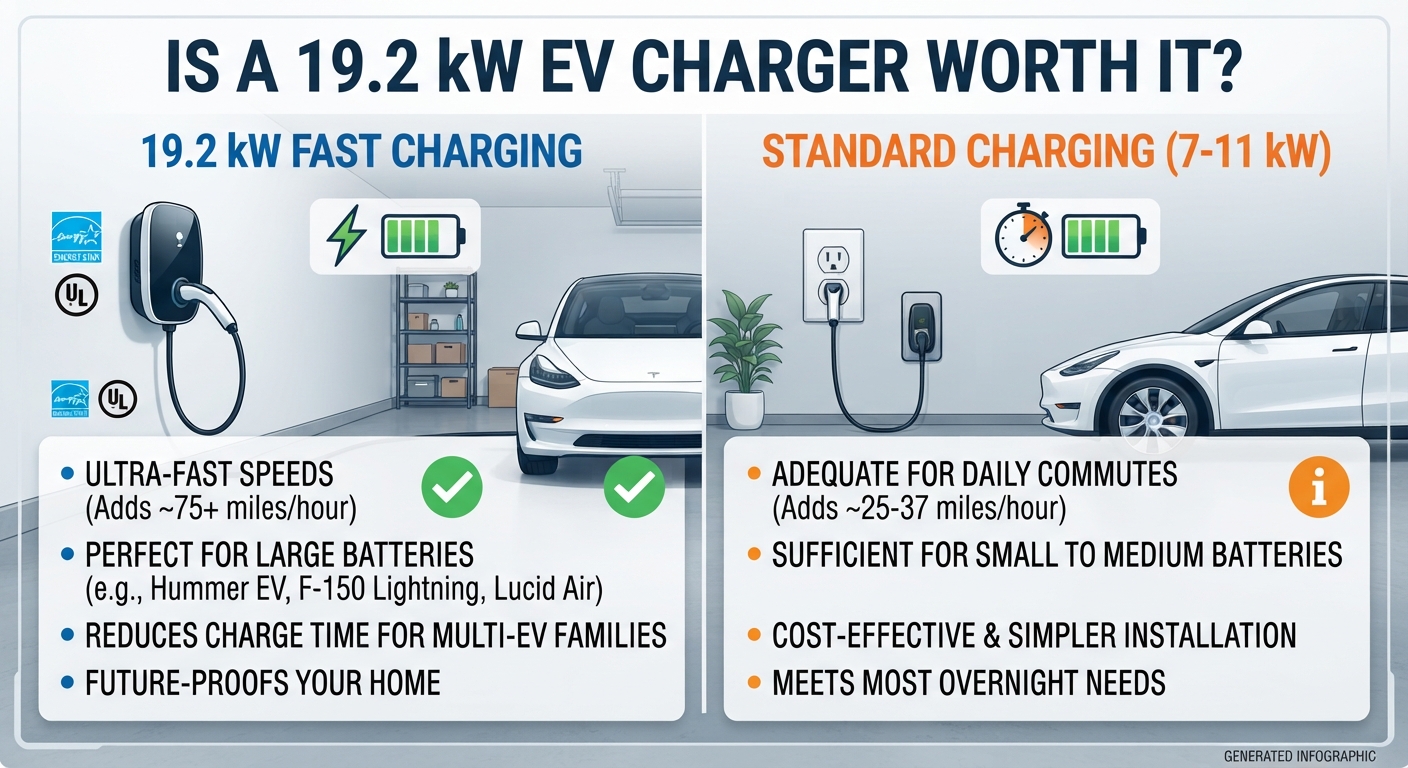
When planning a residential EV charging setup, bigger numbers often look appealing on paper. Maximum power delivery promises the absolute fastest turnaround times, leading many homeowners to wonder if they should invest in top-tier equipment. To answer the core question directly: A 19.2 kW (80-amp) EV charger is rarely worth it for most everyday drivers, though it can be a practical choice if you own a large-battery electric vehicle or have a very short turnaround window between heavy commutes.
While standard residential setups typically rely on 7 kW to 11.5 kW chargers, the 19.2 kW tier sits at the absolute ceiling of AC home charging. Evaluating whether this high-output infrastructure matches your actual daily driving needs requires looking closely at installation costs, vehicle compatibility, and home electrical limits.
Understanding the 19.2 kW Specification
A 19.2 kW charging station operates on a heavy-duty 240-volt circuit running at 80 amps. To put that into perspective:
-
Charging Speed: It pumps roughly 60 miles of driving range into your vehicle per hour.
-
Overnight Turnaround: It can completely replenish a massive depleted battery pack from 0% to 100% in just 4 to 5 hours.
-
The Infrastructure Requirement: Because it demands an 80-amp continuous load, it requires a 100-amp dedicated breaker and extremely thick copper wiring, usually hardwired directly into your main electrical panel.
To explore how these heavy-duty systems compare with standard residential equipment, review our detailed guide on various charging types.
Why a 19.2 kW Charger Is Overkill for Most Drivers
For roughly 90% to 95% of electric vehicle owners, an 80-amp charger represents unnecessary financial and technical overhead:
-
The Overnight Window is Already Generous: Most standard EV owners plug their vehicles in for 8 to 12 hours overnight. A standard 32-amp or 48-amp charger easily fills a normal battery during these off-peak hours, making 19.2 kW speed redundant while you sleep.
-
Vehicle Onboard Charger (OBC) Limits: Your car can only accept as much power as its internal AC charger allows. The vast majority of electric vehicles on the market max out at 11.5 kW (48 amps) or lower. If you plug an EV with an 11.5 kW onboard limit into a 19.2 kW charger, your car will simply ignore the extra power, charging at its normal maximum rate anyway.
-
Exclusively Niche Vehicle Support: Only a select few heavy-duty or luxury vehicles—such as the Ford F-150 Lightning (with the extended-range battery), Lucid Air, or GMC Hummer EV—feature internal electronics capable of accepting a full 19.2 kW AC charge.
The Hidden Costs and Infrastructure Hurdles
Installing an 80-amp circuit involves far more than just purchasing an expensive wall unit:
-
Electrical Panel Upgrades: Most modern homes feature 200-amp main service panels. Pulling a continuous 80 amps just for an EV charger can overload a standard panel, requiring an expensive upgrade to 400-amp service or the installation of complex smart load-management systems.
-
Material and Labor Expenses: Thick commercial-grade copper wiring, heavy conduits, and specialized labor drive the installation price well past traditional setups, often costing thousands of dollars out of pocket.
For insights on how to balance intelligent power distribution and home safety, explore our resources on smart home EV solutions.
When Is a 19.2 kW Charger Actually Worth It?
Despite the steep requirements, there are specific scenarios where an 80-amp system makes practical sense:
-
Multi-Vehicle High-Mileage Households: If your household runs multiple pure EVs that commute massive distances daily and must turn around rapidly between day and night shifts, maximum speed ensures zero downtime.
-
Future-Proofing for Monster Batteries: If you drive a heavy electric truck or utility vehicle with a 130+ kWh battery pack and plan to keep it for years, a high-speed home station cuts down lengthy recovery times.
To evaluate your home’s layout, budget constraints, and long-term utility savings, check out our core recommendations at EV Charger Advisor.
Summary: Should You Buy One?
-
Skip the 19.2 kW charger if you drive a standard sedan or SUV, have a typical 40-mile daily commute, or want to keep installation expenses minimal.
-
Invest in a 19.2 kW charger only if your specific vehicle explicitly supports 80-amp AC input and your home’s electrical service can support the heavy load without a costly overhaul.

















Leave a Reply