
When transitioning to electric vehicle (EV) ownership, one of the most critical infrastructure decisions you will make centers around home charging equipment. A common question among buyers is whether it makes more sense to rely on the standard equipment that comes with the car or invest in an upgraded home hardware setup.
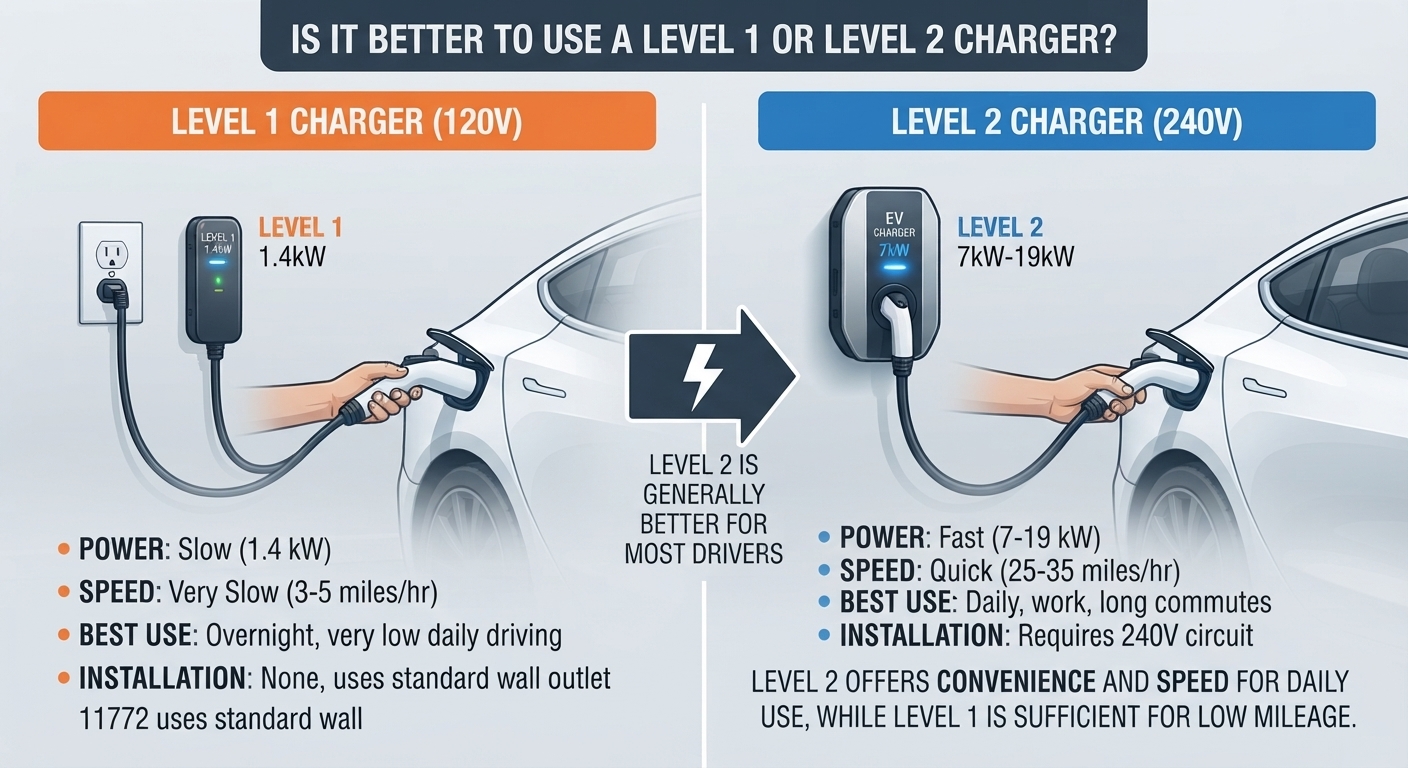
To give you a clear and direct answer: A Level 2 charger is generally better and more practical for everyday electric vehicle (EV) ownership, though a Level 1 charger works well for very low-mileage drivers or plug-in hybrids.
While both methods utilize electricity billed at the exact same utility rate per kilowatt-hour (kWh), they differ vastly in charging speed, electrical requirements, daily convenience, and long-term efficiency. Here is an in-depth guide to help you decide which charging solution best matches your lifestyle, driving habits, and home infrastructure.
Understanding the Basics: Level 1 vs. Level 2
Before diving into a cost-benefit analysis, it helps to understand what these two charging tiers actually mean:
-
Level 1 Charging: This relies on a standard household 120-volt alternating current (AC) plug. It uses the cord set that typically ships directly with your electric vehicle, plugging straight into any standard wall outlet with zero installation required.
-
Level 2 Charging: This operates on a 240-volt AC power source—the exact same voltage used by heavy household appliances like electric dryers or ovens. It requires a dedicated circuit and a hardwired or plug-in wall unit.
To get a deeper look at the mechanical differences and how power is delivered to your vehicle, read more about various charging types.
1. Charging Speed and Daily Practicality
The most glaring difference between the two options is how quickly they pump energy back into your vehicle’s battery pack:
-
The Level 1 Limitation: Level 1 equipment adds a meager 2 to 5 miles of driving range for every hour it is plugged in. If your battery is nearly depleted, it can take anywhere from 40 to over 60 hours to achieve a full charge from a standard household plug. For a typical daily commuter driving 40 miles a day, Level 1 simply cannot keep up with overnight recovery windows.
-
The Level 2 Advantage: Level 2 hardware delivers a powerful punch, adding roughly 20 to 30 miles of range per hour. It can comfortably take a large EV battery from 0% to 100% in just 6 to 8 hours. This means you can plug your car in before going to sleep and wake up to a completely full battery every single morning, regardless of how much you drove the day before.
2. Upfront Costs vs. Long-Term Value
Financial investment is usually the main hurdle when homeowners debate upgrading their garage setup:
-
Level 1 (Zero Upfront Investment): Because the cord comes with your vehicle and plugs into pre-existing wall sockets, your initial equipment and installation cost is strictly $0. For budget-conscious buyers or apartment dwellers with accessible garage plugs, this initial savings is attractive.
-
Level 2 (The Upfront Investment): Installing a Level 2 unit requires purchasing external hardware (typically ranging from $400 to $1,200) plus hiring a licensed electrician to run a dedicated 240V line, install a heavy-duty breaker, and sometimes upgrade your main electrical panel. Total installation costs often land between $500 and $2,000+.
However, Level 2 hardware pays dividends over time through improved energy efficiency (minimizing heat conversion losses over long charging cycles) and unmatched lifestyle convenience.
3. Utility Rates and Smart Energy Management
One of the hidden benefits of upgrading your home setup involves how you interact with your electric utility company:
-
Time-of-Use (TOU) Optimization: Most energy providers offer drastically cheaper electricity rates during late-night off-peak hours (e.g., midnight to 6 AM). Because Level 1 takes days to recharge a car, you are forced to draw expensive peak-rate electricity during the daytime. Level 2 finishes its work entirely within the cheap overnight window.
-
Advanced Automation: Many modern home setups feature intelligent software controls. Utilizing advanced systems—such as those explored in our guide on smart home EV solutions—allows you to schedule charging sessions remotely, monitor real-time energy usage, and automate utility cost savings.
If you want to evaluate your household energy budget and determine which setup makes sense for your long-term ownership goals, check out our core recommendations at EV Charger Advisor.
Summary: Which One Should You Choose?
-
Choose Level 1 if: You drive less than 30-40 miles a day, primarily own a Plug-in Hybrid Electric Vehicle (PHEV) with a small battery pack, or want a temporary zero-cost solution while renting.
-
Choose Level 2 if: You drive a full battery-electric vehicle (BEV), commute long distances daily, live in a multi-driver household sharing an EV, or want to take full advantage of cheap overnight utility rates.

















Leave a Reply