
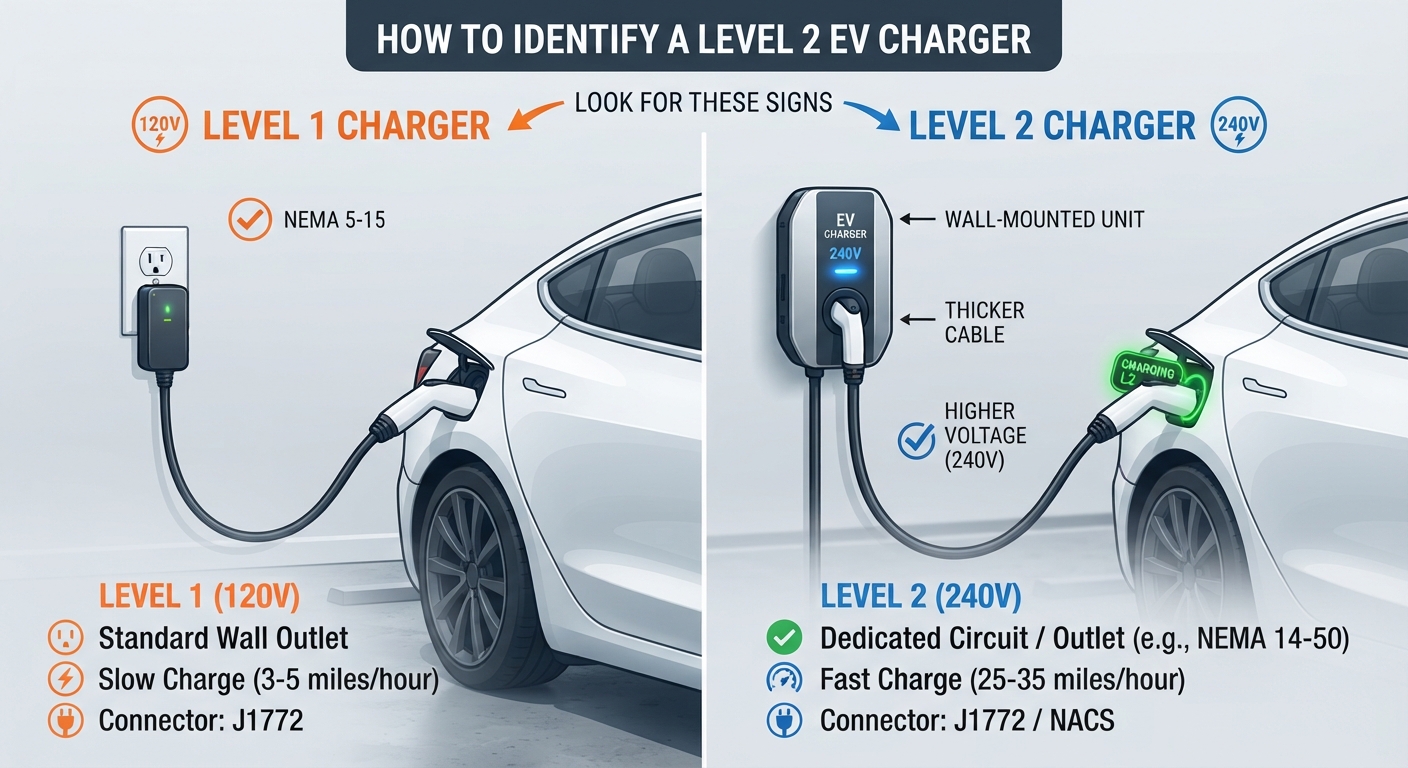
Transitioning to electric vehicle ownership brings a host of new terminology, equipment types, and charging speeds. One of the most frequent questions electric vehicle owners ask is: How do I know if my EV charger is Level 2?
To give you an immediate and direct answer: You can identify a Level 2 electric vehicle charger by checking if it uses a 240-volt circuit, adds 25 to 40 miles of range per hour, and plugs into a large outlet or hardwired wall unit rather than a standard wall socket.
While identifying the equipment may seem straightforward at first glance, understanding the physical differences, electrical requirements, and technical specifications can ensure your home setup operates safely and efficiently. Whether you recently bought a home with a pre-installed unit or are trying to evaluate your current setup, this comprehensive guide will walk you through every step to definitively identify your EV charging hardware.
1. Check the Plug and Outlet Type (Voltage Differences)
The most visible and immediate indicator of a Level 2 charger is the electrical plug and the wall receptacle it connects to. Electrical systems in residential homes operate under distinct voltage tiers, which dictate charging speeds and hardware configurations.
-
Standard Level 1 Outlets (120V): If your charging cord plugs into a standard household wall socket (known as a NEMA 5-15 receptacle), it is a Level 1 charger. This is the exact same two-prong or three-prong outlet you use to plug in a lamp, phone charger, or laptop. It draws power from a standard 120-volt household circuit.
-
Level 2 Outlets (240V): A Level 2 home charger requires a much larger, heavy-duty outlet—typically a NEMA 14-50 or NEMA 6-50 receptacle. These look similar to the heavy-duty outlets used for electric kitchen stoves or large clothes dryers. They feature three or four large prongs and are designed to handle 240 volts of electricity.
If your charger is plugged into one of these large, industrial-looking 240V outlets, you are definitely utilizing a Level 2 setup.
2. Inspect for Hardwired Wall Units
Many modern residential Level 2 setups do not use a plug at all. Instead, they are permanently wired directly into your home’s electrical service panel.
-
Permanent Wall Units: If your charging unit is mounted securely to your garage wall with a thick, heavy-duty cable running straight into a metal conduit behind the wall or into the ceiling, it is a hardwired Level 2 charger.
-
No Standard Plug: Because these units draw substantial electrical current continuously, hardwiring is often recommended by electricians to prevent plug wear and reduce overheating risks. If there is no standard plug involved and the unit is permanently affixed, it operates on a dedicated 240V circuit, classifying it firmly as Level 2 equipment.
To explore how different physical hardware designs and configurations affect overall performance, read more about various charging types.
3. Evaluate Charging Speeds and Range Added per Hour
Another foolproof method to identify your charging level is to monitor how quickly your electric vehicle replenishes its battery pack while plugged in.
-
Level 1 Performance: Standard 120V charging is notoriously slow. It typically adds only 2 to 5 miles of range per hour of charge. Recharging an empty EV battery from 0% to 100% using Level 1 can take anywhere from 40 to 50 hours.
-
Level 2 Performance: True Level 2 equipment is significantly faster. It delivers between 20 to 40 miles of range per hour (depending on your vehicle’s onboard charger capacity and the amperage of the unit). A typical Level 2 setup can completely recharge a fully depleted battery pack overnight in roughly 6 to 8 hours.
If your vehicle gains substantial range in just a couple of hours of plugging in, your equipment is operating at Level 2 speeds.
4. Check the Circuit Breaker Panel
If you are still uncertain about your charger’s classification, take a look at your home’s main electrical service panel (breaker box).
-
Dedicated Breakers: Level 2 chargers require a double-pole circuit breaker—meaning it is a wide switch that spans two slots in your breaker box and is typically labeled for 40, 50, or 60 amps at 240 volts.
-
Level 1 Requirements: Level 1 charging simply utilizes a standard single-pole 15-amp or 20-amp household breaker shared with regular room outlets.
Checking the breaker label or consulting an electrician to trace the dedicated line will instantly confirm whether your hardware is supporting high-voltage Level 2 power delivery.
5. Smart Features and Software Integration
Many contemporary residential Level 2 units come equipped with advanced digital capabilities that distinguish them from basic portable Level 1 cords:
-
Wi-Fi and App Connectivity: Most modern Level 2 chargers feature companion smartphone apps, allowing you to track energy consumption, lock the charger remotely, and set automated schedules.
-
Time-of-Use (TOU) Optimization: Because Level 2 systems handle heavy electrical loads, they often integrate with smart home grids to pull electricity exclusively during cheap overnight off-peak hours.
To learn more about optimizing your electrical infrastructure with connected software, check out our guide on smart home EV solutions.
Summary: Key Takeaways to Identify Level 2 Equipment
-
Voltage: Operates on 240V power (using a NEMA 14-50/6-50 outlet or hardwired connection).
-
Speed: Adds 20 to 40 miles of range per hour.
-
Duration: Fully recharges an EV overnight (6–8 hours).
-
Electrical Load: Backed by a dedicated double-pole breaker in your home panel.
For ongoing guidance, professional tips, and comprehensive evaluations of home electrical requirements, visit us anytime at EV Charger Advisor.

















Leave a Reply