
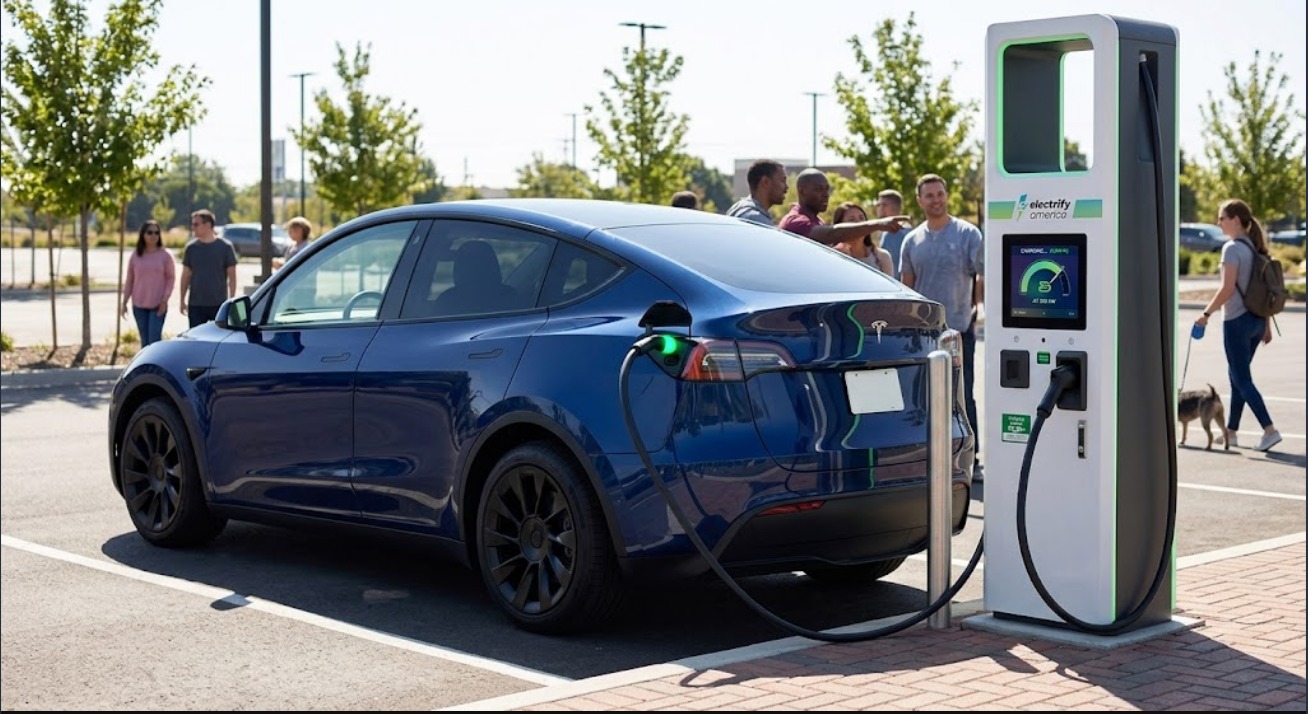
Yes, but only up to your car’s limit. A higher kW charger charges faster if your car can accept the extra power and your electrical circuit can supply it. Beyond that point, the extra kW is wasted.
The weakest-link rule
Four things decide your real charging speed, and the lowest one wins:
- Your circuit and breaker: what your home can safely supply.
- The charger’s rating: what the unit can deliver.
- Your car’s limit: its onboard charger on AC, or its acceptance rate on DC.
- Battery state and temperature: speed tapers as the battery fills.
On home AC charging, effective power is the lower of the charger’s supply and the car’s onboard charger limit. A fast charger paired with a slow car is only as fast as the car.
How to calculate charging time
A simple formula is:
Hours = energy needed (kWh) ÷ (charger power in kW × 0.9)
The 0.9 allows for roughly 10% lost to conversion and heat. For a 75 kWh EV charging from 20% to 80%, you need 45 kWh.
| Charger | Power | Time for 45 kWh |
|---|---|---|
| Level 1 | ~1.2 kW | ~42 hours |
| 32A Level 2 | 7.7 kW | ~6.5 hours |
| 40A Level 2 | 9.6 kW | ~5.2 hours |
| 48A Level 2 | 11.5 kW | ~4.3 hours |
| 19.2 kW charger, car limited to 11.5 kW | 11.5 kW | ~4.3 hours |
Times are my calculation using the 90% efficiency assumption. Real sessions vary with temperature and battery level.
The key takeaway is that moving from 7.7 kW to 11.5 kW saves roughly 2 hours on a big recharge. And the 19.2 kW charger adds nothing for a car that caps at 11.5 kW. A Chevrolet Bolt on a 19.2 kW unit, for example, still charges at its 11.5 kW limit.
When a higher kW charger really is faster
- Your car accepts more power than your current charger delivers, such as an 11 kW onboard charger on a 7.7 kW unit.
- Your circuit can support the upgrade.
- You regularly need large top-ups in a short window.
When it isn’t
- Your car’s limit is lower: if it tops out at 7.7 kW, a 48-amp charger won’t change anything.
- The gain is small: a 48-amp charger is only about 15-20% faster than a 40-amp one, and it usually needs a 60-amp circuit and a hardwired installation.
- The circuit is the bottleneck: a bigger charger on an undersized circuit has to be set lower anyway.
Not sure what your home can support? Get a licensed installer quote https://evchargeradvisor.online/
What about DC fast charging?
Public DC fast chargers follow the same rule: your car’s acceptance rate caps the speed. A car that accepts 55 kW peaks at about the same rate on a 62.5, 150 or 350 kW charger.
Speed also tapers as the battery fills. Average power over a session typically runs about 50-82% of a car’s peak, and the difference between a 150 kW and a 350 kW charger can be just a few minutes.
Is the upgrade worth it?
If you park overnight for 8+ hours, a 7.7 kW charger can deliver roughly 48 kWh in 7 hours (my calculation). At 3-4 miles per kWh, that’s roughly 145-190 miles of range, far more than most daily driving needs. Extra kW mainly pays off when you need big top-ups quickly, drive very high mileage, or own a large-battery vehicle.
Quick checklist
- Find your car’s maximum AC charging rate.
- Ask a licensed electrician what your circuit can support.
- Use the formula to calculate the time each option saves.
- Compare the hours saved against the installation cost.
- Choose the lower of your car’s limit and your circuit’s capacity.
Ready to compare? Compare Level 2 home chargers https://evchargeradvisor.online/
FAQs
Does a higher kW charger charge an EV faster?
Only if your car can accept the extra power and your circuit can supply it.
Will a 19.2 kW charger charge my car faster than an 11.5 kW one?
Not if your car’s onboard charger caps at 11.5 kW. It will charge at its own limit.
Is a 48-amp charger much faster than a 40-amp one?
Only about 15-20% faster, and it needs a larger circuit.
How do I calculate EV charging time?
Divide the energy you need (kWh) by the charger power (kW), then allow about 10% extra for losses.
Why does my EV charge slower than the charger’s rating?
Your car’s acceptance rate, the battery’s state of charge and the temperature all limit speed, and power tapers as the battery fills.
Is 7.7 kW enough for overnight charging?
For most drivers, yes. It can add well over a typical day’s range in a few hours.
Final thoughts
A higher kW charger is only faster when your car and circuit can use it. Work out your numbers first, and you’ll avoid paying for speed you’ll never see.
See our top EV chargers https://evchargeradvisor.online/
General information only. Have a licensed electrician assess your home before installing a charger.

















Leave a Reply