
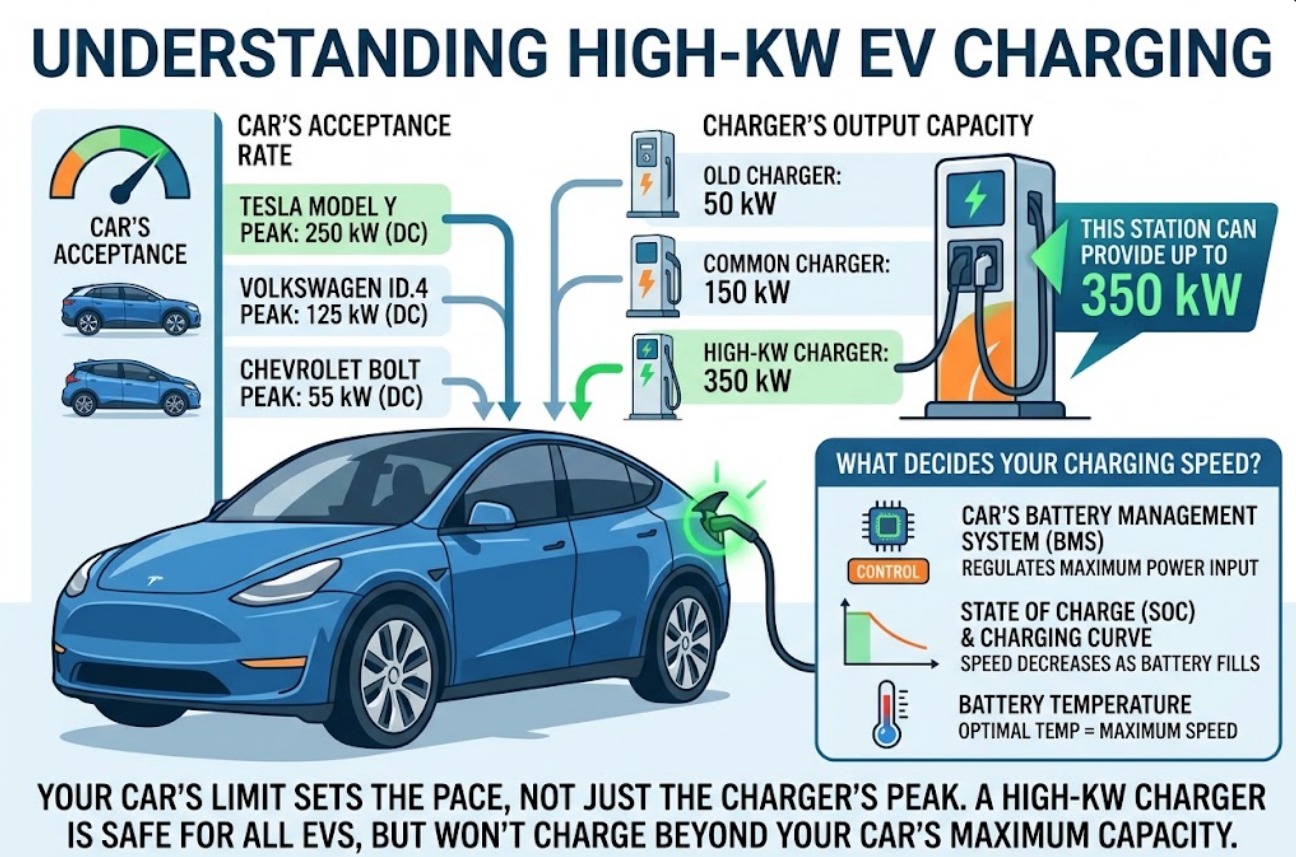
Usually nothing bad, and often nothing faster. Your car charges at the lower of two numbers: what the charger can supply and what the car can accept. A higher kW charger won’t harm your car, but it won’t speed up charging beyond your car’s limit either.
The rule: your car sets the speed
| Situation | What happens | Example |
|---|---|---|
| Charger kW higher than your car’s limit | The car draws only what it accepts. No extra speed. | A Chevrolet Bolt (55 kW) peaks at about the same rate on 62.5, 150 or 350 kW chargers |
| Charger kW lower than your car’s limit | The charger is the bottleneck. | A fast car on an old 50 kW stall charges at about 50 kW |
| Charger and car limits match | You get full speed. | A 7.7 kW car on a 7.7 kW home charger |
Even a Porsche Taycan, which can accept up to 270 kW, is held to 150 kW at a 150 kW station.
At home: a higher kW Level 2 charger
At home, your car’s onboard charger sets the AC limit. If it tops out at 7.7 kW (32 amps), installing an 11.5 kW (48-amp) charger won’t charge it any faster. The same applies to bigger units: a Bolt with an 11.5 kW onboard charger plugged into a 19.2 kW Level 2 unit still charges at 11.5 kW.
A higher-kW home charger also has a cost on the electrical side. A 48-amp charger is only about 15-20% faster than a 40-amp one, but it usually needs a 60-amp circuit and a hardwired installation. A high-amp charger can also overload a panel that isn’t designed for the extra load, so have an electrician assess it first.
Not sure what your home can support? Get a licensed installer quote https://evchargeradvisor.online/
At public DC fast chargers
DC fast chargers range from about 50 kW to 350 kW, and they bypass your car’s onboard charger entirely. The same rule still applies: your car’s maximum DC acceptance rate caps the speed.
Charging also doesn’t hold its peak. Take a Volkswagen ID.4: it reaches 125 kW almost immediately and holds it until about 30% charge. It then eases to about 100 kW at 45%, and 80 kW at 60%, with a steeper drop around 80%.
For this reason, a 10-80% charge typically takes 18-24 minutes on an 800-volt EV and 25-44 minutes on a 400-volt one. In practice the difference between a 150 kW and a 350 kW charger can be only a few minutes.
Etiquette note: If your car accepts a low rate, avoid occupying a high-power charger you can’t fully use. Someone else may be able to.
Does a higher kW charger affect battery health?
The charger’s kW rating isn’t the cause, because your car limits what it draws. What matters more is how often you use DC fast charging. It puts more strain on batteries through heat and higher current, although the effect is modest and the long-term impact of repeated fast charging is still being studied. AC charging, at around 7-22 kW, is gentler and steadier.
When a higher kW charger is worth it
- Your car accepts more than your current charger supplies, such as an 11 kW onboard charger on a 7.7 kW unit.
- You plan to buy a faster EV soon.
- Your home’s electrical service can support the bigger circuit.
- You regularly road-trip and can match a station to your car’s real peak.
When it isn’t
- Your car’s limit is already at or below your charger’s output.
- The circuit upgrade would cost more than the time it saves.
- You only use public fast chargers occasionally.
Know your numbers
Check your car’s spec sheet for the maximum AC rate (home and Level 2) and the peak DC rate (fast charging). Your real speed is the lower of what the car accepts and what the charger supplies, and the peak is only a brief high, not a cruising speed.
Ready to compare chargers? Compare Level 2 home chargers https://evchargeradvisor.online/
Is it bad to use a higher kW charger?
No. Your car draws only the power it can accept, so a higher kW charger won’t harm it.
Will a higher kW charger charge my EV faster?
Only if your car can accept more power. Otherwise, speed stays the same.
Can I use a 350 kW charger if my car accepts only 50 kW?
Yes. It will charge at roughly 50 kW.
Why is my car charging slower than the charger’s rating?
Your car’s acceptance rate, the battery’s state of charge and the temperature all affect speed. Power also tapers as the battery fills.
Does fast charging damage the battery?
Frequent DC fast charging adds some heat strain, but the effect is modest.
What kW home charger do I need?
Match it to your car’s onboard charger (commonly 7.7, 9.6 or 11.5 kW) and to what your electrical circuit can safely support.
Final thoughts
A higher kW charger won’t hurt your car. It just won’t help unless your car and your circuit can use the extra power. Check your car’s limit first, then buy only the kW you can use.
See our top EV chargers https://evchargeradvisor.online/
General information only. Have a licensed electrician assess your home before installing a charger.

















Leave a Reply